
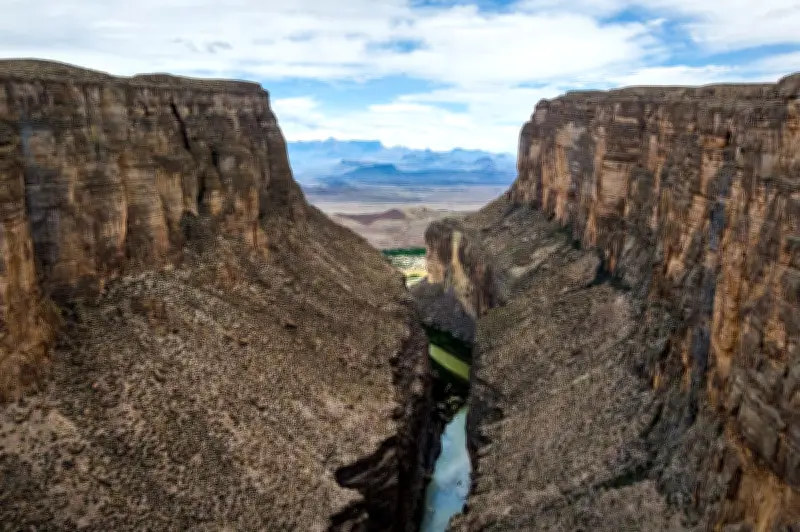
The Trump administration has waived a slew of environmental and historical preservation laws to build a towering border wall through Big Bend National Park, a vast protected wilderness in south Texas. Despite plunging unauthorized immigrant crossings, the Department of Homeland Security (DHS) issued a waiver on Tuesday, empowering Customs and Border Protection (CBP) to construct security infrastructure in the park.
Massive Destruction Feared
Congress allocated $46.5 billion for border wall construction in the “Big, Beautiful” bill last year, fueling Donald Trump’s ambition to seal the southern border. The longest unwalled stretches lie along a roughly 500-mile section of west Texas, known as the Big Bend sector, which includes Big Bend National Park, Big Bend Ranch State Park, and Black Gap Wildlife Management Area.
The prospect of marring these landscapes has drawn fierce backlash from a bipartisan group of local leaders and public land users. Bob Krumenaker, former Big Bend National Park superintendent, called it “massive destruction.” The 800,000-acre expanse of Chihuahuan desert, punctuated by the Chisos Mountains, draws half a million visitors annually.
CBP’s Mixed Signals
For months, CBP sent mixed signals about its intentions. In February, an interactive map showed plans for a steel bollard wall along the park’s river frontage, sparking outcry. Later, the map changed to indicate only detection technology. The current version shows new roads and four 4-6ft-tall vehicle barriers. Advocates worry that an opaque agency with a massive war chest could still wreak severe damage.
The waiver casts aside protections under the National Environmental Policy Act, the Endangered Species Act, the Clean Water Act, and the Native American Graves Protection and Repatriation Act. The Big Bend area hosts endangered species, a struggling bighorn sheep population, and Native rock art.
Legal and Political Challenges
U.S. Representative Lloyd Doggett, a Texas Democrat, criticized the move as “ludicrous” given that illegal crossings in the area account for under 0.5% of all border crossings nationwide. DHS justified the waiver as an emergency measure, but crossings have plummeted since Trump took office in 2025. Within the park, border patrol made only 100 arrests in 2023 and 125 in 2024.
Democrats in Congress attempted to block DHS from using funds for barriers in the park, but the measure failed in an appropriations committee vote on Tuesday. A legal challenge has been filed by Friends of the Ruidosa Church, river guide Billy Miller, and the Center for Biological Diversity, arguing the waivers violate due process and constitutional rights.
Broader Implications
DHS has used border wall-related waivers for other protected lands in Arizona, but this marks the first time in a national park. Krumenaker warned that the broad authority makes CBP unaccountable. “Waiving the law undermines all credibility,” he said. CBP stated that plans are still in the planning stages, with coordination with the National Park Service and other agencies.
“If they’re willing to do this in a national park, where virtually no one is crossing the border, where won’t they?” asked Laiken Jordahl of the Center for Biological Diversity. The story is co-published with Public Domain.




