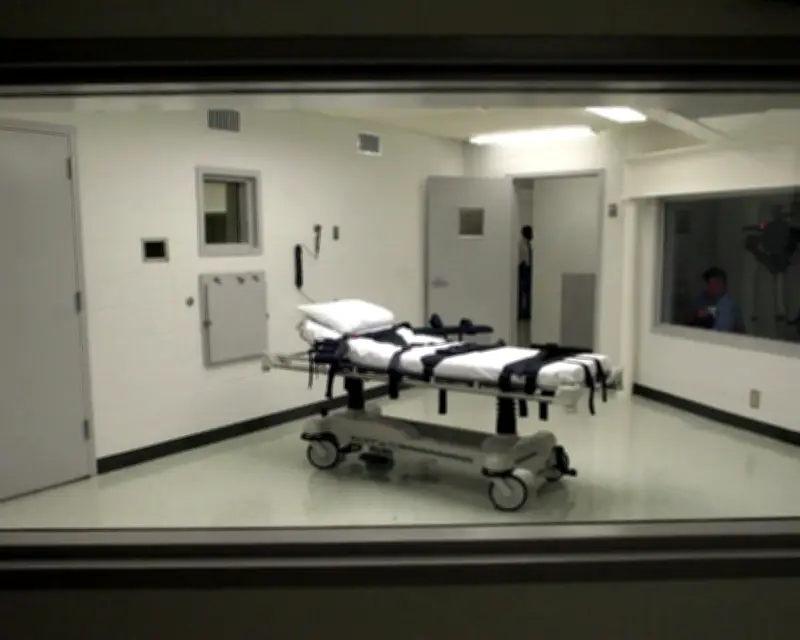
The United States' newest execution method, nitrogen gas, appears headed toward a legal showdown amid a widening controversy over whether it constitutes cruel and unusual punishment.
The US Supreme Court late on Thursday rejected the state of Alabama's request to execute prisoner Jeffery Lee with nitrogen gas, a method where a respirator is strapped to an inmate's face and they breathe pure nitrogen until dying of oxygen deprivation.
The rebuke culminates a week of setbacks for Alabama, after a federal appeals court and a lower court judge barred the state's nitrogen gas protocol as unconstitutional.

On Thursday, the Supreme Court refused to remove the bar imposed by the lower courts. Though Lee will not imminently face execution, Alabama officials have signaled they will push to keep nitrogen execution legal, a move that could force a Supreme Court battle to determine the legality of nitrogen gas executions nationwide.
Background of the Case
At the center of Alabama's fight is the case of Lee, a 49-year-old death row prisoner convicted of killing two people during a 1998 robbery. Lee's case was already mired in controversy after the jury's vote to sentence him to life without parole was overridden by a judge, who sentenced him to death in 2000. Alabama in 2017 became the last state to abolish judicial override and did not make the new law retroactive.
Lee's legal team praised the Supreme Court's decision on Thursday night. "His jury voted for life. Two courts ruled the method unconstitutional. Today, the constitution prevailed," a statement said.
Alabama's Republican attorney general, Steve Marshall, in a statement blasted the high court's ruling as a "miscarriage of justice" and said the state is "prepared to do whatever is necessary to see Mr Lee's lawful sentence carried out."
Rise of Nitrogen Executions
The escalating legal fight comes more than two years after Alabama carried out the world's first known nitrogen hypoxia execution, a then-untested method. Nitrogen executions have emerged as death-penalty states have struggled for alternatives to the troubled lethal injection method, which has faced its own criticism after a string of botched executions in multiple states.
With eight nitrogen executions in the US – seven in Alabama and one in Louisiana – critics of the practice argue that state secrecy laws have shielded a fully transparent look at a process that they say was doomed from the start.
From the outset, the method raised concerns for its apparent brutality and drew comparisons to human experimentation. Eugene Smith, the first person to die by nitrogen hypoxia, thrashed and writhed on the gurney, according to media and other witnesses. The last nitrogen execution, of Anthony Boyd, appeared to take more than 30 minutes as Boyd shuddered and gasped. Alabama's Republican attorney general Steve Marshall called Smith's execution "textbook" and has dismissed criticism as sensational and agenda-driven.
Witness Accounts and Legal Rulings
Rev Jeff Hood, Smith's spiritual adviser who was in the death chamber for both Smith's and Boyd's executions, said this week's judicial rulings "vindicates" the reporters and other witnesses who have seen and spoken out about what he described as torturous death.
"The body doesn't lie," Hood said. "On two different occasions, I've seen [prisoners] heave back and forth, their entire body tense up, their entire body shaking. And now we know the court believes the testimony of these bodies as well."
The nine-member Supreme Court bench on Thursday voted 6-3 and did not explain its reasoning. Three of the most conservative-leaning justices, Clarence Thomas, Samuel Alito and Neil Gorsuch, said they would grant Alabama's request to lift the injunction and let the execution go forward, but were voted down by the majority.
In a statement the legal team for Lee hailed the decision and noted that his jury at trial had voted for a sentence of life in prison, which a judge overruled.
"His jury voted for life. Two courts ruled the method unconstitutional. Today, the constitution prevailed. Now Governor Ivey can finish what the jury started: restore the jury's verdict of life without parole," the statement said, referring to Kay Ivey, Alabama's Republican governor.

What's Next?
Lee was scheduled to be executed on 11 June, and sought to avoid becoming the ninth person to die by nitrogen execution. On Tuesday, the US district judge Emily Marks ruled that he had shown by a "preponderance of the evidence" that "the protocol constitutes cruel and unusual punishment in violation of the eighth amendment."
For now, Lee's execution by nitrogen is on pause while the case moves through the courts. Lee had previously selected firing squad as a backup execution method, though the state is not currently set up for that protocol. The Supreme Court has not yet indicated whether it will take up the Alabama case in its next term.
"If it goes up to the Supreme Court and they find [nitrogen hypoxia] unconstitutional, it would be the first method the court has ever found unconstitutional – and that would be groundbreaking," said Deborah Denno, a Fordham University law professor and death penalty expert.
Unlike the legal arguments against the nitrogen hypoxia method in the lead-up to Smith's execution, evidence of how a nitrogen gas death works – or doesn't – is no longer speculative, according to Robert Dunham, director of the Death Penalty Policy Project, which publishes nonpartisan analysis of the capital punishment system.
Despite this week's legal setbacks, a spokesperson Ivey said Thursday the state "continues to defend its execution protocol in the courts."
Hood, the pastor, keeps a replica of the respirator used to execute Smith as a visual aid for protests and interviews. On Thursday, he held it and said: "There's going to come a time when people will look at this mask and think: 'I can't believe we were that heinous.'"
The Associated Press contributed reporting.