Construction Begins at Sacred Site
On the morning of 16 February, dozens of police officers arrived at San Francisco Ángulo, a small rural community an hour south of El Salvador’s capital. They had come, residents were told, to escort heavy machinery belonging to Cyeemsal, a Mexican-owned company hired to begin construction of a landfill on a site the community considers sacred.
Félix Laínez, 58, president of the San Francisco Ángulo community association, had been warned that this would happen. The community has lost a series of legal appeals against court rulings authorizing the work, and construction is continuing. “It is clear that we will find no support in any state institution,” says Laínez, who has little hope of success in their final constitutional appeal before the supreme court.
Mass Graves Beneath the Surface
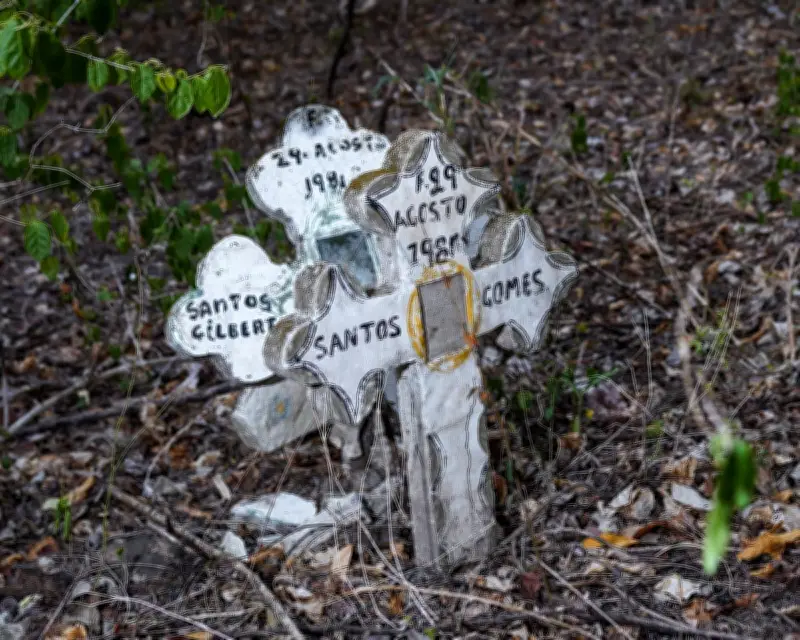
What makes this more than a land dispute is what lies beneath the ground where the machines are digging. A 2018 ruling by El Salvador’s human rights ombudsman documented two military operations carried out at the site 45 years ago. In the first, on 19 June 1981, a group of women were interrogated, raped, and murdered by soldiers. In the second, on 25 July, about 25 armed men entered homes and opened fire, killing about 45 civilians. Their remains are still being exhumed, but most of the victims were women and children.

Rafael Paz Narváez, a sociology professor at the University of El Salvador, says the place was used throughout the war as an execution site. “The army, the guard, the police, and the death squads made Lomas de Ángulo a place of execution of prisoners. The number of remains is very difficult to determine precisely, but it is large. There are remains in many places.”
Disturbed Remains and Threats
According to one excavator operator who asked not to be identified, the construction work has already disturbed some of those remains. He says he found six grave sites when work began. In the first, he found at least three bodies. “The smell was like a cemetery,” he says. He initially worked around the graves but was ordered to remove and rebury the remains. When ordered to move them a second time, he refused, left the site, and says he was threatened with a theft accusation. He says the project’s representatives later offered him money and a job on condition that he declare to the attorney general’s office that he had never seen any bodies. He refused.
Laínez brought the allegation before a hearing in Guatemala of the Inter-American Commission on Human Rights in 2018, stating his concern about the removal of remains from the civil war era in the area where the landfill is to be located.
Environmental and Health Risks
The landfill, promoted by Los Nonualcos, an association of 18 municipalities in La Paz and San Vicente, will receive more than 265 tonnes of solid waste a day, according to documents submitted by the community to the ombudsman’s office this year. A technical assessment found the site lies above a critical water-catchment area with highly permeable volcanic soils, which experts say would accelerate pollution leaching underground and contaminating water sources serving about 1,750 families across 24 communities. A previous landfill nearby is already leaching contaminants into the Salamar River, which communities downstream depend on for drinking, bathing, and irrigation.
Legal and Political Context
For Prof Paz Narváez, the landfill is not an isolated decision but part of a pattern in a country where President Nayib Bukele promotes an authoritarian agenda. The San Vicente region, he says, is becoming what campaigners call “a sacrifice zone” – a place designated for environmental exploitation. “Human life, biodiversity, and the environment will be sacrificed here,” says Paz Narváez.
The community of San Francisco Ángulo was never formally consulted, in violation of the country’s environmental law. Laínez says municipal authorities have produced documents claiming community agreement, but adds: “Here, no one has signed anything, no one has agreed. How can we be in agreement when we are fighting?”

Ongoing Struggles
Cyeemsal says it does not consider itself the executive body directly responsible for the project. A former machine operator identified only as Caín says he was contracted by El Salvador’s national solid waste authority (Andres) to carry out earthworks. Local residents are already being charged through their utility bills for waste collection by Andres, even though they never agreed to the project. Javier Núñez, a spokesperson for the project, did not respond to detailed questions. Los Nonualcos and Andres did not respond to requests for comment.
In March, Laínez presented the community’s case before the Inter-American Commission on Human Rights, where the World Organisation Against Torture called on the commission to urge El Salvador to refrain from reprisals against participants. On 18 May, after a request from the attorney general’s office, the lower court in Tecoluca dismissed the deforestation case against the company in a hearing lasting just seven minutes. Community members say they were notified of the ruling by WhatsApp. “We were not even given the opportunity to present our case,” says René Alfaro, a community member present at the hearing. “They just read the document, and it was over in minutes.”
Community Resilience
César Cañas, a leader of the Movement for the Defence of Land and Natural Resources of Tecoluca, calls the ruling a mockery and says the community will continue to use “every legal tool available” to fight for its rights. Laínez, who was outside the courthouse when the decision came through, regrets the impact the landfill is having on his community. “We were happy here. We lacked for nothing – water, firewood, fish. Today we have none of that,” he says. “I am over 50, and I have already lived. But look at the children in this community. If we do not stop this, there is nothing good waiting for them here.”