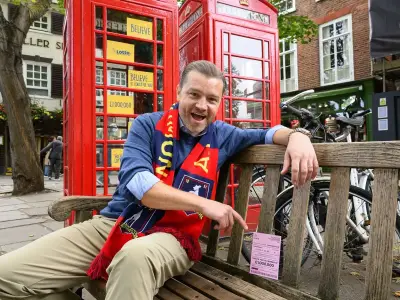
People have protested outside the British Council building in Madrid to stop the sale of the historic Palacete building. The building, located at 31 Paseo del General Martínez Campos in the upscale Chamberí district, has housed the British Council in Spain for approximately 70 years. Each year, about 5,000 students pass through its 35 classrooms to learn English, take exams, and build cultural connections with the UK. Over the decades, hundreds of thousands of Madrileños have used the center, which also serves as a hub for the expat community.
However, news of the sale has sparked protests among staff, who are concerned about job security and the lack of confirmation about where the 320 employees will be relocated. The sale of another building in Barcelona is also reportedly proposed. This is part of a broader backlash across Europe by British Council staff against radical cuts and restructuring, which senior management warns could lead to the disappearance of the world's leading soft-power agency within a decade.
This week, staff in Italy staged a national strike and protest against plans to cease English-language teaching after 80 years in the country, resulting in the loss of 108 out of 130 jobs. The drastic actions are driven by the need to repay a £197 million debt from a Covid-era Conservative government emergency loan, which must be repaid with interest by September.

Staff have expressed anger not only at the UK government's failure to protect the organization, which was founded nearly a century ago to combat fascism and communism, but also at the leadership and implementation of the measures. A letter of no confidence in the senior leadership team, signed by 298 of Spain's 560 staff, has been sent to the board of trustees in London. The letter describes the sale as reflecting a pattern of shortsighted decisions, weak leadership, and poorly communicated changes made without sufficient regard for staff or organizational stability.
It also highlights anger over the British Council's direction in recent years, including repeated restructuring, investments with little return, short-termism, lack of accountability, and centralized decision-making. Similar letters of no confidence have been sent by staff in Italy and France, with more expected to follow. Concerns also exist about the potential sale of the Paris building and the reduction of services in Latvia, Lithuania, Estonia, Croatia, and Austria.
Stuart Anderson, the Workers' Commission union representative, questioned the management strategy, citing very centralized decision-making and what he described as a colonial attitude where London knows best, with little consideration for local markets or on-the-ground expertise built up over decades. Staff are also calling on the UK government to stop the death spiral, emphasizing that a government trying to reset UK-EU relations should not damage soft-power organizations that have existed for nearly 100 years.
Anderson, who has worked for the British Council for nearly 20 years and chairs the British Council European Works Council, expressed concern that people in the UK may not understand what the organization means to millions worldwide. He compared it to the BBC World Service, noting that the British Council has a globally respected brand that is being run into the ground.
Despite the criticism, there is widespread support for the British Council from various quarters, including the arts, universities, the military, and politicians. Neil Kinnock, former Labour leader and former British Council chair, stated that the council does not want to make these cuts but is forced into them by Treasury conditions. He emphasized that the organization was set up to combat fascism and communism through understanding of Britain and its values, which it has done brilliantly for 92 years. Kinnock warned that in a world with rising far-right movements and the UK's diminished military and political power post-Brexit, the British Council's soft power is invaluable.

He sympathized with the staff and noted that the British Council has fought hard within the Foreign Office for the past few years. Kinnock urged the government to cancel or reschedule the debt, as losing the British Council would mean losing recognition, reputation, and countless contacts worldwide, including current and future decision-makers. The organization operates in over 100 countries and will continue in Spain, where it has been for 85 years. The property sale does not represent a withdrawal from Madrid or Barcelona.
A British Council spokesperson confirmed the organization's commitment to building connections, trust, and understanding between the UK and people across Europe. They acknowledged financial challenges and stated that they are taking necessary steps to cut costs and grow revenue, including the proposed sale of some buildings, to protect jobs, maintain vital work, and secure long-term future. They expressed understanding that the changes may be worrying and committed to managing the process with transparency and care.