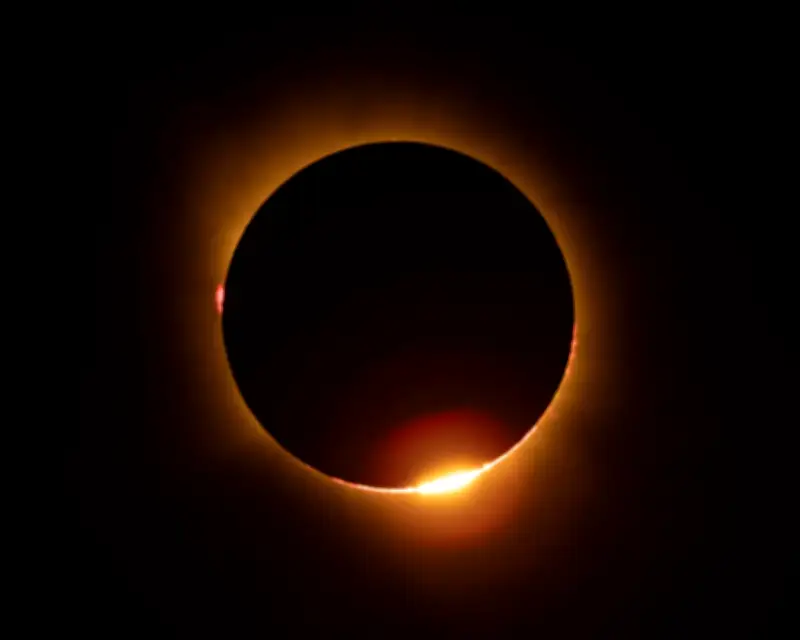
Wednesday's partial solar eclipse drew crowds across Britain, who gathered to witness the sun's power wane as twilight shifted and temperatures dropped. Lisa Redfern, speaking from Cornwall, described the experience to the Guardian as “a magical eeriness,” capturing the blend of beauty and strangeness that accompanied the event. She noted that Britons “may not see another one. We have to make the most of these moments,” as the country faces a 55-year wait for a comparably deep partial eclipse.
A Rare Celestial Alignment
The eclipse occurred as the moon passed directly between the sun and Earth, a rare three-way alignment known as a syzygy. The moon blocked the sun and cast a shadow across the planet, tracing a thin ribbon where day turned suddenly to darkness for a few extraordinary minutes. While Britain experienced a partial version, with the moon covering part of the sun and leaving only a thin yellow crescent, those in the path of totality—crossing Greenland, Iceland, and Spain—witnessed the sun completely obscured, surrounded by a fiery corona in a purplish firmament.
For ancient peoples, such events were often interpreted as cosmic threats. In China, dragons were believed to be eating the sun; in India, a demon's disembodied head was blamed. The Greek philosopher Anaxagoras arguably first proposed the correct theory of eclipses after experiencing one in 478BC. Later, astronomical knowledge became political power, as when Columbus exploited his knowledge of an approaching lunar eclipse in 1504 to frighten Jamaica's Indigenous people into providing food.
British Contributions to Eclipse Science
Britain and its empire made significant contributions to understanding the heavens, turning eclipse expeditions into laboratories for astrophysics. The 1868 solar eclipse over colonial India led to the discovery of helium by astronomers Pierre Janssen of France and Norman Lockyer of Britain. By the late 19th century, the Royal Society and the Royal Astronomical Society had established a “joint permanent eclipse committee,” with government funding and access to naval and colonial resources.
The committee organized the 1919 eclipse expeditions to Príncipe island and Brazil, which changed science forever. Their observations confirmed that the sun's gravity deflected light from distant stars, as predicted by Einstein's theory of general relativity. Though the 1919 results remain debated, the expeditions made Einstein, a German-born physicist, the most famous scientist in the world, just months after Britain and Germany had fought a catastrophic war.
A Shared Human Experience
Today, eclipses serve as a reminder that some experiences belong not to nations or individuals but to humanity as a whole. In a divided world, there is comfort in coming together in awe. The next total eclipse over Britain will not occur for 64 years, making each such event a fleeting opportunity to unite beneath the sky in shared amazement.