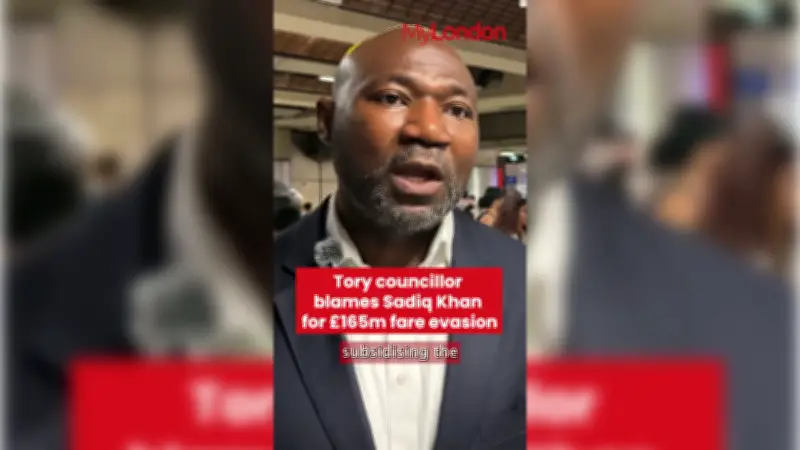
A senior Conservative campaigner has accused City Hall of rewarding Transport for London (TfL) officials who have "lost control" of fare evasion on the network, as the annual cost of unpaid fares reaches an estimated £190 million. Festus Akinbusoye, a Westminster City Councillor and former Police and Crime Commissioner, is urging Mayor Sadiq Khan to redirect funds from executive bonuses to bolster enforcement across the Tube and buses.
Fare evasion costs and executive pay under scrutiny
Fare evasion encompasses a range of behaviours, from physically forcing through Tube barriers to failing to tap in on buses or the Docklands Light Railway (DLR). According to a TfL report from July, 2,048 staff received more than £100,000 in total compensation, including bonuses and overtime, with Commissioner Andy Lord earning £635,533 in the last financial year. Akinbusoye argues that such rewards are inappropriate while evasion rates remain high.
"You have to blame the people who are in charge - it's an absolute indictment of the fact that someone has actually lost control when you consider that fares have increased by 5.5% in the last year," he said. "It makes you wonder who's actually funding the criminal decisions of those people who choose not to pay to use the trains as the rest of us have to. Someone has got to take responsibility for this."

Taxpayers subsidising criminal choices
Akinbusoye emphasised that law-abiding passengers are effectively subsidising fare evaders. "Taxpayers are subsidizing the criminal choices of those who choose not to pay, and people in City Hall are being rewarded for failure. This is wrong," he stated. He called for a fundamental change in incentives, insisting that no bonuses should be paid to TfL executives while evasion is on the rise.
"You have to incentivise best practice in City Hall. You cannot be giving a bonus to people who are failing. There is no way that the Commissioner for TfL should be getting any bonus whatsoever at all at a time where fare evasion is rising," he added.
Lost revenue could fund thousands of enforcement officers
Akinbusoye highlighted that the £165 million lost to evasion on the Tube and Elizabeth Line alone could finance a significant expansion of enforcement staff. "The £165 million that has been lost to evasion could actually recruit about 2,000 enforcement and revenue inspection officers on TfL," he said. "That is a phenomenal number of people that we can actually use to get the money back. If you're playing by the rules and you're paying, you should have the Mayor supporting you, not going against you."
Recent analysis by Conservative Assembly Member Neil Garratt revealed that successful prosecutions for unpaid fare evasion fines have plummeted from 29,113 in 2020 to just 14,406. The number of enforcement officers on the network remains around 500, the same as in 2010. Additionally, the Centre for Government Reform found that fare evasion on the Underground and Elizabeth Line nearly matches the extra revenue generated by the March fare hikes.
Enforcement halved while evasion doubled
Akinbusoye pointed to a stark imbalance: "Enforcement has halved in the last year, whereas evasion has doubled. Clearly, something is not right here when you consider the fact that about £165 million, according to some of the data we've seen recently, is what has been lost through fare evasion, and £168 million is what has been received through fare increases effectively."
Estimates indicate that 3.5 per cent of the 3.6 billion annual passenger journeys across the TfL network go unpaid, amounting to 126 million free journeys each year, or 2.4 million weekly. TfL now claims the rate has fallen to 3.3 per cent. The authority has set a long-term target to reduce system-wide fare evasion to 1.5 per cent or less by the 2030/31 financial year.

Mayor's defence and criticism
The Mayor has previously praised TfL's efforts and noted that evasion in other global cities like New York and Paris is higher. However, Akinbusoye dismissed this comparison: "How many people in London do you think care about that? Londoners are faced with a cost-of-living crisis. They've seen their fares go up. They do not care about New York. And quite frankly, I just want to make sure that here in London, the Mayor of London does not increase fares anymore until his office finds a way to reduce the level of fare evasion, because we are literally subsidising criminal activity on our network."
Proposed measures and social contract
Last year, the City Hall Conservatives unveiled a 10-point plan to tackle fare evasion, including higher barriers, AI-enabled ticket gates, and a city-wide awareness campaign. The report, authored by Tory Assembly Member Thomas Turrell, recommended installing barriers at every entrance point, with taller designs to prevent jumping, crawling under, or pushing through.
Akinbusoye argued that any delays caused by the New York-style barriers, compared to London's current "through flow" system, are "very, very worth the money we're going to save from it." He framed the issue as a broader societal breakdown: "This is about a collapse in the social contract that we have in London, where law-abiding citizens see every day people pushing through the barriers. It just tells them nobody cares about the social contract anymore, and we need to find a way to bring this back and give people confidence in our system in London."
A TfL spokesperson responded: "By focusing our enforcement teams on locations with a high prevalence of people pushing through gates and using the latest technology to target the most prolific fare evaders across the network, the pan-TfL fare evasion rate has dropped to 3.3 per cent from down from 3.9 per cent in 2022/23. This builds on the work of our team of more than 500 uniformed officers already deployed across the network to deal with fare evasion and other anti-social behaviour, keeping staff and customers safe. By increasing enforcement activity to tackle fare evasion, last financial year we issued over 69,000 penalty fares and reported over 21,000 individuals for possible prosecution. We are committed to reducing the current rate of fare evasion to 1.5 per cent by 2030/31 financial year and the strategy we now have in place will help us ensure more persistent evaders face justice."