
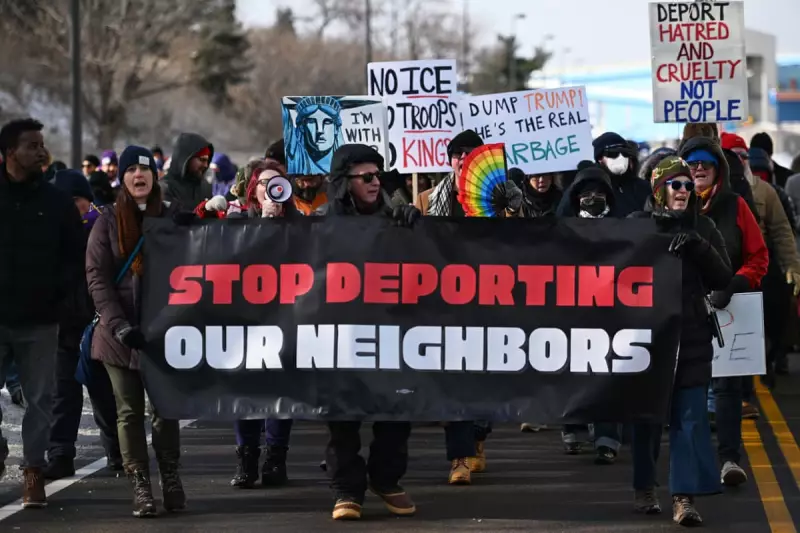
Community organisers in Minneapolis are mobilising to protect their Somali neighbours, following a series of virulent racist remarks from former President Donald Trump and amid fears of intensified immigration enforcement.
Presidential Vitriol and Local Response
On Wednesday, 3 December 2025, Trump launched into an extended tirade against Somali people from the White House. When asked about Minneapolis Mayor Jacob Frey's defence of the local Somali community, Trump responded with a barrage of insults. He disparaged Somalia as a failed nation and falsely claimed Somali residents had taken "billions and billions" of dollars from the United States.
He again targeted Congresswoman Ilhan Omar, a Somali-American US citizen, stating she should be thrown "the hell out of our country" and barred from serving in Congress. He also labelled Minnesota Governor Tim Walz as "crooked" and "incompetent." These comments followed remarks earlier in the week where he referred to Somalis as "garbage" and expressed a desire for none to be in the US.
City Leadership Takes a Stand
In direct response, Minneapolis Mayor Jacob Frey took executive action on Wednesday night. His order prohibits federal, state, and local agencies from using city-owned property—including parking lots, ramps, and garages—to stage immigration enforcement operations. This mirrors a policy recently enacted in Chicago.
Frey also directed the city to create signage for local businesses to clearly state that immigration agents are not permitted on their premises. "Minneapolis is – and will remain – a city that stands up for our residents," Frey asserted in a statement. The city reaffirmed its pride in its Somali community on social media, highlighting available free legal clinics with immigration attorneys.
Community Mobilises Against Expected ICE Surge
The Trump administration has signalled plans to send additional federal agents to Minneapolis with a mandate to target Somalis, particularly those with final deportation orders. While specifics remain unclear, the local community is not waiting.
Activists have been conducting rapid-response trainings, educating residents on their rights if confronted by Immigration and Customs Enforcement (ICE). Trainers from Chicago shared tactics for effective "ICE watch" programmes, and volunteers were organised to stand watch outside schools with large Somali student populations.
Small businesses showed solidarity, with some distributing whistles—a tactic borrowed from Chicago—to alert communities of ICE presence. Conversely, local Republican party accounts shared an "ICE tip line" number, encouraging people to "Turn them in! Send them home!"
Jennifer Stohl Powell, Executive Director of the Immigrant Law Center of Minnesota, emphasised that the majority of Somalis in the state are either US citizens or legal residents. She urged non-citizens to know their status and rights, including the right to remain silent and to refuse entry without a judicial warrant.
The local Immigrant Defense Network reported multiple accounts of "rapid ICE operations" across the city on Wednesday, with actions occurring so quickly that observers often arrived after agents had departed.
A History of Settlement and Recent Scrutiny
Minnesota is home to the largest Somali population in the United States, with approximately 84,000 people of Somali descent residing there. The community has grown over the last three decades, with most members now being US citizens or legal residents.
Right-wing media and the Trump administration have recently focused on a years-long fraud case involving dozens of Somali residents, more than 50 of whom have been convicted. The administration has previously threatened to revoke Temporary Protected Status for Somalis in Minnesota, labelling the state a hub for fraudulent activity.
The political climate has drawn stark comparisons. Minneapolis City Council member Jamal Osman, who is Somali, told CNN that Trump's attacks and the ICE activities remind him of "1930s, 1940s Germany." He expressed dismay at advising his community to carry identification at all times. The situation underscores a deep national divide on immigration and community values, with Minneapolis firmly positioning itself as a city of sanctuary and solidarity.




