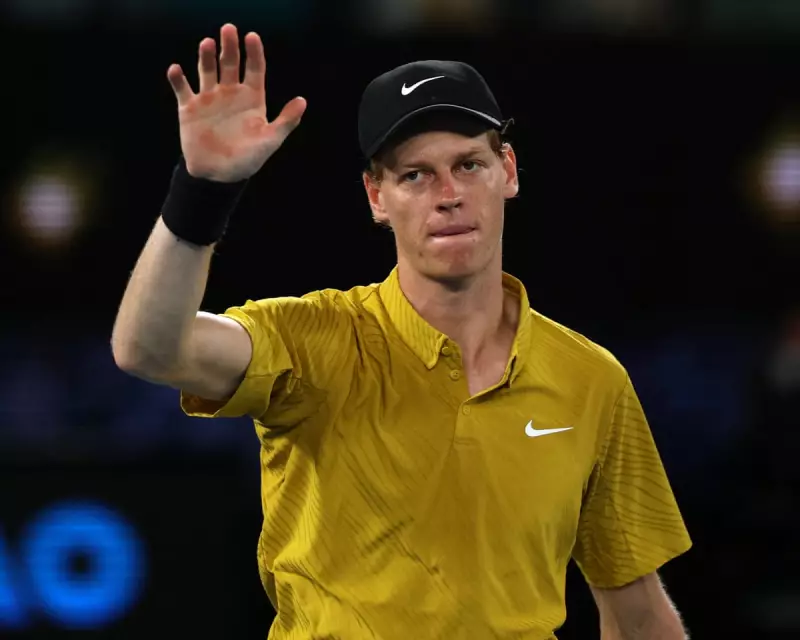
Italian Champion Battles Through Adversity in Melbourne
In a display of sheer determination and resilience, Jannik Sinner overcame significant physical challenges to secure his place in the fourth round of the 2026 Australian Open. The reigning champion faced not only a spirited opponent in American Eliot Spizzirri but also the brutal Melbourne heat, which reached a scorching 36 degrees Celsius during their encounter at Melbourne Park.
A Match Defined by Extreme Conditions
The straightforward scoreline of 4-6, 6-3, 6-4, 6-4 fails to capture the dramatic narrative that unfolded on Rod Laver Arena. Sinner, the tournament's second seed, found himself in serious trouble during the third set as full-body cramps threatened to derail his title defence. The Italian's grim expression and ginger movements told the story of an athlete pushed to his physical limits.
Spizzirri, ranked 85th in the world and competing in just his third grand slam main draw, capitalised on the challenging conditions. The American looked surprisingly comfortable in the oppressive heat, taking the first set with composed, consistent offensive play that exposed Sinner's growing discomfort.
Critical Intervention from Tournament Officials
The turning point arrived precisely when Sinner appeared most vulnerable. As the Italian trailed 1-3 in the third set, the Australian Open's Heat Stress Scale reached level five, triggering the tournament's extreme heat rules. This prompted officials to suspend play and close the roof, providing Sinner with a crucial opportunity to recover.
"I got lucky with the heat rule," Sinner admitted after the match. "They closed the roof. I took my time, as the time passed, I felt better. I'm very happy with this performance."
The perfectly timed intervention proved decisive. Sinner used the break to address his cramping issues, though he still returned to court with diminished movement. Remarkably, the Italian opted to stand during most changeovers for the remainder of the match to prevent the cramps from returning.
Mental Fortitude Prevails
What followed demonstrated Sinner's exceptional mental strength. Despite his physical limitations, the champion immediately went to work in the cooler indoor conditions, breaking back with relentless first-strike tennis. As his movement gradually improved, Sinner began to resemble his usual self, taking control of the match with increasing authority.
This victory continues a pattern for Sinner, who has previously shown remarkable ability to overcome physical adversity in Melbourne. Last year, he battled through illness in difficult conditions against Holger Rune, demonstrating similar resilience that has become a hallmark of his championship mentality.
Historical Context and Future Implications
Extreme heat has emerged as one of Sinner's few vulnerabilities in recent years. His only hard-court defeat since September 2024 to any player other than Carlos Alcaraz came in similar conditions at last October's Shanghai Open, where he retired against Tallon Griekspoor due to heat and humidity.
These challenging experiences have often served to strengthen Sinner's resolve, propelling him to greater achievements. His ability to navigate such difficult circumstances suggests he will enter subsequent rounds with enhanced determination and confidence, potentially making him an even more dangerous opponent as the tournament progresses.
The match highlighted not only Sinner's fighting qualities but also the effectiveness of the Australian Open's heat management protocols. The tournament's Heat Stress Scale, which rates conditions from one to five, provided a clear framework for protecting player welfare while maintaining competitive integrity.
As Sinner advances to the round of sixteen, his victory serves as a testament to the combination of elite athleticism, mental toughness, and sometimes fortunate timing that defines championship performances in the most demanding conditions.