
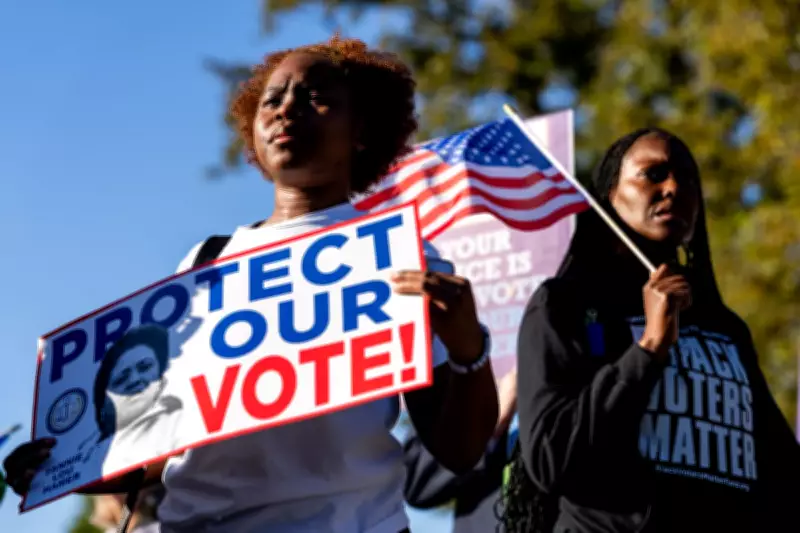
Demonstrators gathered outside the US Supreme Court in Washington DC in October 2025, protesting a landmark ruling that has reshaped voting rights protections. The case, Louisiana v Callais, decided by a 6-3 conservative majority, ordered Louisiana to redraw its congressional maps, rejecting the use of race as a factor in redistricting. This decision deals a severe blow to the Voting Rights Act of 1965, a cornerstone of civil rights legislation.
What is the ruling about?
At its core, Louisiana v Callais concerns how states draft congressional maps under Section 2 of the Voting Rights Act. Louisiana had created two majority-Black districts out of six, reflecting its one-third African American population. A group of white voters sued, claiming this constituted an unconstitutional racial gerrymander. The Supreme Court agreed, ruling that maps can only be challenged if intentional racial discrimination is proven, a difficult standard. The decision also prohibits considering race when proposing alternative maps.
Impact on voting rights protections
Section 2 of the Voting Rights Act had long shielded minority voters from discriminatory maps. Previously, plaintiffs could block maps that had the effect of diluting minority voting power. Now, they must prove discriminatory intent, which is nearly impossible given the strong correlation between race and party affiliation—83% of Black voters support Democrats. States can claim partisan motives to avoid liability.
Reactions to the ruling
Republican leaders in Louisiana celebrated the decision, with Attorney General Liz Murrill declaring, "We win!" Civil rights advocates, however, expressed dismay. The three liberal justices—Elena Kagan, Sonia Sotomayor, and Ketanji Brown Jackson—dissented, calling it a "demolition" of the Voting Rights Act that will lead to a sharp decline in minority representation.
Impact on midterm elections
The ruling came unusually early, suggesting conservatives aimed to give states time to redraw maps before the November midterms. Louisiana has already postponed its primary elections to revert to a single majority-Black district. Other southern states are following suit, with Donald Trump signaling Tennessee's governor plans to redistrict for an extra Republican seat. This flurry of mid-decade redistricting could shift control of the House.
Long-term implications
The Voting Rights Act was enacted to enforce the 15th Amendment, which granted freed slaves the right to vote. While extreme Jim Crow-era tactics are unlikely to return, the ruling leaves minority voters vulnerable to practices like "cracking" and "packing." As Justice Kagan warned, the Act is now all but dead, diminishing the political voice of Black and other minority Americans.




