
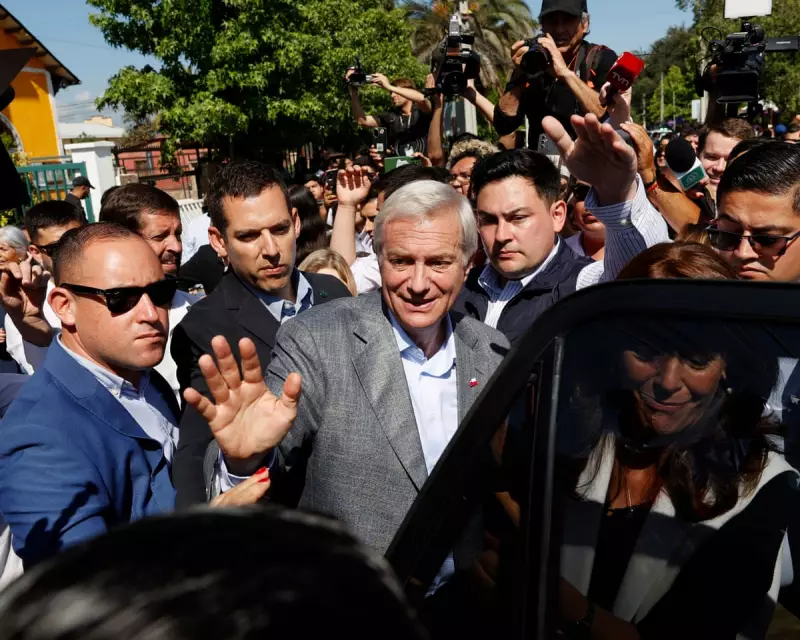
Far-Right Candidate Emerges as Frontrunner in Chile's Presidential Election
In a dramatic development that could reshape Chile's political landscape, far-right candidate José Antonio Kast has positioned himself as the clear favourite to become the country's next president. The ultraconservative lawyer secured his place in the decisive second round after Sunday's initial vote, where he will face Communist party candidate Jeannette Jara in a runoff election scheduled for 14 December.
First Round Results Set Stage for Political Showdown
With more than 70% of ballots counted, Kast captured approximately 24% of the vote, while his left-wing opponent Jara, a former labour minister under outgoing centre-left President Gabriel Boric, achieved slightly higher support with around 26%. However, political analysts immediately identified Kast as the likely ultimate victor after other right-wing candidates collectively secured nearly 30% of the first-round votes.
The election outcome took a decisive turn when two other conservative contenders threw their support behind Kast. Radical libertarian Johannes Kaiser, who won about 14% of votes, announced his endorsement, explicitly stating he backed his far-right rival "because the alternative is Mrs Jara" and Chile's "lefty impoverishers".
Conservative candidate Evelyn Matthei, who secured approximately 13% of the vote, quickly followed with her own endorsement, citing concerns about migration and claiming Chile required a "sharp change of direction". Matthei appeared alongside Kast, telling supporters: "Please support Kast … It's super important that this government does not remain in power. We have too many problems."
Trump-Inspired Policies Dominate Kast's Campaign
The 59-year-old Kast, making his third presidential bid after losing to Boric in 2021, has built his campaign around two central pillars: combating crime and immigration. His platform carries distinct echoes of Donald Trump's political approach, complete with a pledge to "put Chileans first".
One of Kast's most controversial proposals, dubbed Escudo Fronterizo (Border Shield), involves constructing miles of ditches, barriers and walls along Chile's northern border to prevent migrant entry. This policy responds to the arrival of more than half a million Venezuelans in recent years, fleeing their country's economic collapse. "Chile has been invaded … but this is over," Kast declared in a campaign advertisement.
Kast has openly celebrated Trump-era immigration policies, noting in October that 1.6 million migrants had "self-deported" from the United States after 500,000 were formally deported under the former US president. "That's [a proportion of] three-to-one. Here, we think that it can be four-to-one, or five-to-one," he said regarding his plans to create a hostile environment for immigrants in Chile.
On crime, Kast has drawn inspiration from El Salvador's authoritarian leader Nayib Bukele, who has imprisoned at least 2% of his country's adult population since 2022. Public security has emerged as a central election issue despite Chile remaining one of South America's safest countries, following increases in assassinations, kidnapping and extortion cases.
Regional Political Shift and International Reactions
Kast's strong performance will likely be welcomed in Washington, where Trump-aligned officials such as Secretary of State Marco Rubio have hailed what they perceive as a conservative wave sweeping South America. The political landscape across the continent appears to be shifting rightward, with neighbouring Bolivia recently electing a centre-right president after two decades of socialist rule.
The trend seems set to continue, with right-wing candidates positioned favourably for upcoming presidential elections in Colombia and Peru next year. Even in Brazil, left-wing veteran Luiz Inácio Lula da Silva faces a challenging battle to maintain his presidency despite his far-right predecessor Jair Bolsonaro's recent sentencing for orchestrating a failed coup.
Outgoing President Gabriel Boric described the election as a "spectacular day of democracy" and congratulated both candidates progressing to the second round. Meanwhile, Jara used her post-election address to remind supporters that Chile remains a great country, directly countering her right-wing rivals' claims that the nation has deteriorated.
As Chile prepares for its 14 December runoff, the election represents a critical juncture for the country's political direction, with Kast's Trump-inspired platform challenging the left-wing governance that has dominated recent years.




