Rubio's Strategic Support for Orbán Ahead of Hungarian Election Alarms European Union
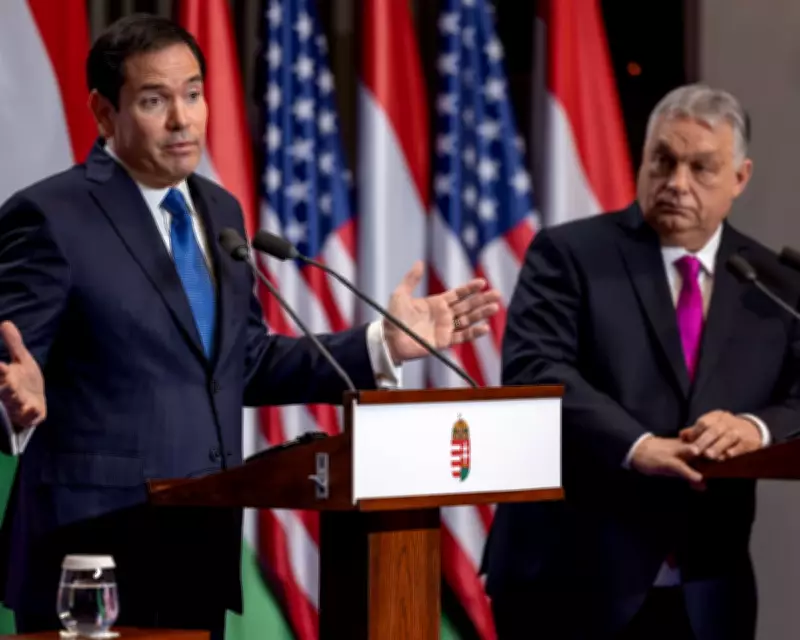
In a move that has sent shockwaves through European diplomatic circles, US Secretary of State Marco Rubio extended a significant offer of financial support to Hungarian Prime Minister Viktor Orbán. This gesture occurred merely two months before Orbán's Fidesz party confronts a pivotal parliamentary election, representing the most substantial challenge to his sixteen-year dominance in Hungary.
A Golden Age Declaration Amidst Transatlantic Tensions
Rubio's itinerary across Europe was already viewed as provocative, particularly following his participation in the Munich Security Conference during a period of strained relations between the United States and its traditional allies. His subsequent visits to Slovakia and Hungary, both nations heavily reliant on Russian energy and skeptical of the European Union's unwavering support for Ukraine, further underscored this perception.
During his meeting with Orbán, Rubio proclaimed that US-Hungary relations had entered a "golden age" and would remain prosperous as long as Orbán retains power. "If you face financial struggles, if you face things that are impediments to growth, if you face things that threaten the stability of your country, I know that President Trump will be very interested ... to finding ways to provide assistance if that moment ever were to arise, and obviously with regards to finances and the like," Rubio stated explicitly.
Election Interference Concerns and Historical Parallels
The timing of this financial pledge, coupled with hints about extending Hungary's exemptions from sanctions on Russian oil and gas, has ignited serious concerns about potential foreign interference in Hungary's imminent electoral process. Analysts have drawn parallels to previous US financial interventions, such as the substantial $20 billion bailout extended to Argentina's Javier Milei, which is widely credited with stabilizing the economy and securing crucial midterm election victories for his party.
"Especially as long as you’re the prime minister and the leader of this country, it’s in our national interest that Hungary be successful," Rubio emphasized to Orbán, reinforcing the personalized nature of this diplomatic and financial support.
Reinforcing EU Anxieties Over American Intentions
In Brussels, Rubio's visit has unequivocally amplified existing fears that the United States is actively seeking to foster chaos and disunity among its European allies. This apprehension grows amidst escalating tensions over a range of critical issues, including the ongoing conflict in Ukraine, territorial disputes involving Greenland, and contentious trade and defense spending negotiations.
Theresa Fallon, Director of the Brussels-based Centre for Russia, Europe, Asia Studies, characterized the visit as a deliberate provocation. "It’s an ‘eff you’ to the EU," she remarked. "It was really clear." Many European officials interpret Rubio's actions and statements as a transparent attempt to influence the outcome of a major election within the heart of Europe, undermining the sovereignty of EU member states.
A Contrast in Diplomatic Styles Within the Trump Administration
European diplomats in Washington have expressed a preference for dealing with Rubio over Vice President JD Vance, viewing Rubio as a more traditional Republican who has historically supported conventional US foreign policy approaches. In a Trump administration where personal dynamics frequently dictate policy directions, Rubio's continued involvement is seen by some as a stabilizing factor.
However, as one European diplomat cautiously noted, "He is much preferred to Vance, but they still both work for Trump." This sentiment highlights the underlying uncertainty and apprehension regarding the overarching strategic goals of the current US administration towards Europe.
Substance Over Style: The Persistent Message of Strategic Autonomy
While Rubio's speech at the Munich Security Conference was notably more restrained and received a standing ovation from many European officials, analysts argue that the core message remained consistent with the administration's previous communications. Matthew Kroenig of the Atlantic Council observed that Rubio "did not repudiate anything in Vice President JD Vance’s more pugnacious speech last year, but he presented the same themes in a more positive light."
Theresa Fallon echoed this analysis, stating, "Everybody wanted to hear something positive. And when they slept on it, they realised, oh my gosh, no, it’s the same thing, just packaged a little better." Ultimately, the diplomatic takeaway, as summarized by one official, is unequivocal: "The message coming from both [Rubio and Vance] is clear: you are on your own."
This episode underscores a deepening rift in transatlantic relations, where overt political and financial support for contentious leaders like Viktor Orbán is perceived not as bilateral cooperation, but as a calculated strategy to destabilize European unity from within.