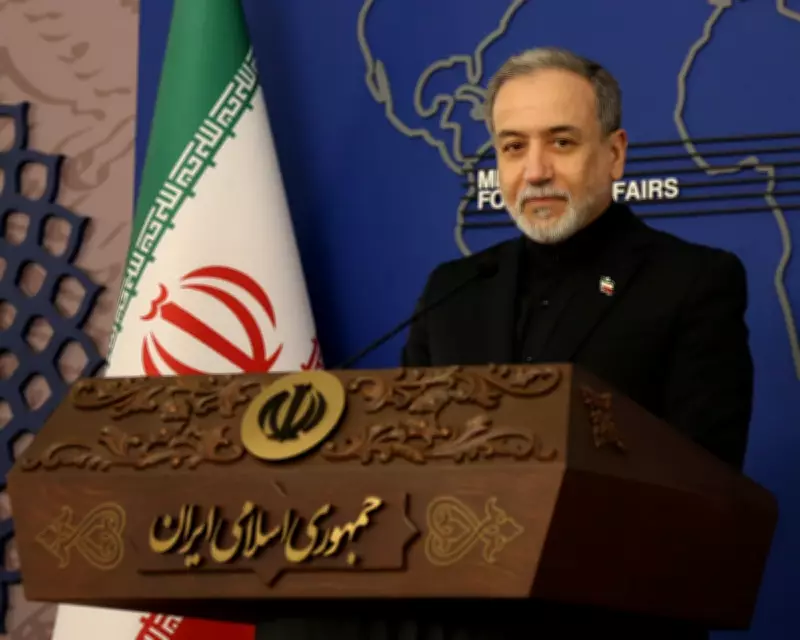
Iran's foreign minister has launched a scathing accusation against certain Gulf states, claiming they may be secretly encouraging American military strikes that have resulted in significant Iranian civilian casualties. Abbas Araghchi issued a demand for immediate clarification regarding reports that Saudi Arabia's Crown Prince Mohammed bin Salman has been privately urging former US President Donald Trump to intensify attacks on Iranian targets.
Contradictory Positions Exposed
Araghchi was responding to the second consecutive US media report within a week revealing that the Saudi crown prince's public opposition to American military actions against Iran starkly contradicts his private communications with the Trump administration. According to these reports, bin Salman maintained regular private conversations with Trump where he explicitly encouraged the US president to "continue hitting the Iranians hard."
"Stances should be promptly clarified," Araghchi declared in a social media post, emphasizing that hundreds of civilians, including more than two hundred children, have been killed in what he described as US-Israeli coordinated attacks. The Iranian foreign minister's statement represents a thinly-veiled but unmistakable attack on Saudi Arabia and other Gulf nations that host American military forces.
Security Council Secretary Issues Stark Warning
Ali Larijani, secretary of Iran's Supreme National Security Council, issued a direct appeal to Muslim populations across Gulf states, questioning their alignment in the ongoing conflict. "Are we being asked to stand idly by while US bases in your countries are being used to attack us?" Larijani demanded, defending Iran's retaliatory strikes against Gulf nations.
He framed the confrontation as a fundamental struggle between "America and Israel on the one hand, and Muslim Iran and the forces of resistance on the other," urging Gulf populations to reconsider which side they truly support in this escalating regional conflict.
Military Escalation Across the Gulf
The diplomatic warnings coincided with a significant escalation of Iranian military actions on Monday, with drone strikes targeting Bahrain, Saudi Arabia, Qatar, and the United Arab Emirates. These coordinated assaults represent one of Iran's most comprehensive military operations since the conflict's inception.
Simultaneously, Iran declared its intention to maintain an indefinite closure of the Strait of Hormuz to "enemies and those supporting their aggression." This strategic maritime chokepoint, through which approximately one-fifth of global oil shipments pass, has become a critical flashpoint in the regional confrontation.
Internal Hardline Consolidation
The Iranian military posture has been reinforced by internal political developments, particularly the appointment of uncompromising hardliner Mohsen Rezaee as military adviser to Supreme Leader Mojtaba Khamenei. Rezaee, a former commander of the Islamic Revolutionary Guards Corps with sixteen years of experience who played crucial roles during the Iran-Iraq war, has taken a firm stance against any ceasefire negotiations.
"There should be no ceasefire until the US agrees to vacate its military bases in the Middle East," Rezaee declared over the weekend, reflecting the increasingly rigid position of Iran's military leadership. His appointment further consolidates the IRGC's influence within Iran's power structure following Khamenei's recent elevation.
Civilian Toll and Infrastructure Damage
The human cost of the conflict continues to mount, with Iranian civilian casualties approaching 1,500 after neighborhoods across Tehran endured some of the most intense bombardments since hostilities began. Critical infrastructure has suffered extensive damage, with electricity grid facilities being struck and power temporarily lost in eastern sections of the capital.
Tehran Mayor Alireza Zakani reported that the capital has absorbed approximately 13,000 separate attacks, representing more than half of all assaults on Iranian territory. The sustained bombardment has forced the suspension of parts of Tehran's metro system and exacerbated an already severe humanitarian situation.
Information Control Intensifies
Iranian authorities have significantly tightened information controls over the past forty-eight hours, implementing more extensive internet blackouts and restricting access to newspapers and Telegram communication channels. This censorship escalation coincides with the military intensification and reflects the government's effort to control narrative and information flow during the crisis.
Strategic Waterway Negotiations
Despite the closure of the Strait of Hormuz to hostile vessels, Iranian officials have indicated some flexibility for neutral parties. Foreign Ministry spokesperson Esmail Baghaei confirmed that "vessels belonging to countries not involved in the war have been allowed to transit the strait of Hormuz with coordination and permission from Iran's military."
This policy has resulted in limited exceptions, including two Indian-flagged gas tankers bound for Gujarat that were permitted passage following direct negotiations between Iranian and Indian officials. However, Araghchi emphasized that this arrangement represents a "one-off" exception based on his historical engagement with India, not a broader policy shift.
Reports suggest Iran may be seeking reciprocal concessions, including access to medical supplies and the release of three Iranian vessels currently detained by Indian authorities.
International Diplomatic Calculations
Iranian officials have expressed satisfaction with what they perceive as diplomatic setbacks for the Trump administration, particularly the largely negative response to American calls for a seven-nation coalition to help secure the Strait of Hormuz. The proposed coalition, which would have included China, France, and the United Kingdom, failed to materialize as envisioned.
Tehran has been quick to highlight any apparent fissures in US-European relations, interpreting these diplomatic developments as evidence that Trump's unilateral military campaign—conducted without prior consultation with international partners beyond Israel—lacks broader international endorsement. This perception has bolstered Iranian confidence in their diplomatic and military positioning despite significant domestic costs and international pressure.