EU Foreign Policy Chief Kaja Kallas Links Middle East Chaos to Erosion of International Law
Kaja Kallas, the European Union's foreign policy chief, has issued a stark warning, stating that the current turmoil in the Middle East is a direct consequence of the weakening of international law. Her remarks come amid escalating tensions following the US-Israeli bombardment of Iran, which has highlighted broader geopolitical challenges.
Trump's Actions and European Dilemmas
The recent military actions initiated by the United States and Israel, under the leadership of Donald Trump, have once again underscored a disregard for international legal frameworks. This approach has placed European leaders in a difficult position, as they navigate the fallout from unilateral decisions made without consultation with allies.
In January, when Trump unilaterally intervened in Venezuela by abducting President Nicolás Maduro, Europe's response was cautious. Kallas affirmed the importance of respecting international law while questioning Maduro's legitimacy, but attention soon shifted to other crises. However, the Iran conflict presents more immediate dangers, with Trump pressuring allies like the UK's Sir Keir Starmer for support and threatening Spain with trade embargoes after Prime Minister Pedro Sánchez criticized the assault as "unjustified and dangerous."
European Unity and Strategic Autonomy
Facing a US administration that views multilateral principles as a weakness, Europe is being pushed toward greater strategic autonomy. French President Emmanuel Macron has suggested expanding France's nuclear umbrella beyond its borders, signaling a potential shift in European defense paradigms. Macron also described an Iranian drone attack on a RAF base in Cyprus as "an attack on all Europe," emphasizing the need for collective security measures.
The surge in oil prices due to the Iran war has further highlighted the security implications of investing in the EU's green transition, a move often criticized by Washington. This underscores the necessity for Europe to strengthen its independent stance in global affairs.
Kallas's Call for Moral Clarity
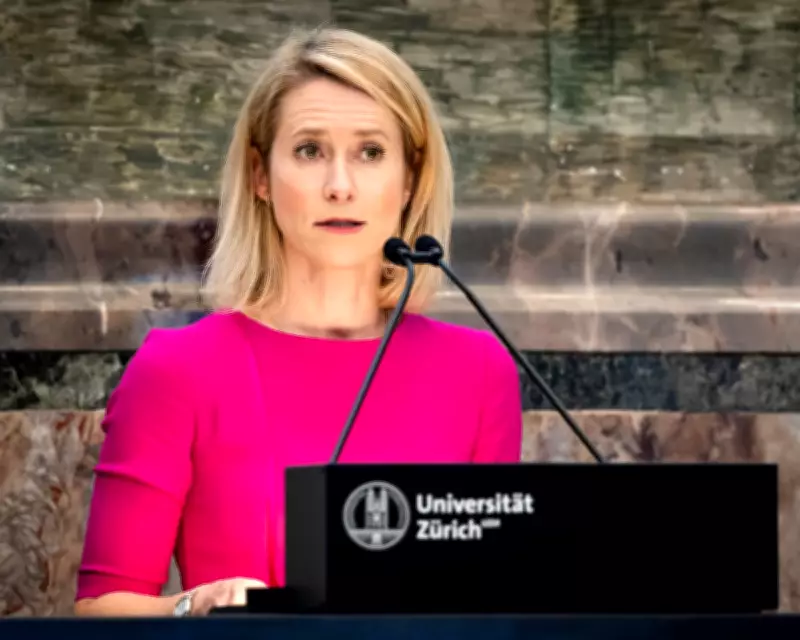
In a recent lecture at the University of Zurich, Kallas was more direct than in her earlier statements, arguing that Europe is "collectively addicted to the way the world was" when international law and the UN charter held primacy. She asserted that the chaos in the Middle East today stems directly from the erosion of these legal standards, calling for a new moral clarity and unity of purpose among European nations.
As the war in Iran continues with minimal popular support in the West, Kallas's analysis stresses that Europe must move beyond mere damage limitation and tightrope diplomacy. Instead, it needs to reshape its approach to ensure its voice is heard in a world where power dynamics are increasingly unchecked by legal norms.
The Path Forward for Europe
The events since Trump's re-election have shown that a strategy focused on limiting damage is insufficient. Europe must advocate robustly for multilateral principles to make the world safer, even as it protects its interests in regions like the Gulf. This requires a concerted effort toward strategic independence and a reaffirmation of international law as a cornerstone of global stability.