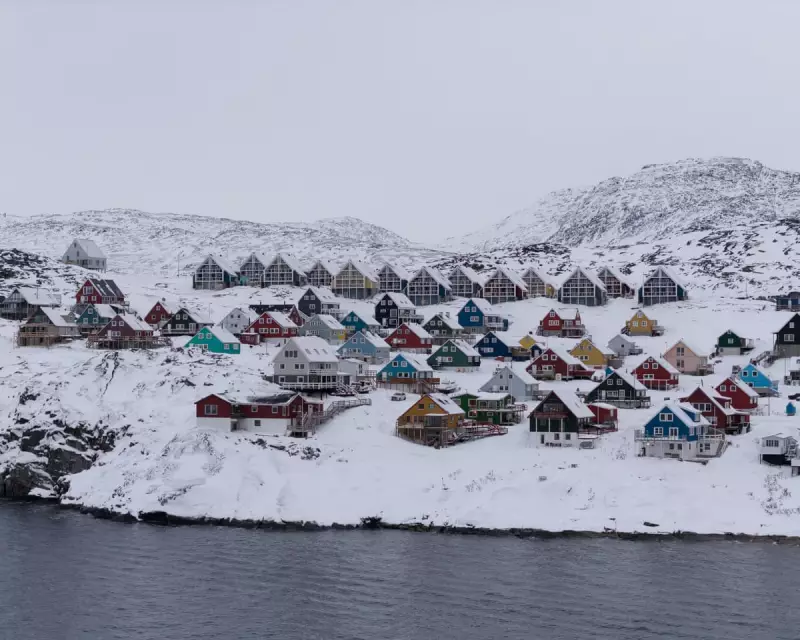
The political landscape of the Arctic has been plunged into crisis following renewed threats from former US President Donald Trump to acquire Greenland. European capitals are now engaged in a frantic diplomatic effort to support Denmark's sovereignty while grappling with their own profound dependence on American military protection.
A Stark Warning from Washington
In the wake of a controversial US military raid on Venezuela, which was met with silence from European allies, Trump's stated ambition to control Greenland "one way or the other" is no longer being dismissed as mere rhetoric. Analysts across Europe now view it as a serious intention, potentially driven by a combination of ideology, neo-imperial expansionism, and the strategic pursuit of critical minerals found on the vast island.
This situation has laid bare a painful dilemma for European powers. Trump's self-professed disregard for international law forces them to choose between confronting a key security guarantor or appeasing actions they have condemned elsewhere, such as Russia's invasion of Ukraine. The stark reality was underscored by Trump aide Stephen Miller, who boasted on CNN that "nobody is going to fight the United States" for the territory.
European Powers Draw a Line
In a significant tonal shift, the leaders of six major European nations – France, Germany, Spain, Italy, Poland, and the United Kingdom – issued a rare joint statement. They firmly reaffirmed support for Danish sovereignty, effectively warning Trump to back down. "It is for Denmark and Greenland and them only, to decide on matters concerning Denmark and Greenland," the statement declared.
However, the nature of any potential European "fight" for Greenland remains undefined. As Denmark engages in high-stakes talks in Washington, its strategy is one of de-escalation, offering security assurances while insisting Greenland is categorically not for sale. This stance has unified Copenhagen and Nuuk, despite historical ambivalence among some Greenlanders towards Denmark's colonial past.
US Vice-President JD Vance has been expected to revive 19th-century concepts like purchasing the territory's secession. Meanwhile, analysts question Trump's stated justification of protecting Greenland from Russian or Chinese aggression, noting that existing security frameworks could address such concerns without annexation.
The Search for a Diplomatic Solution
Amid growing alarm in Denmark and Greenland, where reports describe a fearful local population, the UK is attempting to broker a compromise. Prime Minister Keir Starmer's government is seeking a "modus vivendi" with Washington. Having remained quiet on the Venezuela raid, London now hopes to address US security worries about the Arctic under existing treaties, while reassuring Denmark on the issue of ownership.
Starmer and Trump have spoken twice recently about protecting the "high north" from Russia. "The view in London is that there is a deal to be done on Greenland," noted diplomatic sources. The core challenge is deciphering Trump's true motives regarding "ownership"—whether it is a practical security demand or a symbolic desire for territorial expansion.
UK Foreign Secretary Yvette Cooper has visited Finland and Norway, framing the issue around NATO's need to step up in the Arctic as climate change opens new frontiers, carefully acknowledging US concerns without endorsing occupation.
Europe's Limited Leverage and Strategic Options
With Trump seemingly willing to destabilise NATO over Greenland, Europe's options are fraught with risk. Yet, some strategists propose bold countermeasures. Former German Vice-Chancellor Robert Habeck suggested Europe could exercise its own machtpolitik (power politics) by offering Greenland a path back to EU membership alongside a massive investment package, potentially altering the territory's geopolitical calculus.
Fabian Zuleeg of the European Policy Centre argues that a united Europe must move beyond symbolic gestures and impose tangible costs on Trump's policies, targeting his political base through trade, market access, and regulatory levers. In a more radical proposal, commentator Alexander Hurst advocates for forcing a "rupture" with the US, including the potential expulsion of American troops from European bases, framing the annexation threat as a symptom of "American fascism."
The crisis over Greenland has become a stark stress test for transatlantic relations, exposing Europe's strategic vulnerabilities and forcing a reluctant continent to consider how far it will go to defend the principles of sovereignty and international law against its most powerful ally.