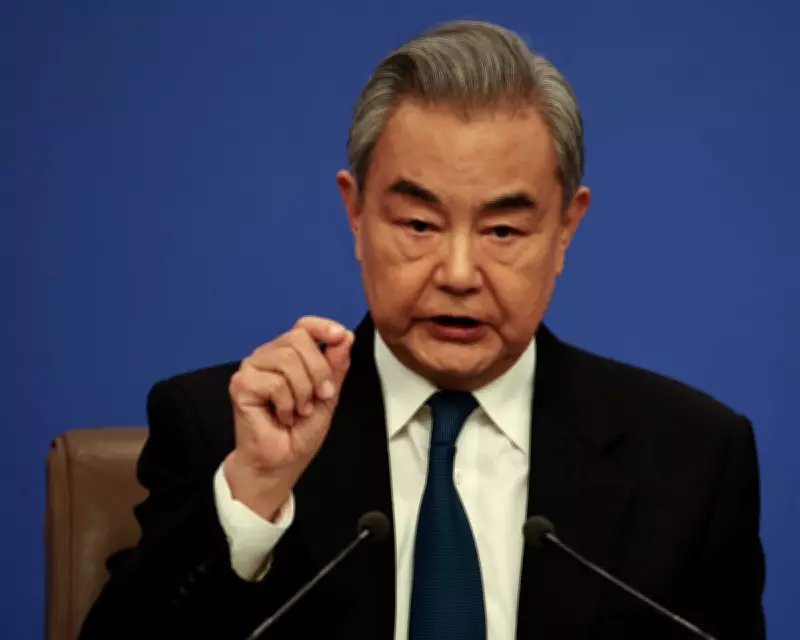
China's Top Diplomat Issues Stark Warning on Middle East Conflict
Chinese Foreign Minister Wang Yi has delivered a powerful statement declaring that war in the Middle East "should never have happened," even as he adopted a notably conciliatory approach toward the United States in anticipation of Donald Trump's upcoming visit to Beijing. The remarks came during a press conference held alongside China's annual parliamentary and political gatherings, known as the Two Sessions, where Wang serves as the country's top diplomat and foreign affairs official.
Avoiding Direct Criticism of the United States
In a significant departure from last year's more confrontational tone, Wang carefully avoided directly criticizing the United States or President Trump. Instead, he emphasized China's commitment to "mutual respect" in bilateral relations and described recent communications between Trump and Chinese President Xi Jinping as "heartening." Wang stressed that 2026 represents a "big year for China-US relations" and called for both nations to engage with "sincerity and good faith."
"A strong fist does not mean strong reason. The world cannot return to the law of the jungle," Wang declared, offering a clear critique of military aggression without specifically naming the United States. He further warned that "sliding into conflict or confrontation could bring the whole world down" and emphasized that "neither side can remodel the other."
Strategic Restraint Amid Global Tensions
Despite recent destabilizing foreign policy moves by the Trump administration—including the capture of Venezuelan leader Nicolás Maduro in January and joint military strikes with Israel against Iran in February—China has maintained strategic restraint. Both Venezuela and Iran serve as important Chinese oil suppliers and partners within Beijing's network of global south alliances.
Analysts suggest China sees significant value in maintaining dialogue with the United States, particularly given the Middle East turmoil's impact on global energy prices and trade routes. "Given the ongoing turmoil in the Middle East, including the impact on global energy prices, China likely sees even more importance in having a chance to address a wide range of difficult issues with Trump in person," noted William Yang, a senior analyst at the International Crisis Group.
Firm Stance on Taiwan and Regional Tensions
While adopting a measured tone toward the United States, Wang maintained China's characteristically firm position on Taiwan, declaring that "reunification" between China and Taiwan "is a historical process that cannot be stopped" and warning that "those who defy it shall perish." Beijing consistently claims Taiwan as part of its territory and has vowed to achieve reunification by force if necessary.
Wang also directed criticism toward Japan, whose relations with China have deteriorated significantly since Japanese Prime Minister Sanae Takaichi suggested that an attack on Taiwan could trigger deployment of Japan's self-defense forces. Wang accused Japan of using self-defense arguments to "hollow out its pacifist constitution" and raised concerns about Japan's historical military ventures in Asia.
Trade Relations and Diplomatic Calendar
The White House has confirmed that President Trump will travel to China between March 31 and April 2, marking his first visit to the country since 2017 and the most recent by any US president. Trade negotiations are expected to feature prominently on the agenda, following the temporary truce to the trade war agreed upon last October.
Both nations appear focused on stabilizing their relationship ahead of the high-stakes visit, despite the complex geopolitical landscape. China's approach reflects a calculated diplomatic strategy that balances firm principles on territorial issues with pragmatic engagement on economic and global security matters.