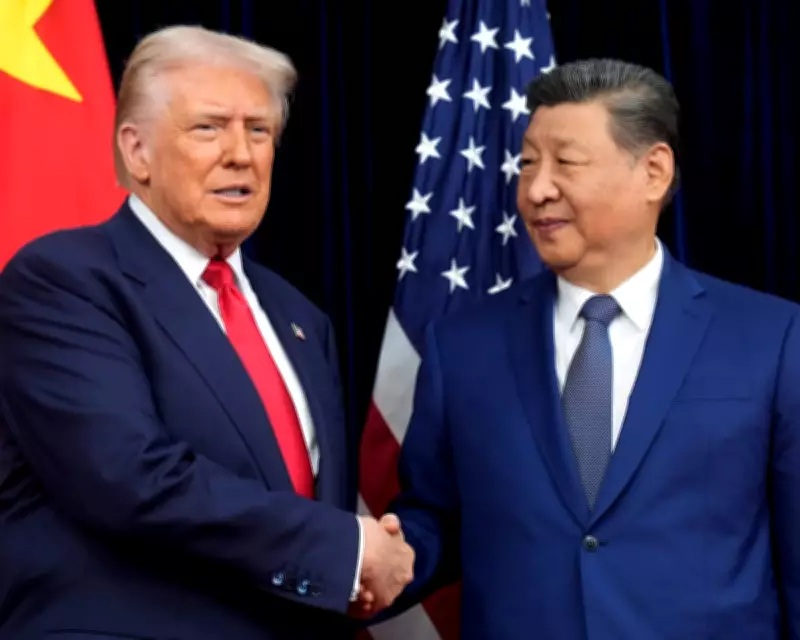
The White House confirmed on Wednesday that China has agreed to postpone a highly anticipated visit by US President Donald Trump to Beijing, originally scheduled for late March. This delay comes as the ongoing war in the Middle East, particularly involving Iran, complicates Trump's domestic and international standing. China has not publicly commented on the postponement, which will push back the first in-person meeting between Trump and Chinese President Xi Jinping since October.
Geopolitical Calculations and Electoral Pressures
The summit, now likely rescheduled for May, was expected to address the next phase of the US-China trade war, which has been under a temporary truce since last fall. However, the conflict with Iran, a nation with friendly ties to China, is poised to become a significant agenda item. This delay underscores how Middle Eastern hostilities are influencing global politics far beyond the region's borders.
Beijing is meticulously observing the potential impacts on US-China relations and the upcoming US midterm elections in November. Analysts suggest that a US president seeking electoral success domestically might prove more flexible in negotiations. Yet, Trump's notorious unpredictability adds a layer of complexity to China's strategic assessments.
Economic Leverage and Trade War Tactics
The postponement may actually relieve Chinese officials, who were reportedly frustrated by inadequate US planning for what Beijing envisions as a meticulously orchestrated event. It also increases pressure on Trump to secure a favorable deal when he eventually travels to China, especially as the Iran conflict drives oil prices upward. A recent NBC News poll indicates that over half of registered US voters disapprove of the strikes on Iran, including more than one-third of non-MAGA Republicans.
Neil Thomas, a fellow at the Asia Society Policy Institute, noted, "Beijing can reasonably assume that Trump wants to avoid a fresh inflation spike heading into the midterms, which gives China some leverage in trade talks." However, he cautioned, "that leverage has limits ... Trump's war with Iran shows that he is willing to accept economic costs when he believes other strategic or political priorities matter more."
Economic Interdependence and Retaliatory Measures
Both nations share an interest in preventing last year's trade war from escalating in 2026. China's economy, still heavily reliant on exports, saw a 22% growth in exports during January and February. While the US experienced limited economic fallout last year, economists anticipate more negative effects—such as inflation and rising unemployment—in the coming months if no deal is reached to avert high reciprocal tariffs.
Compounded by energy price inflation due to the Iran war, Trump could face a disgruntled electorate in the midterms. Amanda Hsiao, China director at Eurasia Group, explained, "There is a view [in Beijing] that ahead of the midterms Trump may be more motivated to secure economic deals with China as this will help boost his message of economic affordability to voters."
Beijing has demonstrated its ability to apply targeted pressure. Following Trump's initiation of the trade war in April last year, Chinese purchases of US soybeans—a key agricultural export from Trump-supporting regions—vanished, resuming only after the October truce. This tactic is rehearsed; during the 2018 midterms, areas affected by Chinese retaliatory trade measures saw declining Republican vote shares, contributing to the party's loss of House control. One study estimated this retaliation cost Republicans four seats.
Post-Midterm Scenarios and Strategic Ambiguity
With a narrow majority of just four seats in 2026, a similar defeat for Trump is conceivable. However, a weakened Trump might not benefit Beijing. Hsiao added, "There are also questions among Chinese observers as to what happens after the midterms and whether a weakened Trump will harden his posture toward China." A Trump loss could reinvigorate Republican China hawks, who have been marginalized as Trump softened the US stance, approving advanced semiconductor exports to China and delaying weapon sales to Taiwan.
Yun Sun, director of the China programme at the Stimson Center thinktank, stated, "Overall, China has seen the second Trump term as a positive development for US-China relations. The weakening of Trump's power could see the hawkish view on China on the rise again. If anything, the Chinese will want to see Trump stay in power, and that means potentially more support of his domestic trade agenda, not less."
Conflicting pressures render Beijing's perspective on the midterms nuanced. Regardless of whether a Republican defeat aligns with Chinese interests, many experts in China anticipate that outcome. Wang Wen, dean of the Chongyang Institute for Financial Studies at Renmin University of China, characterized Trump's tenure as "truly dismal." As Beijing deciphers the effects of the Iran war on US politics, it remains poised to strategically apply pressure during the rescheduled summit, balancing economic leverage with geopolitical uncertainties.