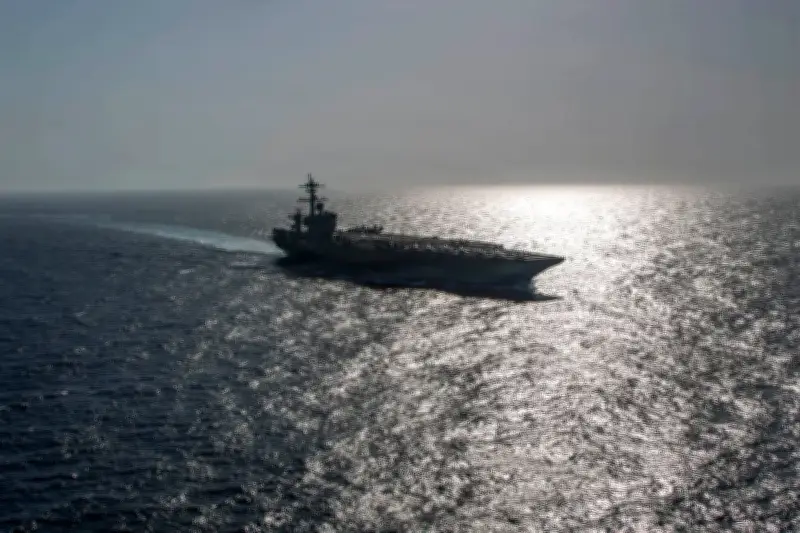
The USS Abraham Lincoln, an aircraft carrier with 5,000 sailors and marines aboard, has been at sea for nine months, with the crew spending 250 consecutive days without making land—a record for a modern carrier. Reports from Navy Times and Stars and Stripes indicate multiple attempts by sailors to jump overboard as mental stress reaches a breaking point.
Families Confront Navy Leadership
At a town hall meeting in San Diego last Thursday, about 200 family members voiced concerns directly to acting Navy Secretary Hung Cao and other officials. One spouse reported that her husband texted her saying “he hopes he doesn’t wake up tomorrow,” according to Stars and Stripes. Another woman told Cao that the Navy had “broken trust between us and the leadership.”
Navy Times detailed thwarted suicide attempts, including one case where Annabelle Loma’s husband tried to jump overboard after his deployment was extended. “He’s scared. He thinks he’ll get a dishonorable discharge, and just because he was burnt out his 13-year career is ruined, just like that,” she said. Another sailor’s wife recounted an incident where her husband prevented a fellow crew member from jumping by grabbing them and bringing them back on deck.
Lawmakers Sound Alarm
Democratic Congressman Mike Levin of California described conditions on the Lincoln, which is in its fifth month of combat operations against Iran, on X: “moldy showers, broken toilets, laundry down for weeks, long stretches with no hot water, a meal that came down to half a cup of rice and two tortillas. No soap, deodorant, or toothpaste.” Jason Crow, a Democratic Congressman from Colorado and former Army Ranger, warned that the strain on service members and their families is “building week by week.”
The deployment, which began when the ship left San Diego on 21 November, was initially intended for the Pacific but was redirected to the Middle East after the US-Israel war with Iran began. MS Now revealed that the crew has had only two days on land—in Guam in December and Oman in July—and the deployment, originally scheduled to end in May, has been extended multiple times.
Official Response and Mental Health Concerns
In April, public criticism grew over poor food quality, water shortages, and broken equipment. Defense Secretary Pete Hegseth dismissed the accounts as “more fake news.” Levin responded this week, saying, “These men and women signed up to serve their country. The least their country owes them is hot water, a working toilet, and a real meal. Hegseth cannot even manage that, and he has the nerve to look their families in the eye and call them liars.”
The US Navy did not immediately respond to requests for comment. A study from last year on deployed sailors found common stressors including loud noises, lack of rest, and inadequate mental and physical healthcare. Nearly half of surveyed sailors said they were not receiving adequate help coping with stress at sea, and the study concluded that “given the high rates of military suicide, including within the Navy, efforts to improve health care access on ships are urgently needed.”