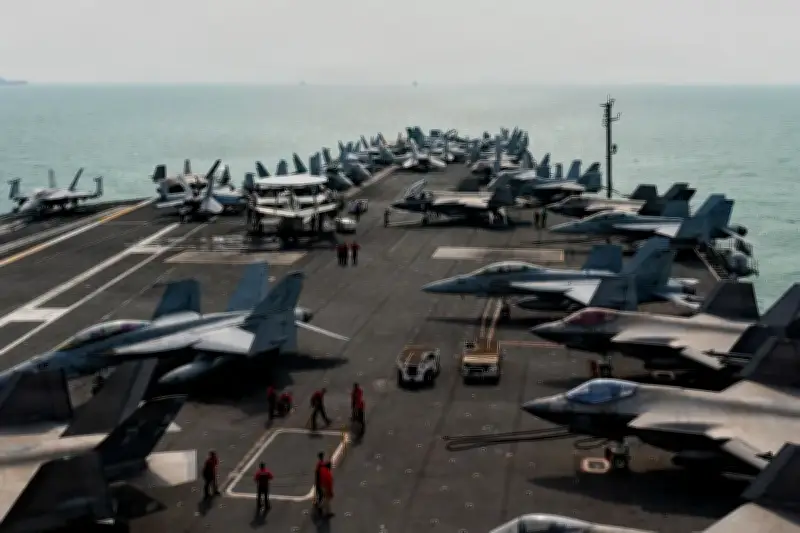
The USS George Washington aircraft carrier has arrived in the Middle East, where it is expected to relieve the USS Abraham Lincoln from its record deployment amid concerns about poor living conditions and morale. US Central Command announced on Thursday that the Washington arrived in the area on Wednesday, posting an image of sailors working on the flight deck as the ship transited the Arabian Sea. No date has yet been announced for the Lincoln to return to the United States.
Family Concerns Over Conditions on USS Abraham Lincoln
In an interview this week, the wife of a sailor onboard the USS Abraham Lincoln told the Guardian that she has noticed a change in her husband’s messages as the deployment has stretched on. “There’s less hope in the way he talks and less positive things that he has to say,” she said. “You can just tell the little things.” She added, “He’s just exhausted. It’s a long, long deployment and it takes a toll.”
The woman, who spoke on the condition of anonymity out of fear of retribution, said that her husband rarely complained. However, photographs he sent of what she described as his sometimes sparse meals as supplies ran low have left her worried. One meal she described as just a “couple of pieces of bacon and three or four chicken wings.” “He’s never complaining. It’s just when I ask him a question, I’m like, OK, wait a minute, that’s not right,” she said. “To put it plainly, I just don’t think they’re getting enough calories.”
Record Deployment and Reported Shortages
Her account comes as recent reports have rung alarm bells about conditions onboard the Lincoln, which has spent more than 250 days at sea supporting US operations against Iran without a significant port visit or date to return home for the 5,000 sailors aboard. Reports from families of crew members published in the Navy Times and Stars and Stripes military newspapers described food and water shortages, disrupted mail services, plumbing problems, low morale, and worsening mental health, prompting Democratic lawmakers to demand answers from the Pentagon.
“I just don’t really think they’re treating them like people. I think they’re treating them like a uniform, like a pawn on a chessboard,” the wife said in a telephone interview.
Official Responses and Challenges
Over the weekend, Adm Brad Cooper of US Central Command visited the ship and released a statement saying the Lincoln “currently has among the lowest number of cases related to mental health” of the navy’s 11 active aircraft carriers, but acknowledged “that doesn’t mean all is perfect,” describing long deployments at sea as “uniquely challenging and tough.” A navy official, in a statement last week, also recognized that the war had disrupted traditional supply hubs, but said that “current reports from the ship confirm continuous access to clean water, functional [air conditioning] and healthy meal options.”
But the wife of the sailor still worries for her husband and his shipmates. “He has not point-blank said anything, but I feel like I can tell through text it’s getting hard … being deployed without having any stops, and just kind of doing the same thing over and over again for months is exhausting,” she said, adding: “especially when you’re dealing with high stress” in a war zone.
Retired Navy Officers Weigh In
Carl Otis Schuster, a retired US navy captain, said he thought more attention should be paid to the “human element” of these deployments, adding that “until we do that, you’re going to have repeats” of the kinds of problems that have emerged. “Unfortunately, we’ve made a habit of placing the sacrifices on the crewmen,” Schuster said. “Every generation says that this generation is soft, but I would argue the guys serving on the Abraham Lincoln have undergone stresses and strains that my generation rarely faced, and certainly I never faced.” Schuster served for 26 years on various US and allied warships.
The Lincoln’s crew, he said, had “shown really strong resilience.” During his own service, he said, he never spent more than 90 days at sea, and warned: “All of us have a breaking point.” He said that typically about 70% of the crew on a ship like the Lincoln are age 26 or younger, living and working together in a confined space. “We have one carrier fulfilling the mission that would normally be done by two, so there’s nowhere to rotate them out, and so the tension and stress on the crew grows,” he said.
Asked about Donald Trump’s comments last Friday that the Lincoln’s deployment was “not nearly long enough,” Schuster said that the US president may be correct strategically that the US needs a carrier in the region for longer, but that the statement “ignores the human element,” which he said was “everything.”
Lory Manning, who served more than 25 years in the navy, said that sailors typically leave for deployments with a sense of when they will be returning and that “every time that is changed, it’s demoralizing.” Aircraft carriers, she said, were noisy, crowded and constantly operating. Sailors often work long hours, some in warm areas of the ship such as the engine room, where “you might not get much daylight,” and shortages of basic supplies can make prolonged deployments even harder. “There’s no privacy,” she said. “In a sense, [it can ultimately feel like] you’re in a jail because you’re on this ship and you can’t get off.”
Yet Manning, who after retiring from the navy got involved with work centered on female veterans and women in the military, said that sailors continued to do their jobs despite the strains. “The work is getting done, the people are doing what they’re supposed to do,” she said. Still, she wonders what the long-term consequences may be. “How many of them will re-enlist someday?” she said.