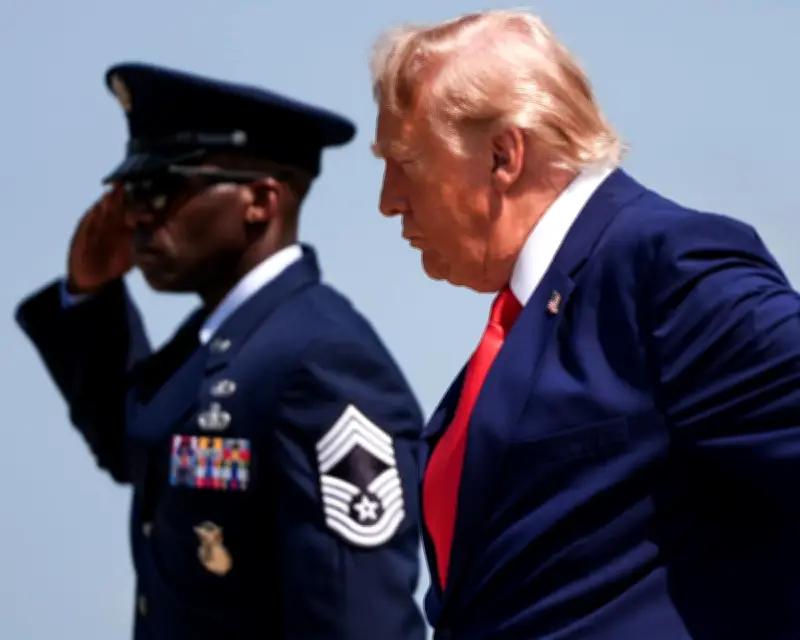
Donald Trump has said he is close to deciding whether to launch 'a massive attack' against Iran, on a scale larger than strikes already witnessed during the months-long conflict with Tehran. Speaking to the Axios news site, the US president stated: 'I am considering a massive attack. Bigger than ever before. I am close to making a decision. We are all set for it.'
Oil Prices Surge Amid Red Sea Attacks
Trump made his remarks on Thursday as oil prices once again surged past the symbolic $100 per barrel for Brent crude, the international benchmark, amid indications the price could go higher. He acknowledged that such a decision would have consequences but said he had not yet made a final determination. Israel 'would join in two minutes if I ask them to,' he added, before saying: 'We don't need anybody.'
Trump's comments followed the earlier threat of 'major military punishment' against Iran and the Houthis, after the Iran-backed Yemeni militia's attacks on two Saudi Arabian oil tankers in the Red Sea. The Houthis' Saba news agency said the rebels had struck the tankers Encelia and Layla, causing fires on both. No casualties were reported in their first attack on a vessel since they announced a blockade of Saudi-linked shipping.
UN Warns of 'Unimaginable' Escalation
Underlining the sense of a region increasingly approaching an abyss, UN Secretary General António Guterres told the Security Council that the Middle East was being pushed to the 'edge of the unimaginable.' 'The situation is getting out of control. It is teetering on the edge of the unimaginable. The region is being pulled into an ever-widening circle of confrontation. One crisis feeds another. One escalation triggers the next,' Guterres said. 'As this dynamic spreads, the political objectives are becoming increasingly obscured by the confrontation itself.'
The UK announced it was temporarily withdrawing diplomatic staff from Iran on Wednesday, and the German military said on Thursday it would withdraw two vessels from the Red Sea. As Israeli cities opened bomb shelters, the US State Department warned Americans living in the region that flights may be cancelled.
Houthi Blockade Threatens Key Shipping Route
The Houthi attacks threatened the safety of a second major maritime route connecting the Suez Canal to the Red Sea and Gulf of Aden. They also came amid reports that Iran had sent military advisers and drone parts to the Houthis 10 days ago. Quoting four sources, including two Iranians, Reuters reported on Thursday that Iran had transferred Islamic Revolutionary Guard Corps personnel and military-related equipment on a flight from Tehran to Yemen on 13 July, as Tehran was calling for the Houthis to blockade the Bab el-Mandeb strait.
Ships began turning back from sailing through the narrow strait this week after the Houthis announced a blockade of Saudi ports, most notably the Red Sea port of Yanbu, which Riyadh has been using to ship oil to Asia during the conflict that has all but halted shipping through the Strait of Hormuz. The maritime data and analysis firm Lloyd's List Intelligence said the Houthi attacks put Saudi oil shipments from Yanbu at risk and presented a 'double whammy' on top of the Hormuz disruptions, adding that the threat 'raises questions on the viability of this route.'
Trump's Escalating Rhetoric and Political Pressures
Trump wrote on social media: 'If [the Houthis] do this again, the US will hold Iran responsible, in that the Houthis are a Surrogate and/or Proxy of Iran, and major military punishment will be inflicted upon Iran and, of course, the Houthis, themselves.' He has been escalating his rhetoric against Iran in recent days, hinting the US is prepared to bomb an underground tunnel complex at the 'Pickaxe mountain' site where Israel alleges Tehran has hidden centrifuges used in uranium enrichment.
As Trump has struggled to get a grip on the spiralling crisis, during which Iran has occasionally launched lethal strikes against US bases and Washington's Gulf allies, he appears to have been sucked into an 'escalation trap,' threatening ever more violent retaliation. On Wednesday, Trump said the US would destroy one bridge or power plant every time Iran shot at a ship in the Strait. US Secretary of State Marco Rubio said Trump was seeking a 'head for an eye' after the recent deaths of several US service members in an Iranian strike on the Muwaffaq Salti airbase in Jordan. However, speaking on the outskirts of the ASEAN conference in Manila, Rubio said Iran was 'begging for a deal' and insisted 'they need to come to their senses' and that they will 'pay a very heavy price for the things they are doing' – claims US officials have made before.
With Trump's poll ratings in freefall and his war against Iran deeply unpopular at home, the president and his administration are running short of time before the autumn midterm elections to find a resolution on Washington's terms. Underlining Trump's growing political problems, the US House of Representatives narrowly passed a resolution on Thursday to halt US military action in Iran, the second such warning to the president.