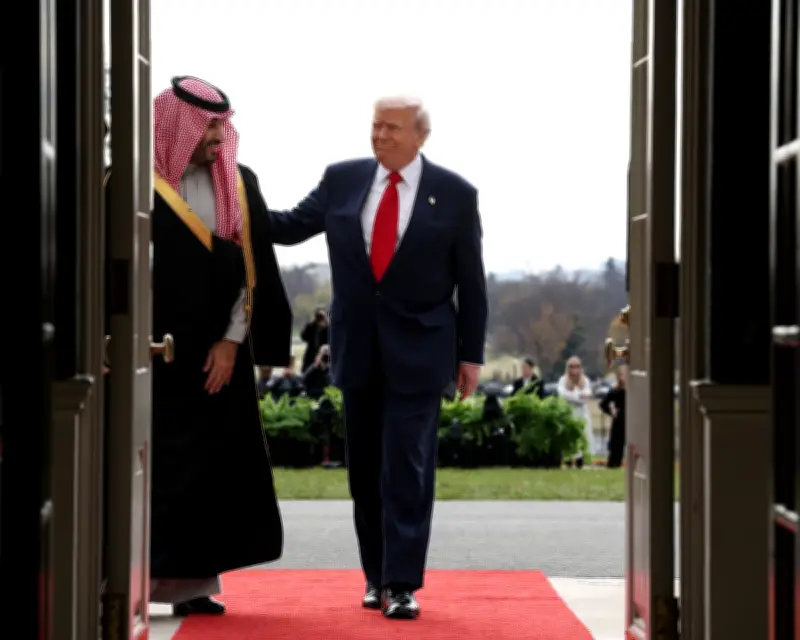
Donald Trump has approved an agreement with Saudi Arabia that could provide the kingdom with uranium enrichment capability for its civilian nuclear programme, according to news reports citing people familiar with the matter. Trump is expected to announce that he will ask Congress to approve the agreement.
The timing of the announcement is controversial as the US’s war with Iran is being fought in part to prevent Tehran enriching uranium domestically and make it near-impossible for Iran to build a nuclear weapon.
Details of the US-Saudi nuclear deal
The US-Saudi deal is expected to last 30 years and involve US firms such as Westinghouse in developing the programme. It could allow for the building of a uranium enrichment facility in Saudi Arabia after a joint US-Saudi study. The proposal has been in discussion for years. At one point the Biden administration wanted to condition Saudi Arabia’s access to the technology on normalising relations with Israel, something Saudi Arabia is still refusing to do.
The plan is expected to be submitted to Congress for review, where it could face opposition among lawmakers who fear a lack of monitoring safeguards to restrict Saudi Arabia’s uranium enrichment. Saudi Arabia has in the past said it would need a nuclear weapon if Iran acquired one, an intention Iran has repeatedly denied. But in lengthy talks stretching over more than one administration, the US also feared that Riyadh would look elsewhere for nuclear technology if the US did not provide what it wanted.
Concerns over monitoring and regional impact
It is likely the agreement will not include the enhanced monitoring by the International Atomic Energy Agency (IAEA) that is found in the so-called additional protocol to which Iran had been subjected under the 2015 nuclear deal. Rosemary Kelanic, the head of the Middle East programme at Defense Priorities, warned in a social media post: “Giving Saudi Arabia uranium enrichment technology is a terrible idea on many counts. But it’s especially idiotic to do it *in the middle of a war over Iran’s nuclear programme*.” She described the decision as reckless and not in the US national interest. “Saudi enrichment would put immense pressure on Iran to get the bomb. Is Trump TRYING to provoke Iran into weaponising?”
Others said it showed the US thought Saudi Arabia had matured into a country that wanted to diversify its energy mix away from oil. The debate about the wisdom of Iran’s stated refusal to acquire nuclear weapons is very live inside Iran, and there will be anger that Tehran’s biggest regional rival is permitted to enrich uranium domestically while Iran is sanctioned for doing so.
Historical context and comparisons
In negotiations in Geneva in February, before the outbreak of the war, the US demanded Iran commit to a 10 to 20-year suspension of any right to enrich domestically. Iran was willing to consider a suspension of three years. Separately, the US had been willing to consider a regional consortium to enrich uranium that would include Saudi Arabia, Iran, the US and the United Arab Emirates.
Saudi Arabia is a member state of the IAEA, a Vienna-based UN agency that promotes peaceful nuclear work but also does inspections to make sure countries do not have clandestine atomic weapons programmes. Congress can review and block nuclear cooperation agreements, also known as “123 agreements”. Enrichment to 90% purity is only one step in the process of acquiring a nuclear weapon.
Saudi Arabia and nuclear-armed Pakistan signed a mutual defence pact after Israel launched an attack on Qatar targeting Hamas officials. Pakistan’s defence minister then said his nation’s nuclear programme “will be made available” to Saudi Arabia if needed, something seen as a warning for Israel, long known as the Middle East’s only nuclear-armed state.
The United Arab Emirates, a neighbour to Saudi Arabia, signed a “123 agreement” with the US to build its Barakah nuclear power plant with South Korean assistance. But the UAE did so without seeking enrichment, something non-proliferation experts have held up as the “gold standard” for countries wanting nuclear power.
US administration's stance and future steps
During Saudi Crown Prince Mohammed bin Salman’s visit to Washington in November, the White House announced a US-Saudi framework for nuclear cooperation that “builds the legal foundation for a decades-long, multi-billion-dollar nuclear energy partnership” between the two countries “in a manner consistent with strong nonproliferation standards”. In a report to Congress earlier this year, the US administration urged support for the US-Saudi nuclear deal, in part to “prevent strategic competition from seizing an opportunity to undermine United States national security interests for decades to come”. The report also argued that the US must seize the opportunity to expand nuclear cooperation to “reestablish our leadership in the global civilian nuclear energy market and reap the benefits of expanded influence in foreign countries hosting our reactors”.