Mothers Demand Justice Outside Stadium as Mexico's Disappeared Crisis Deepens
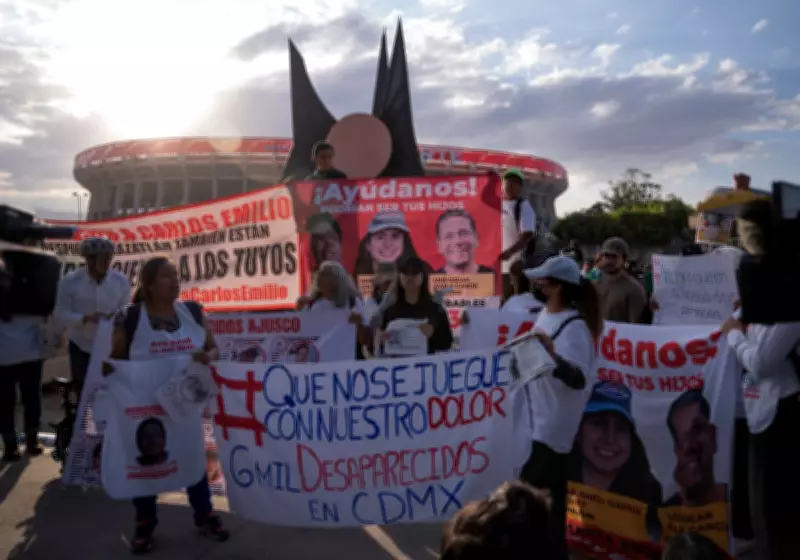
On March 28, a group of determined mothers gathered outside Banorte Stadium in Monterrey before the Mexico versus Portugal football match, holding photographs and placards demanding justice for their missing loved ones. Their silent protest highlighted what has become Mexico's most severe human rights catastrophe, with more than 130,000 individuals having vanished since the government declared war on drug cartels over a decade ago.
Government Report Sparks Outrage Among Families
The recent release of a government report has ignited fury among relatives who have spent years searching scrublands, poking at earth for signs of corpses, and flooding social media with desperate pleas for information. According to the document, approximately one-third of registered missing persons showed signs of life through cross-referencing with state databases like tax filings and vaccination records, while another 36% lacked sufficient data—such as full names or disappearance locations—to enable effective searches.
"What the government is doing is illogical and outrageous," declared María Herrera Magdaleno, a prominent leader in the movement of mothers searching for missing children, whose four sons are among the disappeared. "Instead of looking for our disappeared, they're disappearing them."
Controversial Data Revision Minimizes Crisis, Say Activists
Authorities announced that through database cross-referencing, they located 5,269 missing individuals, but identified 46,742 cases with incomplete records that make searches impossible. Human rights experts and activists argue this revision represents another attempt to downplay the crisis rather than genuinely address it.
"The state is ultimately making the disappeared disappear all over again," stated Armando Vargas, a security analyst at the public policy thinktank México Evalúa. "This recount fails to deliver any form of justice to victims and completely disregards civil society recommendations."
Historical Context of Forced Disappearances
Forced disappearances in Mexico trace back to the 1960s and 70s during the country's dirty war, when government forces detained activists, students, and guerrillas. The practice resurged dramatically in 2006 with the anti-cartel campaign, becoming a tool to sow terror and conceal homicides through mass graves, body burnings, or acid dissolution.
Despite official claims that recent disappearances are "committed by individuals" rather than the state, numerous cases—including the 2014 disappearance of 43 students from a rural teachers' college—have involved state actors. The Centro Prodh human rights group emphasized on social media that "limiting the number of missing persons minimizes the magnitude of a crisis that has a human face."
Families Bear Search Burden Amid Government Inaction
Advocates note the government presented no concrete plan to fill information gaps for the 46,000 cases deemed insufficiently documented, leaving families to undertake dangerous searches independently. Many relatives fear reporting disappearances to local prosecutor's offices due to widespread collusion between authorities and criminal groups.
Anthropologist Rosalva Aída Hernández Castillo, author of an upcoming book on Mexican disappearances, observed: "There is deep mistrust of prosecutors' offices. Significant collusion between these offices and criminal groups is common knowledge." Of the over 43,000 missing persons who couldn't be located through cross-referencing, less than 10% are under criminal investigation.
Political Responses and Ongoing Protests
President Claudia Sheinbaum reaffirmed her administration's commitment to searching for all missing persons, but activists remain skeptical. The data revision has drawn comparisons to previous administration efforts to minimize disappearance statistics before national elections.
As protests continue at stadiums and public squares across Mexico, families maintain that only genuine accountability and comprehensive search efforts—not administrative reclassifications—will address this enduring human rights emergency.