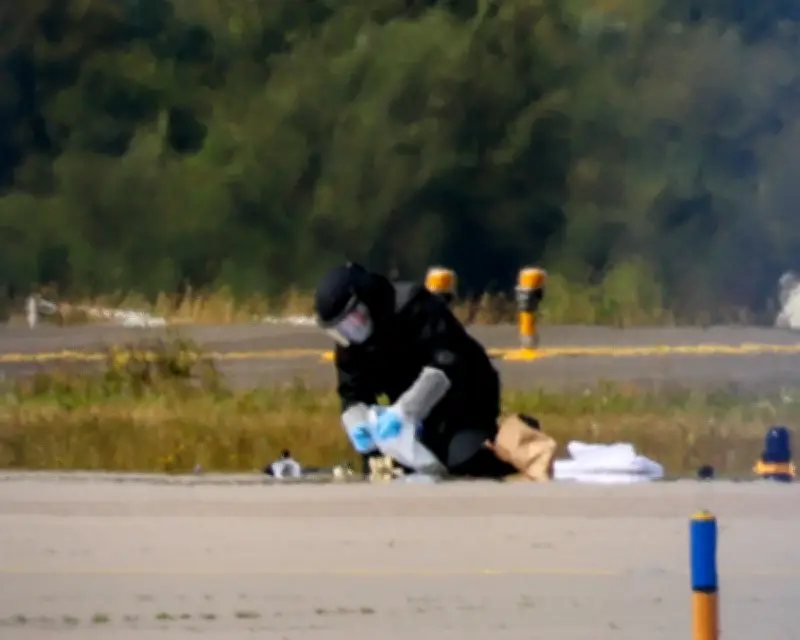
An armed drone discovered at Leipzig airport on Wednesday did not explode, but its presence near Ukrainian cargo planes signals a dangerous escalation in European security threats. Initial evidence strongly suggests Russian involvement, marking the first time an explosive-laden drone has been found in Europe far from the Ukrainian border.
Drone Found Near Ukrainian Aircraft
Photographs published by German newspapers show a quadcopter, a design familiar from the Ukraine war, with a package attached. It lay just a few metres short of a Ukrainian Antonov cargo plane, easily identifiable by its yellow and blue livery. Police from the German state of Saxony confirmed the drone was “carrying an unknown explosive device,” discovered by an employee in the “secure cargo flight operations area” near the airport’s southern runway.
German media reported the attached bomb was made of PETN and semtex plastic explosive—the latter being the same type that exploded aboard Pan Am 103 over Lockerbie. However, the bomb did not explode because the detonator was faulty. The Leipziger Volkszeitung reported that police found as much as 800g of explosive, which, according to Trevor Lawrence, an explosives expert at Cranfield University, would be “enough to do considerable damage” to a plane, especially since “aeroplane bodies are ridiculously thin, often only 3mm aluminium.”
Second Incident and Security Concerns
In the aftermath, a second unidentified flying object, possibly another drone, collided with a DHL cargo plane several hundred metres above the ground. The cargo plane sustained only minor damage. Leipzig airport is a sensitive site: it serves as the European base for Ukrainian Antonov jets used for heavy cargo, is used by Nato and the German military for transport, and is a DHL hub. The presence of Ukrainian planes suggests it may also be a node for supplies to Kyiv.
Nato said it was aware of the incident but did not comment further. The fact that drones could fly into and over a strategic airport without being prevented raises significant security questions.
Pattern of Russian Operations
This is not the first dangerous incident at Leipzig airport. In July 2024, a firebomb sent via DHL exploded there, and a second travelled to the UK, catching fire at a warehouse in Birmingham. Two similar packages were found in Poland. A subsequent pan-European investigation identified 22 suspects in Lithuania and Poland suspected of being employed by Russian intelligence. The perpetrators were recruited online, given instructions, and often paid in cryptocurrency, with limited knowledge of the full plot.
Russia has also been behind a series of drone incursions into Europe over the past year. Around 20 unarmed Russian delta-wing Gerbera drones crossed into Poland last September, triggering a major alert, with residents in two eastern provinces told to shelter indoors. An analysis by the International Institute for Strategic Studies (IISS) concluded last month that the Kremlin was behind a drone surveillance campaign targeting the US airbase at RAF Lakenheath and other key military sites in France, Belgium, and the Netherlands.
In these cases, Nato jets struggled to shoot down the drones, and western militaries failed to capture any or respond promptly. Russia has conducted firebomb operations and drone harassment with relative impunity, likely believing the west has little more to impose in sanctions beyond those already in place since the invasion of Ukraine.
Expert Assessment
“A drone carrying a charge with a detonator that failed is a different proposition to what we have seen before,” said Charlie Edwards, a senior fellow at the IISS, adding ominously: “It is likely, though not yet certain, that this was intended to function rather than to be found.”