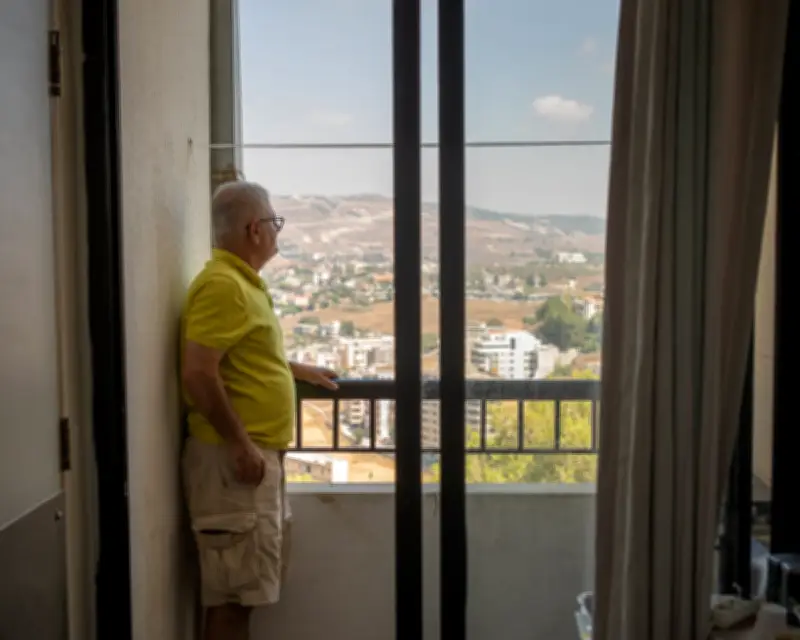
At least 135 healthcare workers in Lebanon have been killed by Israeli bombardment since March 2, according to the Lebanese health ministry. Many died in so-called double-tap strikes. Israel claims ambulances were used to transport weapons for Hezbollah, but human rights groups like Amnesty International say this is not supported by evidence.
Surgeon trapped in hospital
Dr Moustapha Hamze, a 66-year-old surgeon at the Nabih Berri governmental hospital in Nabatieh, has been living in a hospital room since March. He can see his house in the village of Kfar Roummane from the hospital balcony, but cannot return. The last time he tried, an Israeli drone dropped a stun grenade and then launched a bomb about 10 meters away. He escaped with his life.
“I have a room here, but I no longer have any clothes. The last time I went home, I took my clothes with me. I didn’t realise that I might not be able to return to the house,” Hamze said. He shut his private clinic and volunteered at the public hospital when Hezbollah fired rockets on March 2, triggering an Israeli invasion and war. He spent nearly five months in the hospital, with only four days of rest since a June ceasefire.
Direct targeting of medics
Hamze said the latest conflict is the most intense he has experienced. “The Israeli bombardment was worse. I saw greater injustice and bodies in unnatural, horrifying conditions. When they burned people alive in Nabatieh, the sight was terrifying.” For the first time, he felt he and his colleagues were targeted. “I would see paramedics leave in an ambulance and return dead. That was psychologically very difficult,” he said.
He described a paramedic he knew, Mahdi Abu Zeid, who was killed by Israeli forces. “He was a polite, decent young man. What upset me was that I had to come to know him. Sometimes, I wish I had not known him, because then his death might have hurt less.”
Paramedic chief loses son
Mohammed Suleiman, chief paramedic for Nabatieh emergency services, has worked through three wars. He said that in previous conflicts, paramedics were not directly targeted. “But in this war, no – they targeted us directly,” said Suleiman, 44. Three paramedics were killed directly by Israeli airstrikes. One was Joud, Suleiman’s 16-year-old son, killed in March with his colleague Ali while bringing food to people in Nabatieh. A drone struck them despite their paramedic uniforms.
Suleiman dispatches ambulances and now hesitates before sending teams. “Before the attacks, I would dispatch the teams without hesitation. But after these incidents, I would make a hundred calculations before sending out a vehicle.” He said he constantly resists radioing paramedics to check on them, knowing it would distract them. “When you are at the centre, away from the crews, you are more stressed than the people who are actually on the ground.”
Random targeting and continued bombing
Paramedic Hassan Boussi, assistant director of the Islamic Health Society for Tyre, said the random nature of Israeli targeting was stressful. After trying to understand why colleagues died, he gave up. “There are many justifications offered by the Israelis, but the reality is one: they did not want ambulance and rescue teams to operate,” Boussi said.
Despite a ceasefire in June, bombing continues in Lebanon, albeit at a slower rate, centered on Nabatieh. An ambulance was struck by an Israeli drone in the village of Nabatieh al-Fawqa on June 30, 2024.