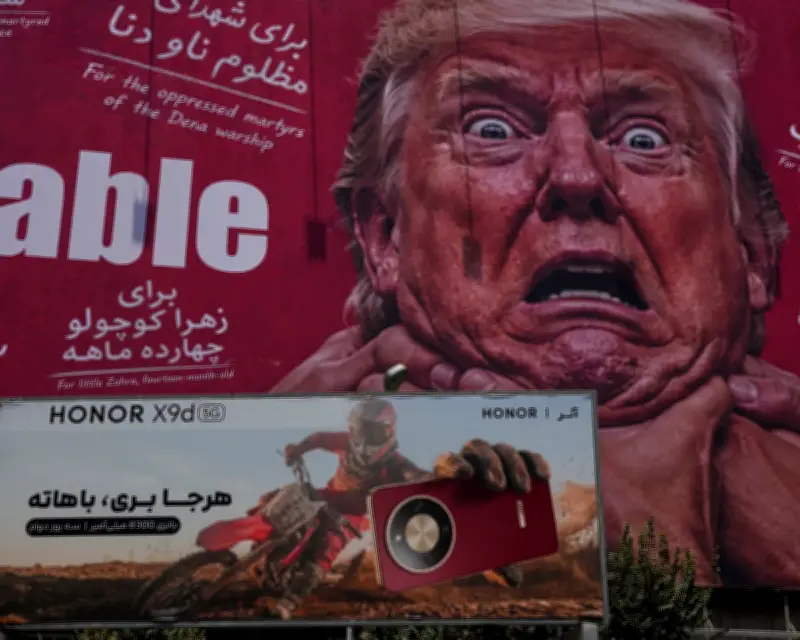
The US has paused its 13-night summer bombing campaign against Iran, a tacit admission that military power alone cannot achieve Washington's stated objectives. Iran, despite suffering an estimated 3,500 casualties and $150bn-$270bn in damage, has maintained enough missile and drone capability to threaten merchant shipping in the Strait of Hormuz, a key chokepoint for global oil traffic.
Asymmetric Conflict Flips the Tables
According to HA Hellyer, a Middle East expert at the Royal United Services Institute, "Iran's initial standard for victory was simply to survive. If anything, that's been raised. The regime has demonstrated it is not going anywhere, and Tehran has changed the calculus on the Strait of Hormuz." Iran's extensive mountainous geography and dispersed military assets have allowed it to absorb the US bombing campaign without capitulating.
Two tankers were attacked last week north of Oman, one catching fire in the engine room and requiring evacuation before being towed to safety. These attacks are part of a series of serious incidents during the July escalation.
US Munitions Depleted at Alarming Rate
The US has spent at least $38bn and used over 1,000 Tomahawk cruise missiles (costing up to $3.6m each) and 1,100 JASSM cruise missiles ($2.6m each), according to estimates by the CSIS thinktank. This represents a third and a quarter of total stockpiles, respectively, with Tomahawks not expected to be fully replaced until 2031. Patriot missile interceptors have been depleted by about 1,000 units, or 50% of the US stockpile, raising concerns about the ability to defend Gulf bases.
President Trump partly blamed Ukraine, claiming "so much was given" to Kyiv, but Ukraine never received long-range cruise missiles, only Patriot air defense systems. The US used more Patriot interceptors during 38 days of spring fighting than Ukraine received in four years of war (roughly 600).
Houthi Escalation Complicates Picture
Iran's Yemeni allies, the Houthis, have stepped up attacks in the Red Sea, targeting a refinery in the Saudi city of Jizan on Saturday. Saudi Arabia is seeking to redirect oil traffic through the Red Sea, but the Houthi attacks complicate that strategy.
US Maximalist Goals Unenforceable Without Ground War
The US's stated war aims have shifted but remained maximalist: regime change (demonstrated by the killing of Ali Khamenei), destroying Iran's entire missile program, or preventing Iran from obtaining a nuclear weapon. However, enforcing such demands would require ground forces to occupy Tehran, an option the US has not prepared for and appears unwilling to pursue. Trump previously threatened to bomb Iranian power plants to force capitulation, but dropped those threats in April and again last week amid concerns they would amount to war crimes.
Peter Ricketts, a former UK national security adviser, stated: "I don't think the Iranians can be bombed into accepting US terms. Until the US accepts it can't get its way by bombing, Iran has effective leverage. Tehran can absorb the pain, and they know they can close the strait with the economic impact it has on the US."
Escalation Dominance Favors Iran
Ricketts describes the situation as "escalation dominance" favoring Iran. Tehran can string out peace negotiations, wait for the White House to restart bombing, then close the Strait of Hormuz until the US stops due to high oil prices. With US midterm elections in November and only a third of Americans supporting the war (71% of Republicans, per a Reuters/Ipsos survey), Iran may believe it has leverage.
Laurel Rapp of Chatham House suggested that "a resumed ceasefire and promise of future talks is the least bad option for Washington." However, Israeli Prime Minister Benjamin Netanyahu, facing his own election in October, may resist such a move.
Iran's Long-Term Sustainability Questioned
While Iran may have short- to medium-term leverage, Hellyer argues that any notion of victory is exaggerated: "Ultimately this isn't sustainable for Iran, because its economy isn't going to be able to survive." Iran remains under heavy Western sanctions and cannot afford to rebuild without a deal with the US.