
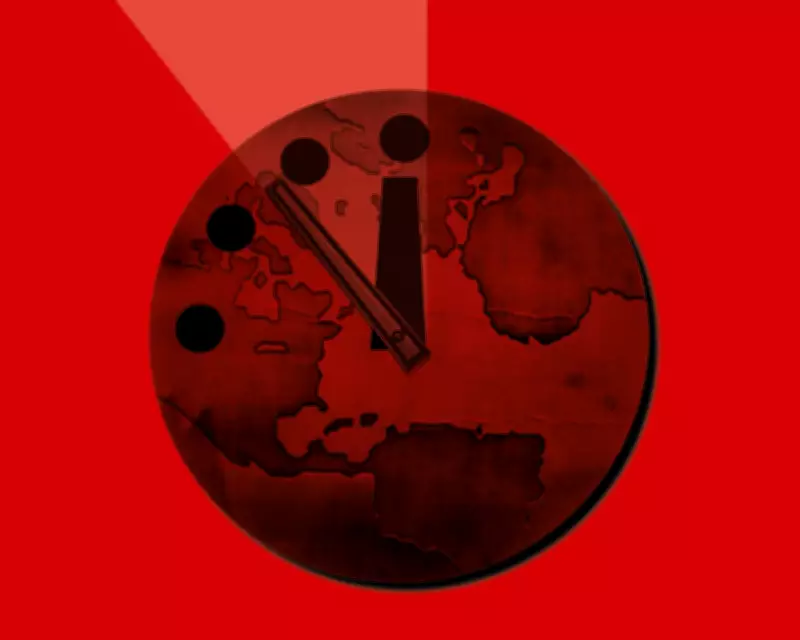
The Doomsday Clock, a symbolic timepiece representing humanity's proximity to global catastrophe, now stands at 85 seconds to midnight, the closest it has ever been. Experts warn that the convergence of nuclear threats, climate breakdown, artificial intelligence risks, and other emerging dangers has pushed the world to the brink.
The Clock's Origins and Purpose
Established in 1947 by Manhattan Project scientists, the Doomsday Clock was designed to alert the public and policymakers to the dangers of nuclear weapons. The clock is set annually by the Bulletin of the Atomic Scientists' Science and Security Board, a group of leading scientists, academics, and diplomats. While it is a symbol rather than a precise scientific measurement, it distills complex existential threats into an easily understood format.
Alexandra Bell, CEO of the Bulletin, describes the current situation as a "slow sleepwalk into increasing dangers over the last decade." She points to a "complete failure in leadership" globally, as threats like climate change and AI integration into nuclear decision-making compound one another.
Historical Milestones
The clock's time has fluctuated in response to global events. In 1947, it was set at seven minutes to midnight. After the Soviet Union's first nuclear test in 1949, it moved to three minutes. The farthest from midnight was 17 minutes in 1991, following the end of the Cold War. Since 2020, the clock has been measured in seconds, reflecting the heightened urgency.
In January 2025, the clock was set to 85 seconds to midnight, citing insufficient arms control, lack of climate action, misinformation, and AI threats. Within weeks, experts argued that the situation had already worsened due to political decisions and military conflicts.
Key Threats Identified
The Bulletin considers multiple human-made threats when setting the clock. Nuclear war remains the primary concern, with conflicts in Ukraine and the Middle East increasing the risk of escalation. Climate change exacerbates global instability, while AI's unpredictability and potential for misuse add new layers of danger. Additionally, advances in biotechnology could lead to accidental or intentional pandemics.
Daniel Holz, chair of the Science and Security Board, notes that the board's discussions often reveal that experts fear unknown dangers more than their own fields. "Whatever your expertise is, you think someone else's is scarier, because it's always scarier when it's unknown," he says.
The Role of Public Action
Despite the grim outlook, those involved in setting the clock express cautious optimism. Historical precedents, such as the reduction of nuclear arsenals from 70,000 to around 10,000 weapons, demonstrate that progress is possible. Bell emphasizes that public pressure can influence political leaders. "Elected leaders care about what their constituents call them about," she says, urging citizens to engage with these issues.
Kennette Benedict, former executive director of the Bulletin, believes that awareness is the first step toward action. She teaches a course on nuclear policy and requires students to read John Hersey's Hiroshima, telling them, "The truth shall set you free. But first, it's going to make you miserable."
Looking Ahead
The Doomsday Clock serves as a wake-up call, but its effectiveness depends on how it is interpreted. Holz considers the psychology of the clock's symbolism, aiming to motivate without inducing paralysis. "If people feel powerless and petrified, then we're making things worse," he says.
Dieter Gruen, a 103-year-old Manhattan Project veteran, offers a unique perspective. Having lived through multiple crises, he finds the current situation more alarming than the Cuban Missile Crisis. When asked about the public's tendency to ignore existential risks, he simply states, "That's not rational."
The Bulletin's message remains clear: humanity has the power to turn back the clock through collective action and informed decision-making. As Bell puts it, "If we get the nuclear problem wrong, nothing else matters."




