
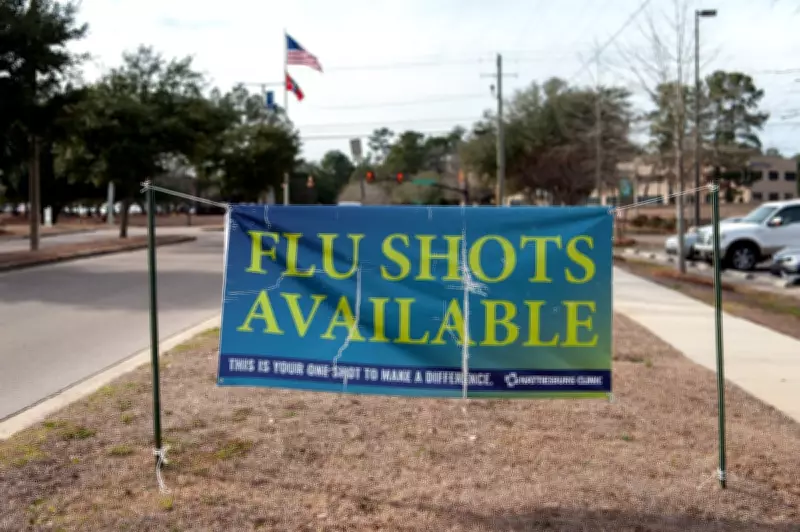
A banner encouraging flu vaccines remains outside the Hattiesburg Clinic in Hattiesburg, Mississippi, on 10 February 2026. Republican mistrust in the healthcare system is widening health disparities between liberals and conservatives, according to a new study published in Nature Human Behaviour.
Study Reveals Two Phases of Widening Health Gap
Neil O’Brian, a political science professor at the University of North Carolina, Chapel Hill and co-author of the study, explained that researchers observed two distinct phases. The first phase began in the 2010s, driven by education polarization. Individuals without a college degree shifted to the right, while those with a college degree moved left. Since education is a strong predictor of health outcomes, this political sorting initially explained the growing gap.
The second phase emerged during the Covid-19 pandemic, when social determinants like education could no longer account for the expanding disparity. O’Brian noted a puzzling trend: people on the right were less likely to trust, engage with, or use medicines to treat chronic illness compared to those on the left.
Vaccine Hesitancy and Broader Medical Distrust
Past research indicated that Republicans' hesitation to vaccinate against Covid-19 led to higher death rates during the pandemic. However, O’Brian’s study suggests that even vaccination rates do not fully explain the health gap; a general lack of trust in the medical system plays a significant role. The study relies on survey data from 2024, and O’Brian suspects the gap has worsened during the second Trump administration, which began in January 2025.
Jay Van Bavel, a professor of psychology and neuroscience at New York University, agreed that the dynamics from the pandemic are continuing and expanding. He pointed to the appointment of Robert F. Kennedy Jr. to oversee health decisions as a factor entrenching anti-vaccination attitudes in national policy. During the pandemic, anti-vaccine rhetoric focused on Covid vaccines, but now it has broadened to include long-established vaccines for diseases like measles. This hesitation is reflected in policy, as more red states and Kennedy himself attempt to strike down vaccine mandates.
Populism Undermines Health Authority
Van Bavel noted a paradox: Kennedy, despite holding high health authority, continues to claim that the government lies about health. This anti-elite, anti-authority populism is strong on the right and part of the Trump administration's identity, yet it undercuts their own authority. Followers often perform what Van Bavel calls “mental gymnastics,” resisting vaccines due to fear of unknown chemicals while seeking unproven treatments like ivermectin.
Beyond Vaccines: Avoiding Doctors for Chronic Conditions
O’Brian’s research shows that conservatives avoid doctors for reasons beyond vaccines. For example, individuals on the right have higher rates of hypertension but are less likely to visit a doctor, trust medical advice, or believe that hypertension medications are safe and effective. Cardiovascular disease is the leading cause of death in the US, and untreated hypertension poses serious risks for both individuals and public health.
Van Bavel added that Republicans are more likely to suffer from long Covid due to lower vaccination rates, but they are also less likely to identify or seek treatment for it. As the health gap grows, O’Brian emphasizes the need for medical researchers to track political beliefs consistently. Large health surveys rarely include political questions; the National Longitudinal Study of Adolescent to Adult Health is a rare exception. O’Brian called for more studies to monitor this trend.




