Cape Town's Gang Violence: Communities Fight Back with Hope and Resilience
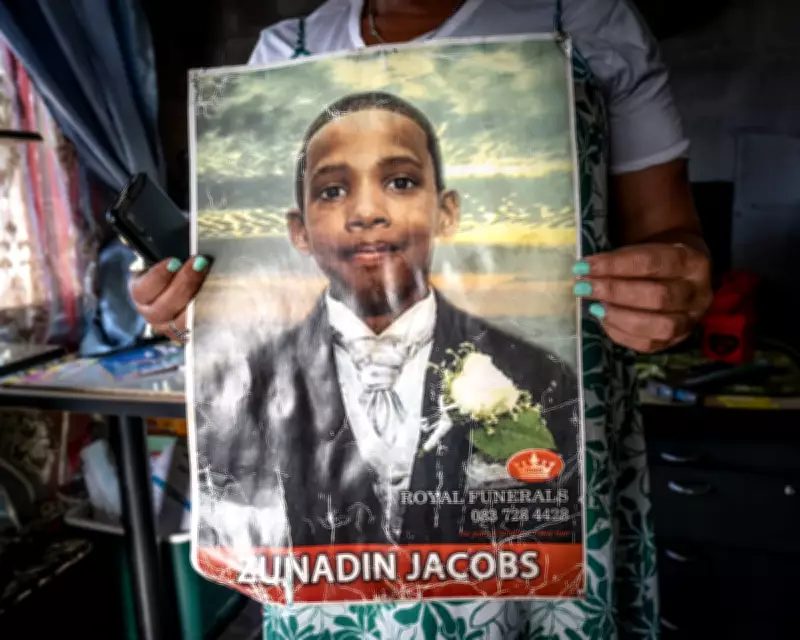
Lindy Jacobs clutches a photograph of her son Zunadin, who was tragically killed in a gang-related shooting at just 15 years old. In the Cape Flats townships of South Africa, volunteers are tirelessly working to carve out safe havens through initiatives like football training and dance classes, offering a glimmer of hope amidst pervasive violence.
A Mother's Heartbreak and Determination
In 2015, Deniël de Bruyn relocated nearly 300 miles to Cape Town to live with relatives and combat a drug addiction. Tragically, nine months later, he was shot dead in what gangsters in the Wesbank township claimed was a case of mistaken identity, according to his cousin Lindy Jacobs. The shooting was witnessed by Jacobs's 12-year-old son Zunadin, whose life was irrevocably altered. "My son's life was never, never ever the same again," Jacobs recounted. In 2018, gangsters attempted to kill Zunadin, prompting Jacobs to report the incident to the police. However, just two months later, her son was also murdered. Jacobs now raises her 12-year-old grandson Noah, whose father fell victim to gang violence as well.
The Cape Flats townships, where Black, Coloured, and Indian South Africans were forcibly relocated by the apartheid regime in the 1960s and 70s, are rife with similar stories of families torn apart by gangs. Despite this, many residents remain steadfastly committed to their communities. After the alleged killer of her son was himself killed by a rival gang, Jacobs refused to celebrate, reflecting, "I said to myself, 'He is also somebody's child.'" Instead, she channels her energy into running home gardening workshops and football training for children, leading the local chapter of Balls Not Guns. This collective of Cape Flats women's volunteer groups promotes sports participation to steer youth away from violence. "I always remember light, light, light in this darkness," Jacobs emphasized. "Because if there's nobody that is trying to light, what is going to happen with our youth?"

Escalating Violence and Government Response
Last year, police data recorded over 1,037 gang-related murders in the wider Western Cape province, marking a 16% increase from 2024. The splintering of gangs has intensified turf wars over territories where drugs are sold and businesses extorted, often trapping innocent civilians in the crossfire. This surge in violence prompted South African President Cyril Ramaphosa to announce in his annual state of the nation address on February 12 that the military would be deployed to combat gangs. However, many community members express skepticism, noting that when the army was sent into the Cape Flats in 2019, gangsters merely lay low before resurfacing. "They're going to instil fear, it's going to happen for a short while ... and then what?" questioned Gloria Veale, an activist who runs Balls Not Guns.
Acting Police Minister Firoz Cachalia acknowledged these concerns in an interview, stating, "Those concerns are legitimate ... I do think that, in the circumstances, in order to save lives and restore some calm, this action was necessary." He clarified that the army would support the police rather than carry out policing themselves, adding, "This is not a magic bullet ... What these communities need ... is development."
Root Causes and Community Challenges
Gangs proliferated in Cape Town during apartheid, when the forced removal of approximately 150,000 people from designated "white areas" to the Cape Flats disrupted families and communities. Ben de Vos, a criminologist running an NGO in Mitchells Plain, highlighted the underlying issues: "The spatial inequalities, the congested communities, the unemployment, which is sky-high. The drug economy gives an alternative economy." South Africa's unemployment rate exceeds 40%, and while the Western Cape has lower unemployment than the national average, non-white South Africans, who constitute the majority of township populations, face the highest joblessness.

Local experts also raised alarms about the growing recruitment of children by gangs, including those left without state support after being excluded from schools. "The whole of government has failed to come up with a youth intervention strategy," said Martin Makasi, chair of the Nyanga community police forum. Irvin Kinnes, an associate professor in criminology at the University of Cape Town, pointed to a "huge lack of trust [in police]" and noted that corruption, from ground-level officers to top government officials, fuels gang crime. "The violence on the Cape Flats is a symptom of the bigger problem of corruption, in a system of accumulation that's not working for people," he explained.
Grassroots Efforts and Safe Spaces
In every township, volunteers are creating safe spaces to counteract the violence. In Hanover Park, people lined up outside a community centre to receive handouts—peanut butter, mouthwash, and deodorant—from the charity CeaseFire. Inside, Craven Engel, who runs the anti-gang organisation, expressed concern over recent gang splits that birthed new groups like the Ghetto Kids, Only the Family, and the Young Gifted Boys. CeaseFire employs former gangsters to mediate conflicts and support individuals seeking to leave gang life.
Dalton (a pseudonym), a 24-year-old gang member, recently sought help from CeaseFire after his younger brother was shot dead by a rival gang. He joined his first gang at 17, driven by the shooting of his father when he was just five months old. Now, with his brother's killers hunting him, Dalton wants out. "Before he died, his word was he don't want to lose me, because I'm the oldest," Dalton shared. "The reason why he was in this gang was because of me. He was just 20 years old." Glenn Hans, a CeaseFire outreach officer, promised to assist Dalton in building a new life, expressing optimism: "There's gates up, out of the gang. You can go up. So he wants to move up in life."
In Manenberg, the local Balls Not Guns chapter provides weekly lunches for pensioners and a chance to decompress, followed by football sessions for a grandmothers' team. Deidre Richards, 55, a chapter leader, admitted to sometimes feeling like giving up but perseveres due to her passion. "But then again, if it's your passion, you will just get up and try something or somebody else," she said. Nearby, professional dancer Darion Thorne runs dance classes for children every Saturday and fortnightly film screenings. "There are things that exist that are negative, but in the same way, things can exist that are positive," Thorne remarked, even as gunshots echoed outside his home. He acknowledged being in "constant awareness of danger" but remains dedicated to creating safe, positive environments for youth.
Through these grassroots efforts, communities in Cape Town's townships demonstrate resilience and hope, fighting back against gang violence with compassion and determination.