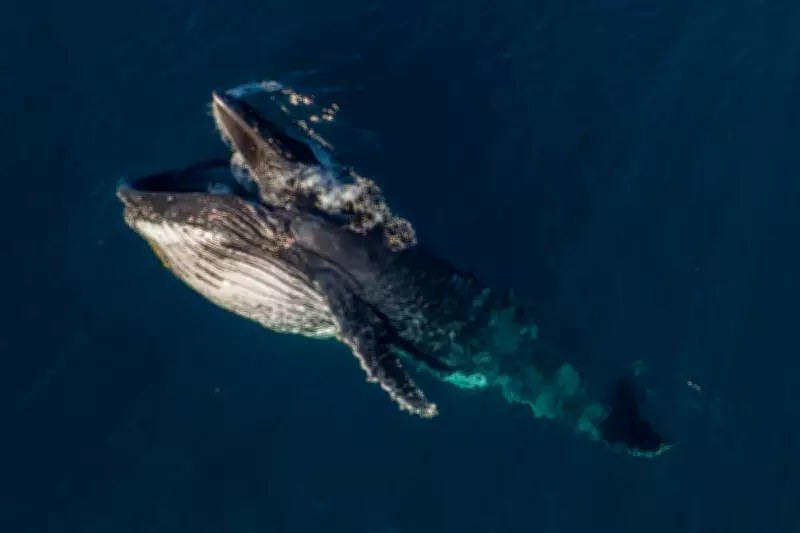
On the coast of Western Australia, a humpback whale is performing a pirouette, sweeping its pectoral fins through the water while its massive jaw hangs wide open. This underwater ballet, captured on camera by an onlooker and shared online, is one of the clearest examples of a rarely documented phenomenon known as 'gaping.'
Whale watching tours and citizen scientists are proving to be a significant source of data for researchers, capturing rare behaviors such as this. A new study from Macquarie University, published just in time for the annual humpback migration, analyzed social media footage of 66 humpbacks, including the pirouetting whale from Western Australia. The researchers believe that jaw-gaping could be a social display.
Citizen Science Reveals Mysterious Behavior
Dr. Vanessa Pirotta, a renowned Australian whale scientist and co-author of the paper, emphasized the value of citizen contributions. 'Just when we think we know a lot about humpback whales, we don't,' she said. 'Tourism operators and citizen scientists spend hours observing whales and are a powerful resource for capturing and reporting on behavior.'
The researchers have termed the behavior 'gaping' and suggest it could be play, social signaling, interacting with debris, or calves stretching their jaws before feeding. 'It was so unusual to see this happen,' Pirotta added, 'and when I heard the commentary of people watching it, I knew it was rare.'
Distinct from Feeding Lunges
Veteran humpback researcher Dr. Olaf Meynecke, currently surveying marine life off South Australia, explained that baleen whales typically open their jaws wide when feeding. 'Concentrated prey, either fish or krill on the surface, is being taken in by the whale coming from the depth and lunging out with a wide open mouth,' he said. However, gaping lacks the acceleration, prey capture, and dramatic throat expansion of a feeding lunge. The mouth hangs open, sometimes above water, sometimes below.
Katie Trepess, managing director of Whale Tales Whale Watching in Sydney, noted that observing this behavior on the east coast is particularly special. 'Humpback whales are generally not feeding during the four to six months of the migration into warmer waters when they are traveling and breeding; instead they are relying on fat reserves,' she said.
The Great Migration and Its Challenges
As autumn chills Australia's east coast, the ocean transforms into a bustling humpback highway. May marks the mammals' annual migration from Antarctic waters to the warmer breeding grounds of Queensland and northern New South Wales, heralding the start of whale-watching season. The 2026 season has already been demanding for whale rescue crews, with 19 strandings and 28 entanglements across NSW in 2025, and a 93% spike in March hotline calls for the Organisation for the Rescue and Research of Cetaceans in Australia (Orrca).
'This is one of nature's great migrations, but it's also one of its most vulnerable,' said Orrca's president, Ashley Ryan. 'We're already seeing increased whale activity along our coastline and that means increased risk.'
Funding Gaps and Citizen Science
Meynecke highlighted that a lack of funding means citizen scientists are now the 'main drivers' tracking whales in Australia. With whales forced to rapidly adapt to climate change, melting sea ice, pollution, and overfishing, continuous monitoring is crucial to their survival. Ahead of Orrca's annual whale census on 28 June, authorities are reminding the public to keep their distance. All vessels, surfboards, and drones must stay 100 meters from whales, extending to 300 meters for jetskis or when calves are present.
'Simple actions make a huge difference,' Ryan said. 'Keeping your distance helps ensure these animals can continue their journey safely.'
Where to Watch the Migration
For those hoping to catch a glimpse of the migration, NSW National Parks and Wildlife Service has highlighted dozens of land-based vantage points along the coast. In Sydney and its surrounds, prime spotting locations include Cape Solander in Kamay Botany Bay National Park, Barrenjoey Lighthouse in Ku-ring-gai Chase National Park, and the North Head and South Head trails in Sydney Harbour National Park. Locals also recommend walking tracks along beaches at Sydney's Royal National Park.
Onlookers can also head to Cape Byron Lighthouse in the state's north, the Yuraygir coastal walk near Coffs Harbour, the Cape Hawke lookout in Booti Booti National Park, and the Tomaree Head Summit walk in Port Stephens. Down south, spectacular views from Seven Mile Beach in Jervis Bay, Montague Island near Batemans Bay, and the Green Cape lookout in Eden offer phenomenal viewing opportunities.
To capture a whale's rare 'gape,' a local boat tour might offer the closest view. 'It's lovely to spot whales from the coastline, but being out on the water with them is really the only way to properly experience whales and get a feel for their beauty and size,' Trepess said. 'Humpback whales are naturally quite playful and inquisitive... we see young whales jumping and splashing around and learning how to breach and head lunge.'