Groundbreaking Discovery at CERN: Heavier Proton Variant Uncovered
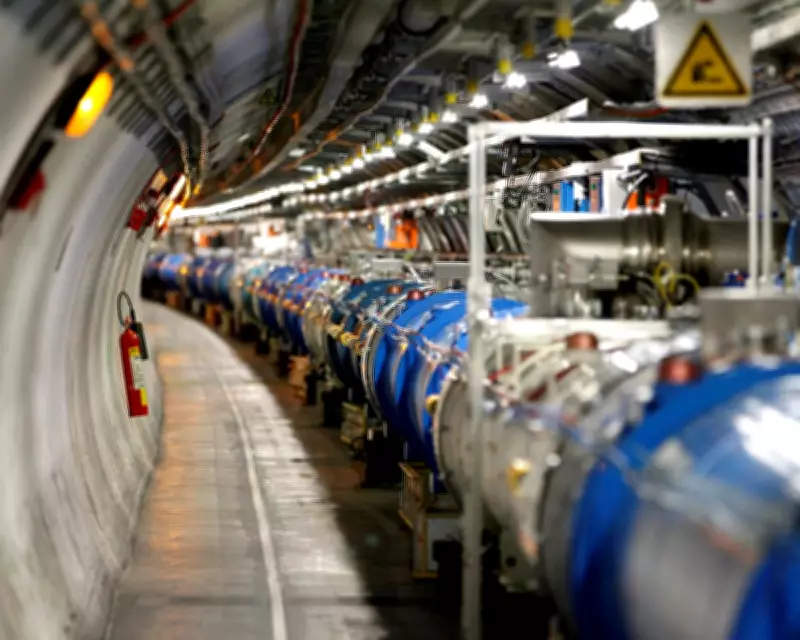
In a significant advancement for particle physics, scientists at the CERN nuclear physics laboratory near Geneva have detected a heavier version of the proton, a fundamental subatomic particle central to all atoms in the universe. This newfound particle, designated Xi-cc-plus, was observed using an enhanced detector at the Large Hadron Collider (LHC), the world's largest scientific instrument buried deep underground at CERN.
Enhanced Detection Leads to Rapid Discovery
The Xi-cc-plus particle was identified in a debris shower generated by proton collisions at near-light speeds within the LHC. These high-energy collisions simulate conditions akin to those just after the Big Bang, producing particles that scatter in all directions. The upgraded LHCb detector, which has been made more powerful, enabled physicists to spot this particle after only one year of data collection, a feat not possible with the original detector over a decade.
Professor Tim Gershon from the University of Warwick, who will assume the role of LHCb international lead in July, emphasized the importance of this upgrade. He stated, "This is just the first of many expected insights that can be gained with the new LHCb detector. The improved detection capability allowed us to find the particle after only one year, while we could not see it in a decade of data collected with the original LHCb."

Understanding the Strong Nuclear Force
The Xi-cc-plus particle is approximately four times heavier than a standard proton and features a unique quark composition. While a regular proton consists of two up quarks and one down quark, this heavier variant replaces both up quarks with charm quarks. This configuration provides valuable insights into the strong nuclear force, which binds atomic nuclei together and behaves like a rubber band, strengthening with distance.
Professor Chris Parkes, a physicist at the University of Manchester, highlighted the broader implications, noting, "The more we learn about these particles, the more we can learn about the strong force, and that is the same strong force that binds our protons and neutrons together." The particle decays rapidly, surviving for less than a millionth of a millionth of a second, making its detection a remarkable achievement.
Funding Challenges Threaten Future Research
This discovery comes at a critical time, as UK Research and Innovation (UKRI), the nation's primary science funder, faces intense criticism for plans to withdraw £50 million in funding for the final upgrade of the LHCb detector in the 2030s. This upgrade is essential to maximize the detector's potential during a major transformation of the LHC, which could significantly enhance its discovery capabilities.
Recent budget cuts have impacted various projects, including the LHCb upgrade and an electron-ion collider developed in collaboration with US researchers. Chi Onwurah, chair of the Commons science committee, has condemned these cuts as "wholly unacceptable" and "a failure" by UKRI and related bodies, calling for swift action to address the funding shortfall.
Professor Gershon expressed concern over the funding issues, stating, "It is so important that we can overcome the problems caused by the UKRI decision to deprioritise the funding for this project. No other experiment either running or planned will be able to do this physics." The scientific community continues to advocate for sustained investment to maintain progress in particle physics research.