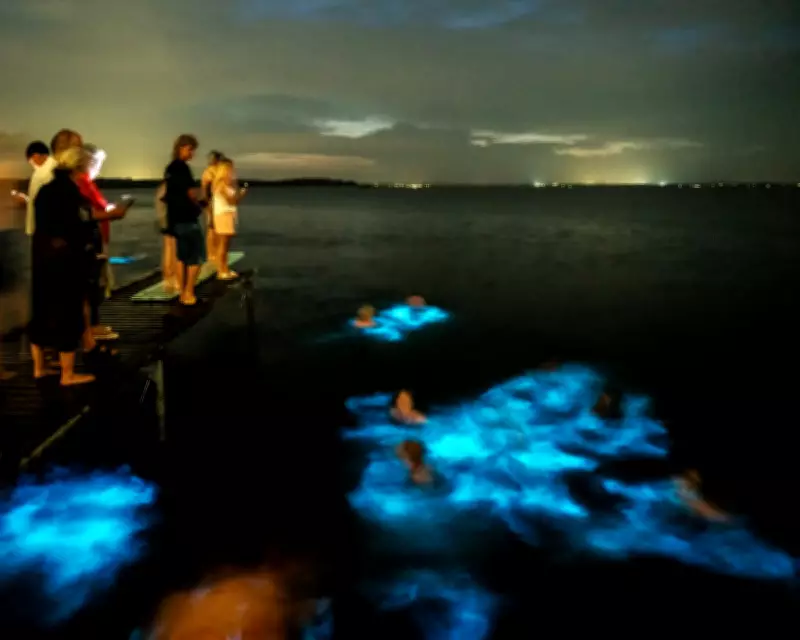
Scientists in the United States have successfully harnessed the captivating blue glow emitted by a sea-dwelling species of algae to create light-emitting structures using 3D printing technology. The research, published in the journal Science Advances, demonstrates a novel method to induce sustained bioluminescence in the single-celled organism Pyrocystis lunula.
From Mechanical Stress to Acidic Induction
Initial attempts by researchers at the University of Colorado Boulder involved replicating the mechanical stress of ocean waves to stimulate the algae's natural light production. However, this approach proved difficult to control. Inspired by previous studies, the team led by Giulia Brachi turned to an acidic solution to trigger a biochemical reaction within the algae's cells. When a slightly acidic solution was added to a flask containing the algae, the pH level dropped, causing the organisms to emit a sustained blue glow for up to 25 minutes.
3D Printing with Living Glitter
The researchers encapsulated the algae within a hydrogel, a jelly-like substance composed primarily of water, and used a 3D printer to create various shapes, including a crescent moon inspired by the algae's microscopic appearance. All printed structures glowed a vibrant cyan blue. The bioluminescence results from the interaction between an enzyme called luciferase and a light-producing compound known as luciferin, both naturally present in the algae.
Potential Applications
Professor Wil Srubar, co-author of the study, suggested that this "living light" could be used in glowsticks or glowing bracelets at events. More significantly, the algae could be integrated into biosensors that emit light upon detecting environmental toxins, offering a sustainable alternative to disposable batteries in small light-emitting devices. Professor Chris Howe of the University of Cambridge noted that while transitioning from lab conditions to real-world applications poses challenges, this research represents an exciting first step.
Challenges and Skepticism
Professor Anthony Campbell of the University of Cardiff expressed skepticism about the algae's long-term survival in the acidic solution (pH 4), comparing it to the acidity of a tomato and noting that such conditions stress the organisms. The study also leaves a lingering mystery: why did Pyrocystis lunula evolve bioluminescence? One prevailing theory suggests it serves as a defense mechanism to deter predators, though this remains unconfirmed.