Doctor Confronts Public Health Crisis at US-Mexico Border, Citing Political Decisions
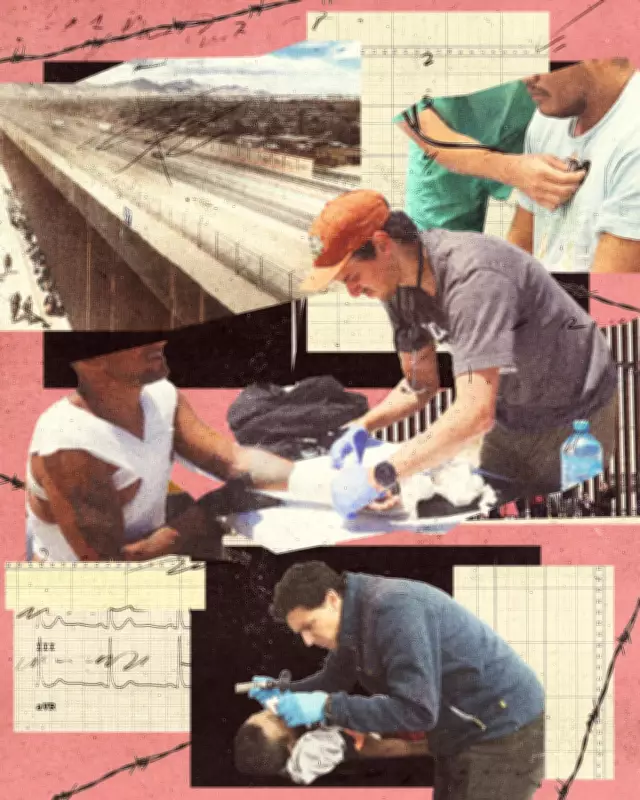
In late spring 2024, Dr. Brian Elmore operated a mobile clinic in Ciudad Juárez, just south of the US-Mexico border wall, treating migrants with severe injuries. One patient, a Venezuelan man, had a fractured arm and a detached left chest from his sternum and clavicle, injuries he attributed to Mexican immigration officials and rubber bullets fired by Texas national guardsmen. The man had fashioned a makeshift splint, but his chest required surgery. When an ambulance arrived, a criminal group controlling the area refused to let him leave, while Texas guardsmen watched from the US side. "It was heartbreaking," Elmore recalled of the scene.
A Disparity in Care and the Birth of Advocacy
Two years earlier, Elmore began his medical residency in El Paso, Texas, at the region's only level 1 trauma center. Located in the Chihuahuan desert with the Rio Grande marking the border, El Paso has long been a gateway for migrants from Latin America and beyond. At the hospital, Elmore witnessed all manner of injuries, with emergency care available to anyone. However, just a few blocks away in Juárez, displaced migrants and refugees had limited or no access to medical services. This disparity struck him as unnecessary and cruel.
After initial efforts to organize health services in fall 2022, Elmore co-founded the Hope Border Institute to address medical needs in Juárez. By then, trauma doctors had already labeled the surge in severe injuries a public health crisis. Migrants were falling from the border wall, fracturing legs, severing spines, and suffering brain damage. Others drowned in Rio Grande canals, sustained deep lacerations from razor wire, or suffered dehydration and heat exhaustion in the desert. From early 2023 to August 2024, El Paso became the deadliest section of the world's deadliest land migration route.

The Policy of Deterrence and Its Consequences
Medical research identified enforcement barriers as the cause of injuries and deaths, with trauma doctors highlighting the US border policy of deterrence. First deployed under President Bill Clinton with Operation Hold the Line, this policy funnels migrants into inhospitable environments to discourage crossings. Under President Donald Trump, promises to expand the border wall and other escalatory measures intensified. Trump's One Big Beautiful Bill Act, passed in July 2024, invested $170 billion in immigration enforcement, including $46.5 billion to complete the wall. Additionally, $30 billion over four years supercharged Immigration and Customs Enforcement (ICE) efforts, leading to clashes and deaths.
Ironically, migrant arrivals had declined before Trump's return to office, with his strict policies causing an even sharper drop and fewer border-related injuries. As Elmore's residency ended in late summer 2025, he reflected on his experiences, believing a physician's responsibility extends to social and political pathologies that manifest as illness. In his free time, he cared for migrants in Juárez and wrote about the humanitarian crisis, seeing it as a moral obligation to get involved.
The Human Toll of Border Barriers
Elmore's journey into medicine was shaped by earlier experiences. Raised on his father's combat stories from Iraq, he backpacked in Kurdistan in 2012, where a conversation with a Syrian refugee about fleeing war-torn countries left a lasting impression. After joining the Peace Corps in Sierra Leone in 2014 and being evacuated during the Ebola outbreak, he felt helpless and realized medicine could address social inequities. He later enrolled at the University of South Carolina school of medicine, founding an asylum clinic to document evidence of torture or trauma for asylum seekers.
On the border, Elmore learned the kind of doctor he wanted to be. In the emergency room, he treated migrants chased by US Border Patrol agents, including a young man with broken bones. Elmore went beyond medical care, learning patients' stories and contacting family members. He noted how personal items, like a rosary or photo, provided grounding in traumatic situations. Drawing inspiration from physician Paul Farmer, Elmore focused on upstream social conditions driving patients to the emergency room.

He argued that border violence stems from conscious political decisions. "These are conscious political decisions to make the border as violent as possible," he said. "If our goal as physicians is to prevent suffering, then we have to address the cause of the suffering." Even if injuries are accepted as a public health threat, they may serve as intentional deterrence. For example, former Border Patrol chief Rodney Scott shared in 2019 that 30-foot wall prototypes were designed based on psychological research showing people are more likely to fall at that height.
Financial and Ethical Challenges
From 2020 to 2022, wall injuries in San Diego created a backlog forcing prioritization of brain surgery, with hospitals footing a $72 million bill. In El Paso, the University Medical Center spent $22.2 million from 2021 to 2023 on migrant patient care. Trauma surgeon Jay Doucet noted the collateral costs point to a poorly considered design, quoting W Edwards Deming: "Every system is perfectly designed to get the results it gets." Neurosurgeon Alexander Tenorio testified before Congress in July 2023 about traumatic injuries and migration drivers, but efforts to stop taller wall construction and allocate more resources to hospitals have stalled.
Among the injured was Juan, a twentysomething Mexican man who fell from the wall in 2023, snapping his ankle. After seven surgeries, he struggled to stand or work, his life forever changed. "Sometimes I can't sleep, thinking about what would have happened to me if I hadn't fallen," he said. Despite evidence of hazards, solutions are scarce, and data often fail to sway voters or officials.
Advocacy and Emotional Toll
Elmore began writing in June 2023 to humanize the crisis, publishing pieces in the Atlantic and Texas Observer. He described scenes like a mother and daughter struck by a car after crossing, with the daughter killed, and mass tragedies filling emergency rooms. "It may be naive, but I believe if I can get the average American into that room with me to see the cost of our policies, I think I can change their mind," he said.
However, Texas Governor Greg Abbott responded with harsher enforcement through Operation Lone Star, costing an estimated $11 billion. By late 2024, he ordered state-funded hospitals to report spending on migrants, and under Trump, border agents whisked away patients mid-treatment, silencing doctors. Elmore faced pressure after questioning if healthcare workers were deputized, receiving a warning from hospital superiors.
The work took an emotional toll on Elmore, who described it as "a perverse Groundhog Day" of repetitive trauma. He maintained emotional separation in the emergency room but connected deeply with patients in Juárez. By mid-2025, migrant crossings and severe injuries had plummeted, but Elmore continued mentoring medical students, hoping they would advocate for patients and address political pathologies.
Looking Ahead
On his last shift, Elmore treated a border wall patient with a fractured ankle, one of over 100 such cases. Despite a good prognosis, the patient faced likely deportation. In Juárez, migrants toil in factories or plan border crossings, with psychological trauma becoming a pressing health need. Before leaving for a fellowship in Virginia, Elmore reflected on the senseless deaths marked by advocacy groups on maps, even amid cheering fans at a baseball game.
As a train crossed the Rio Grande into the US, symbolizing the promised land, Elmore's story underscores the ongoing humanitarian and public health crisis at the border, driven by political decisions with devastating human costs.