A woman who collapsed with a cardiac arrest on her way home from watching the London Marathon two years ago has become the first survivor of a new life-saving protocol. Mel Baker, 52, from Somerset, had been watching a friend take part in the 2024 London Marathon with her daughter Nichea, 26, when she suddenly fell to the floor. Emergency services restarted her heart using a system that allows paramedics to bypass the Emergency Department and go directly to a specialist ECMO centre.
Collapse after watching the London Marathon
Mel and Nichea had spent the day in London supporting a friend who was running the marathon. On their way back home, Mel dropped to the floor without warning. Nichea, who was alone with her mother at the time, described the moment as “really scary” and said she panicked because she was not sure what was happening.
Bystanders helped call 999, and paramedics and police officers arrived quickly to perform CPR. Mel had been defibrillated once by police officers before the ambulance crew arrived, but she remained in cardiac arrest. The London Ambulance Service (LAS) crews continued resuscitation efforts and were able to restart her heart.
New ECMO protocol proves life-saving
Mel’s survival is attributed to a new protocol involving Extracorporeal Membrane Oxygenation (ECMO), a technique that takes over the function of the heart and lungs, providing oxygenated blood to vital organs while doctors treat the underlying cause of the cardiac arrest. Under the new system, paramedics can contact the nearest ECMO centre directly—in this case, St Bartholomew’s Hospital in the City of London—and bring the patient straight to the specialist team, without first going through an Emergency Department.
Mel is the first person to survive under this protocol, which gives paramedics direct access to specialist equipment and staff. Without this streamlined approach, her chances of survival would have been significantly lower, according to the London Ambulance Service.
Reunion with lifesavers
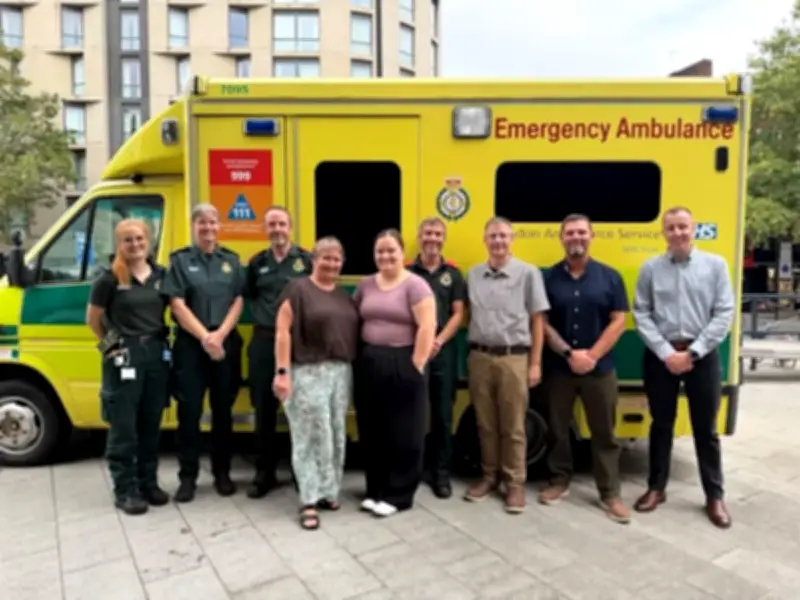
Mel and Nichea recently met the crews who saved her life at London Ambulance Service’s Waterloo headquarters. Mel expressed her gratitude, saying: “It was amazing to meet the paramedics and police officers. I felt like I had to thank them and I’m so glad to have met them. They saved my life. I couldn’t write what I wanted to say, it just wasn’t enough – so this meeting was perfect. Their response was absolutely amazing. If it wasn’t for them, I wouldn’t be stood here today. I cannot thank them enough.”
Nichea echoed her mother’s sentiments, stressing how quickly events unfolded. “It happened really quickly – without the paramedics and police officers she wouldn’t be here today,” she said.
Clinical innovation at London Ambulance Service
Keir Rutherford, Advanced Paramedic in Critical Care at LAS, highlighted the importance of timely intervention in cardiac arrest cases. “When we arrived, Mel had been defibrillated once by police officers but unfortunately remained in cardiac arrest. Timely intervention during cardiac arrest is key to maximise chances of survival. Mel is alive and back with her family today because of the fast actions of those who responded – including our paramedics, the police officers and the clinicians at St Bartholomew’s. Without them she would have died.”
Rutherford added: “Mel’s survival highlights how seriously we take clinical innovation here at the London Ambulance Service. We are constantly working to improve the care we deliver to our patients, including those in cardiac arrest.” The new ECMO protocol is part of ongoing efforts to enhance emergency response and improve survival rates for cardiac arrest patients across London.