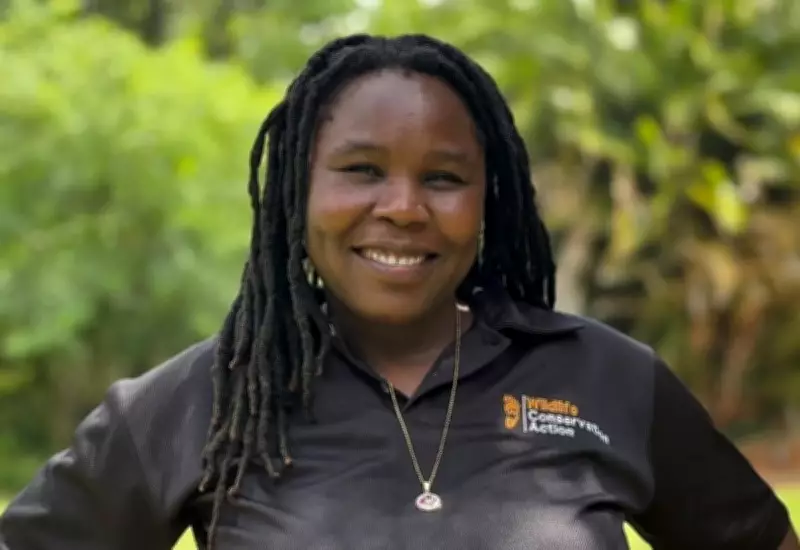
Moreangels Mbizah, a conservation biologist from Zimbabwe, has transformed her approach to wildlife protection after a devastating incident in 2014. While tracking lions for her PhD research in Hwange National Park, she responded to a GPS alert that led her to a village where a lion had killed a seven-year-old boy. The scene, with dozens of villagers helplessly watching the lion guard the child's body, was a turning point. "That was a punch in the gut," Mbizah recalls. "I realised that the work I'd been doing was just half of the problem."
This tragedy inspired Mbizah to found Wildlife Conservation Action (WCA), an organization that prioritizes coexistence between humans and animals. Using innovative techniques and technologies, including a recent Whitley Award, WCA aims to mitigate human-wildlife conflict (HWC) in Zimbabwe's Mbire district. Across Africa, lions have lost up to 90% of their historic range, with fewer than 20,000 remaining in the wild. As human populations expand, lions increasingly venture beyond protected areas in search of food, leading to conflicts with people and their livestock.
Community-Centered Strategies
In rural Zimbabwe's mid-Zambezi valley, livestock is a measure of wealth. A cow can be worth $300, and a goat $30, crucial for survival when the average household income is $108 per month. When predators kill livestock or elephants trample crops, the wild animals are often killed in retaliation. "In that case, we have losses on both sides," Mbizah says. "People lose, wildlife loses – and that's what HWC looks like."

To address this, WCA developed community-led strategies. One key pillar is community guardians—local people trained to raise alarms when GPS signals indicate predators are near. This allows communities to protect their herds, saving assets and removing threats to both sides. "Our model is looking at how we can involve the communities, how we can inspire them, how we can motivate and incentivise them to protect the wildlife they are living alongside," Mbizah explains.
Innovative Technologies
A notable innovation is the mobile boma, a livestock enclosure wrapped in opaque plastic. When a lion approaches, it cannot see the cattle, only smell and hear them, so it does not attack. These mobile bomas have been 100% effective in protecting livestock. The results are striking: WCA reports a 98% reduction in human-wildlife conflict incidents in Mbire. The organization's work now spans 2.6 million hectares of the Zambezi valley, protecting nearly 18,000 livestock worth an estimated $2.3 million.
Pioneering Role for Black African Women
Mbizah, 42, grew up in Chiredzi, a small town in southeastern Zimbabwe. Her first exposure to wildlife came at age 25 when she saw impala and zebras. "That was the moment my career began," she says. For many Zimbabweans, encounters with biodiversity are rare, and for black women, careers in conservation are even rarer. "It was very lonely," she says of her breakthrough. "There was no black African woman who had founded a conservation organisation in Zimbabwe. It was something that I saw as a gap that needed to be filled." Part of WCA's work includes outreach programs offering young female African conservationists work experience and mentoring. "This has been my story, but it doesn't have to be the story of everyone coming after me," she says.
Full Circle with Cecil the Lion
In 2014, during her PhD, Mbizah tracked lions and worked closely with Cecil the lion, whose death by an American trophy hunter sparked global outrage. She still remembers the phone call about Cecil's death. "When you spend so much time with lions, you end up developing a bond with them. It was heartbreaking for me." Determined to prevent further tragedies, she focuses on coexistence. "We are not going to be able to protect lions without protecting the people," she says. Through WCA, Mbizah is proving that community-led conservation can protect both wildlife and human livelihoods.