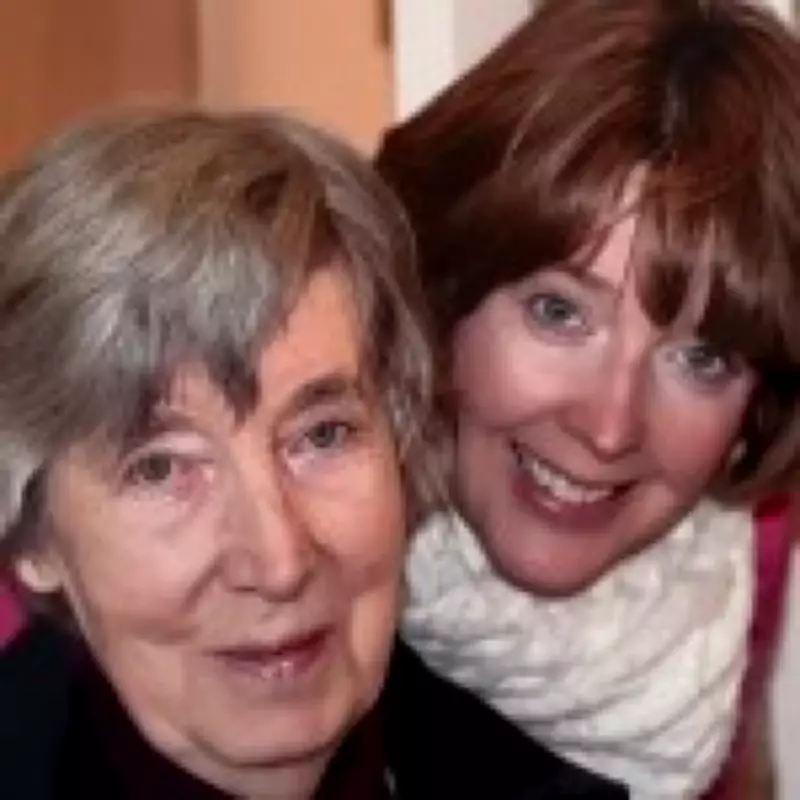
When Margaret Gibson began showing signs of memory loss, her daughter Carolyn Bieda faced a heartbreaking dilemma: how to protect her mother from the truth of her condition. Having watched her own mother die of Alzheimer's, Margaret feared the disease deeply. After a weekend away in 2013, she couldn't remember unpacking her bag, triggering panic.
'She rang me up in a panic, saying she couldn't find her bag. I lived 10 minutes away so I went around and found it in the wardrobe,' recalls Carolyn, 61, from Wiltshire. 'Mum realised that she must have unpacked it, but she couldn't remember doing so. For her, it was a moment of horror, because her mother Prudence had died of Alzheimer’s, and her biggest fear was getting it too. I could see the recognition on her face.'
From that point, Carolyn decided to shield her mother from the diagnosis. She took Margaret to the GP under the guise of a general health check. Although Margaret passed the memory test, Carolyn noticed other signs: losing her phone, misplaced false teeth found in a shoe. 'Mum was very much in denial. It was her way of coping,' Carolyn remembers.

In 2015, a brain scan confirmed Alzheimer's. After the specialist meeting, Margaret insisted, 'I haven’t got Alzheimer’s. How on earth does she know? She doesn’t even know me.' She never fully acknowledged the disease.
Carolyn and her brother Andrew supported their widowed mother through the devastating decline. There were calls about four hobs left burning, or Margaret waiting outside with packed bags for imagined trips. Carolyn did everything to keep her mother in her over-55s flat, as Margaret had pleaded not to be put in a home.
'I used to have to duct tape everything down. I had a diary and I stuck it to her kitchen table, because it was the only way she wouldn’t move it,' Carolyn says. She wrote daily reminders and taped controls to prevent calls about non-working heating. Eventually, she had a lock fitted on the control cupboard. 'We had taped all the sockets because she was unplugging the TV and the monitor for her trip alarm. She lost the alarm for months and we ordered a new one. Eventually I found it tucked inside a pillow case in the spare bedroom.'
Knowing social interaction was vital, Carolyn paid someone to take her mother out every Friday, letting Margaret believe she was meeting a friend for tea and cake. These 'love lies' helped Margaret cope.
The hardest deception came when Carolyn was diagnosed with breast cancer in 2017, a disease Margaret had also survived. 'It was really tough, because I had two lots of surgery, chemotherapy, radiotherapy, and she didn’t really know. We told her initially and she just said, “Oh, didn’t I have that?”' Carolyn recalls. 'I don’t actually know whether I wanted to tell her that she’d had it too. She told me once: “Oh, you haven’t got any hair”. But she could never understand. In a way, there’s no point with Alzheimer’s, because they can’t understand it. It’s cruel to tell them. But you want your mum when you’re going through something like that.'
Carolyn completed her treatment in 2018, but while on a break in Cornwall, she learned Margaret had fallen and broken her hip. The injury accelerated the Alzheimer's, requiring 24-hour care. 'That was horrific. It wasn’t a nice experience looking around care homes. One of them had a room that was like a prison cell,' she remembers. They found a new, nice home 45 minutes away. 'I couldn’t face moving her in. Andrew had to do it. But when she arrived, she said, “This looks like a nice hotel.” Which was brilliant.'
Visiting, Carolyn used a laminated photo of Margaret's mother Prudence to spark memories. But leaving was painful. 'It broke my heart. I couldn’t work out how on earth I could leave her without putting her through this, even though the carers told me that half an hour later she didn’t even remember that I had been there.'

She found a solution on an Alzheimer's Society forum: 'love lies'. She began leaving her coat, handbag, and keys behind, telling her mother she was popping to the loo, then quietly leaving while carers distracted Margaret. 'Alzheimer’s is so cruel. You are constantly losing them,' she explains. 'On a good day, I would try to make her laugh. I would pretend to take her out for lunch, and the care home would set us a table outside the dining room. I would pour her apple juice and tell her it was a glass of wine, and she used to believe me, laughing, “Oh don’t give me any more, because I’ll get drunk”. You have to find ways to make them happy momentarily.'
In 2020, during the pandemic, 18 residents at the home contracted Covid. Margaret developed a cough, then stopped eating and drinking. 'In the end she just slipped away,' Carolyn says tearfully. Margaret died at 84, five years after diagnosis. The private funeral was beautiful, just Carolyn and Andrew with a celebrant and a pot of tea.
Despite the heartbreak, Carolyn treasures small moments. She took Margaret to the Alzheimer's Society Memory Café, where they sang and laughed. 'There were some magic moments. I remember one of the song sheets read “etc etc etc”, and they all sang “etc etc etc” and we all just fell about laughing,' she says with a smile.
Carolyn has raised £3,000 for the charity and continues fundraising. 'We need to have the same emphasis on dementia research that we do with cancer, because it affects so many people. We desperately need more research into this cruel condition, as it currently has no cure.'