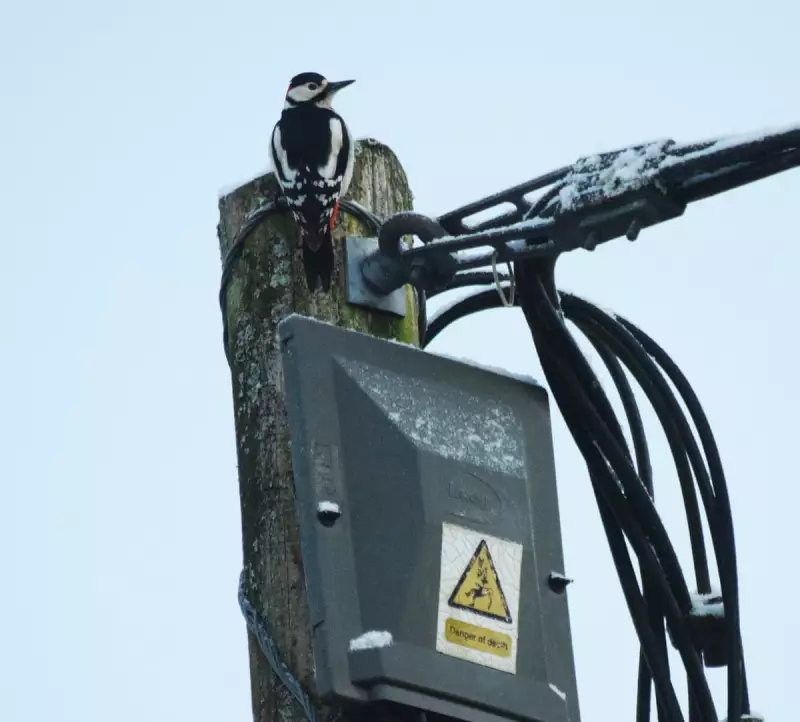
Dartmoor's Dawn Drummer: A Woodpecker's Plastic Percussion
In the frosty landscapes of West Dartmoor, Devon, an unusual avian musician has been captivating local residents with an unconventional performance. A male great spotted woodpecker has forsaken the traditional hollow branches of its species in favour of a most unlikely instrument: a plastic electrical junction box fixed to a roadside telegraph pole.
An Unexpected Alarm Call
Early one snowy January morning, a local resident was awakened by short, sharp bursts of drilling just outside their bedroom window. While familiar with the territorial sounds of woodpeckers in this village near the historic Brentor church, this particular noise carried a distinctive quality. "It had the resonance of someone impatiently tapping their fingers on a desktop," the observer noted, "with the speed of a marching band snare-drum roll."
Peering through the curtains revealed the source: a bold male great spotted woodpecker perched atop the plastic box, completely unfazed by the yellow "Danger of death" warning sign displayed prominently below him. The bird had discovered the exceptional acoustical properties of this man-made structure and was making the most of its percussive potential.

The Unconventional Instrument
While hollow branches remain the standard instrument of choice for great spotted woodpeckers, this particular individual has developed a clear preference for the electrical wiring rain cover. Since its initial discovery, the woodpecker has returned regularly to engage in dawn drumming sessions, transforming what was once a purely functional piece of infrastructure into his personal performance stage.
The great spotted woodpecker presents a striking visual spectacle alongside its auditory display. With bold black and white markings accented by a flash of crimson beneath the tail – "as if it has accidentally sat in wet paint" – and an additional square of red at the back of the head distinguishing males from females, these birds possess undeniable cartoon-like charm. Their tree-chiselling antics and gravity-defying ascents up tree trunks only add to their comical appeal.
Purpose Behind the Percussion
This persistent drumming serves crucial biological functions. Great spotted woodpeckers use their power-drill bills not only to extract grubs from wood and chip out nesting holes but also to communicate through sound. The males employ loud, rapid drumming to signal their presence and attract potential mates – precisely what this Dartmoor resident has been accomplishing with his plastic box performances.
Scientific understanding of how woodpeckers withstand such repetitive impact has evolved significantly. Once believed to possess shock-absorbing tissues at the front of their skulls to prevent unconsciousness, more recent research suggests that such cushioning would actually reduce effectiveness. Instead, their heads and beaks function as integrated hammers designed for maximum impact, with specialised adaptations that prevent injury despite the tremendous forces involved.
Adaptation in Action
This Dartmoor woodpecker's behaviour represents a fascinating example of wildlife adaptation to human-altered environments. By repurposing man-made structures for traditional behaviours, the bird demonstrates remarkable flexibility in its territorial displays. While the woodpecker itself remains perfectly adapted to avoid injury from its headbanging performances, the human residents nearby might experience different effects – as our observer wryly noted: "If anyone is suffering headaches as it pounds out its sunrise beats, it's me."
The regular dawn drumming sessions continue to echo across the Dartmoor landscape, serving as a reminder of nature's capacity to adapt and thrive even when presented with unconventional materials. This great spotted woodpecker has not only staked his territorial claim but has also provided local residents with an unexpected natural spectacle, blending traditional avian behaviour with contemporary infrastructure in a most unusual symphony.