
This week's global wildlife roundup brings a captivating collection of images and stories from the front lines of the natural world, showcasing moments of tranquillity, tension, and triumph in conservation.
Moments of Harmony and Conflict
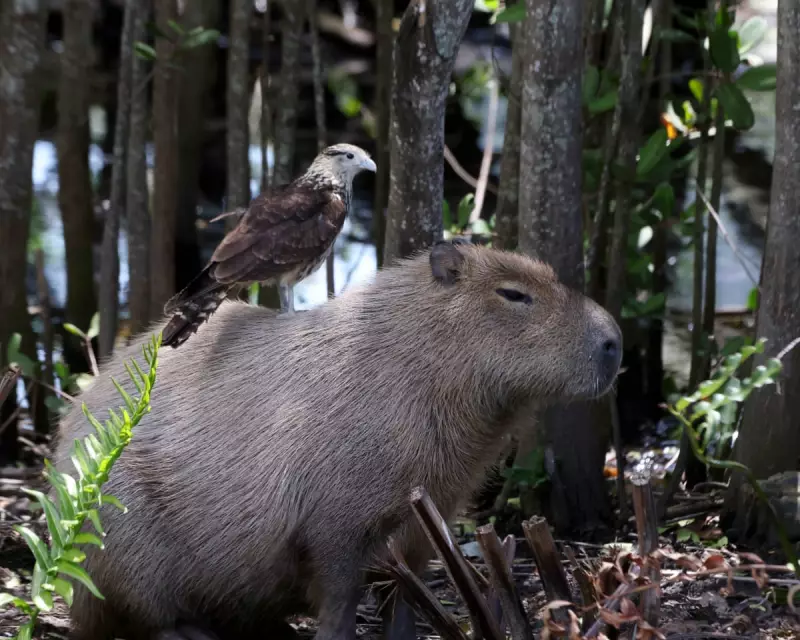
A scene of serene symbiosis was captured in the mangroves at Rodrigo de Freitas Lagoon in Rio de Janeiro, Brazil, where a juvenile yellow-headed caracara was photographed perched comfortably on the back of a resting capybara. These adaptable raptors are commonly seen hitching rides on large mammals, foraging for ticks and insects.
In stark contrast, a tense situation unfolded in Hanamaki, Japan, where a bear was spotted outside a nursery school while approximately 40 children were inside. This incident is part of a worrying trend; since April, a record 13 people have been killed by bears across the country, with almost daily reports of the animals entering homes and public spaces.
Meanwhile, in a conservation area in Riau, Indonesia, a wild Sumatran female elephant was carefully fitted with a GPS collar after being tranquillised and blindfolded as a calming measure. Authorities hope to monitor the movements of the large herd she leads as part of an early warning system to minimise conflict with local human communities.
Conservation Successes and Setbacks
There was positive news from rural Wales, where a camera trap captured an image of a European polecat foraging in woodland in Aberystwyth. This relative of the ferret was once on the brink of extinction in the UK. While still an uncommon sight, its numbers are now rising steadily in rural Wales.
A heartening conservation comeback story comes from North America, where a river otter was photographed surfacing with a catfish in a pond in rural Oregon. River otter populations have rebounded across much of the continent, thanks to concerted reintroduction efforts and significantly cleaner waterways.
However, a grave ecological situation is unfolding in Siberia. Last winter saw more tiger attacks than in decades, with people, dogs, and livestock killed by Amur tigers. Scientists are calling it an ecological disaster, as the big cats are leaving the forest and entering populated areas because swine flu has decimated their primary food source, wild boar. Tragically, 17 Amur tigers have been killed and 27 captured in the region as a result.
Other Notable Sightings
On the Farne Islands off the Northumberland coast, a baby seal was pictured relaxing during the annual census of pup numbers at one of England's largest grey seal colonies. These islands, looked after by the National Trust, are a vital haven for thousands of seabirds and hundreds of adult seals.
A potential fugitive was spotted on the Brittany coast in France, believed to be Frankie the flamingo who escaped from Paradise Park in Cornwall on 2 November. Zookeepers are hopeful the bird's time on the lam may soon be over.
In western Australia, a new species of bee, dubbed Megachile lucifer, was discovered by expert Kit Prendergast. The bee, noted for its devilish horns, is the first new member of its group to be described in over 20 years, highlighting the vast amount of life still to be discovered.
Other compelling images included a dolphin swimming in the canals of Venice, stray dogs in Srinagar, India, under a new relocation law, and the rescue of a hypothermic monkey named Peque in Costa Rica.



