
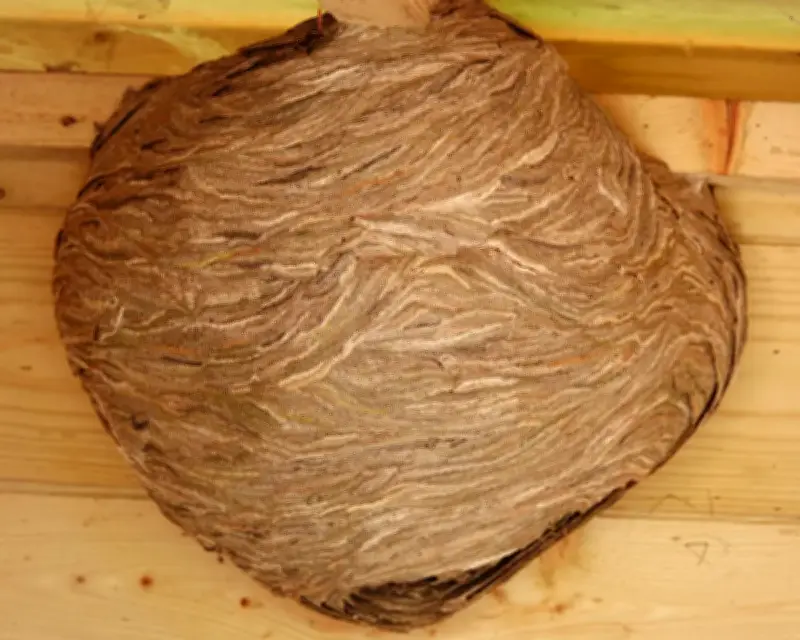
After 10 weeks of being sealed shut, the doors of a shed in Buxton, Derbyshire, have finally been reopened to reveal a wasps' nest that its discoverer describes as a 'sculptural work of art' and a 'family saga'. The nest, which grew to the size of a football, was built by a colony that may have included up to 5,000 workers at its peak.
Discovery and 10-week closure
On 9 June, Mark Cocker, a writer and naturalist, noticed a miniature paper 'lampshade' hanging from the back beam of his shed. As he shouted to alert others, he realised that some of the nest's creators were heading straight for him. The doors were shut immediately and remained closed for the next 10 weeks, during which the wasps continued their work undisturbed.
Throughout that period, Cocker observed a 'sisterhood' of wasps trafficking every few seconds to the shed's rear wall, flying up into a slit that gave access to the interior. Only this week, with almost all activity ceased, have the doors been reopened, allowing a full inspection of the construction.
Architecture and materials
The nest's exterior is composed of roughly equal, coloured bands of pulp-paper, ranging from off-white to cedar red. Through photographs, Cocker was able to determine that the workers widened their search operations from four to at least nine different wood sources, each producing a different shade of paper. He calculated that approximately 5cm of vertical wall contains 36 distinct bands, though the exact number of journeys required to create each strip remains unknown.
The nest also features further layers inside the outer wall, with wasps refashioning the interior as the colony's needs expanded. It is presumed that within the nest are six to 10 suspended, horizontal tiers of brood cells, where all offspring were raised. A large nest can house 5,000 workers at any one time, with a cumulative total of 25,000 wasps during the colony's entire life cycle.
Colony life and ecological impact
The construction process involved tens of thousands of insect victims from the garden, which underpinned the wasps' activities. The adult wasps fed larvae, and in return, the adults received sugars from the larvae's saliva. The entire colony was presided over by a single mother queen, who chemically castrated her daughters and suppressed their brooding instincts to benefit the genetic whole.
Cocker, whose observations are featured in the Guardian's Country Diary, noted that the nest represents a new generation, a family saga, a kind of ghost town, and a sculptural work of art, all funded by the garden's invertebrate economy. He called it 'a summer of extraordinary work'.



