
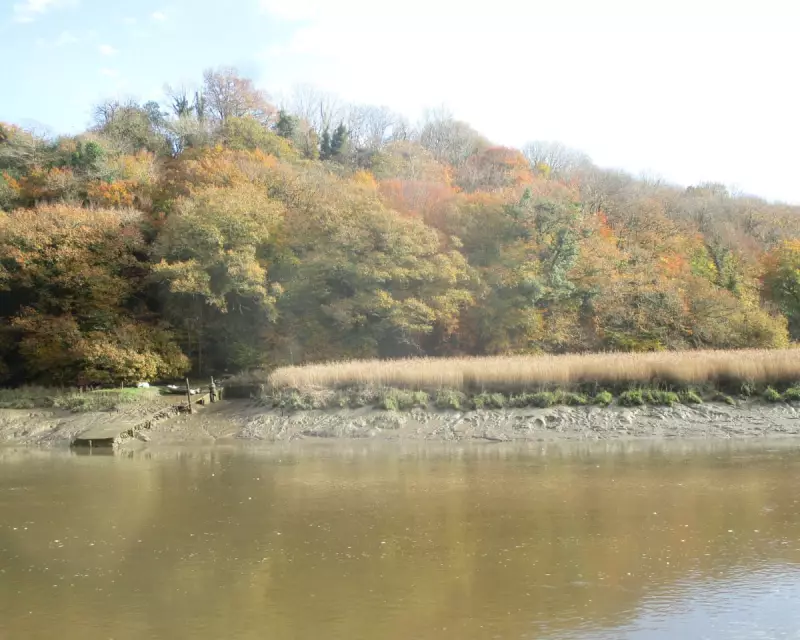
Golden Autumn Defies Winter's Approach in Tamar Valley
The Tamar Valley in Cornwall continues to bask in autumn's golden embrace as November progresses, with frost yet to make its seasonal appearance. The landscape remains remarkably vibrant, offering a spectacular display of colour that typically would have faded by this time of year.
A Landscape Bathed in Golden Light
Yellow leaves clinging to lime trees create an almost luminous effect against the stark branches of leafless eucryphia trees. The early white camellia flowers remain unblemished by frost, while squirrels demonstrate selective feeding habits—ignoring the strawberry-like fruit of dogwoods in favour of more abundant berries and nuts.
One particularly striking observation involves the holly trees, where only a single heavily-laden specimen has been stripped of its berries, likely by a passing flock of fieldfares. The aromatic rosemary bushes showcase their blue flowers, while the ivy-woven undergrowth provides shelter for violet plants that will eventually serve as food for fritillary caterpillars.
Morning Activities in the Valley
Before 8am, the sound of a quad bike echoes through the valley, its headlight piercing the morning mist as south Devon beef cattle are moved to fresh pasture. The cattle enjoy newly greened-up grass that continues to grow despite the advancing season.
Outside the gardened areas, the landmark beech clump stands completely bare of both leaves and mast, while Dupath farm's Aberdeen Angus bullocks graze peacefully in nearby pastures. The contrast between cultivated and wild spaces becomes increasingly apparent as autumn deepens.
Downstream Transformations
Further down the hill, in the overgrown Radland tributary, yellowing hazel leaves accumulate on the shiny surfaces of hart's-tongue ferns. The winter green of male ferns provides a striking backdrop for polypodies and glossy pennywort that thrive on mossy branches of the oldest oaks.
The Iron Age enclosure overlooking the valley appears edged with russet-leafed oaks, mirroring those found below St Dominic village where they contrast dramatically with the greyness of bare and dying ash trees.
Near Cotehele's historic corn mill and the collapsed weir, tall beech, oak and chestnut trees rise majestically above a carpet of orange and gold leaves. This vibrant covering gradually disintegrates into leaf mould, contributing to the valley's rich ecosystem.
High tide temporarily dams the racing millstream, which will eventually carry masses of leaves and eroded earth—washed down steep lanes by heavy rain—toward the tidal River Tamar.
Historical Agricultural Practices
Before artificial fertilisers became commonplace, rotting leaves served as valuable organic fertiliser for the valley's intensive market gardens. This "point stuff" was supplemented by dock dung—street sweepings from Plymouth and Devonport—and limestone shipped upstream to be burned in riverside kilns.
At low tide, accumulated leaves were shovelled off mud banks, loaded into boats and floated toward quays before being carted away for spreading across the valley's cultivated lands. This historical practice highlights the resourcefulness of previous generations in utilising natural materials for agricultural enhancement.
The Tamar Valley's current autumn display not only offers visual splendour but also connects us to centuries of agricultural tradition and environmental adaptation in this unique Cornish landscape.



