Sperm Whale Communication Shows Striking Parallels to Human Language
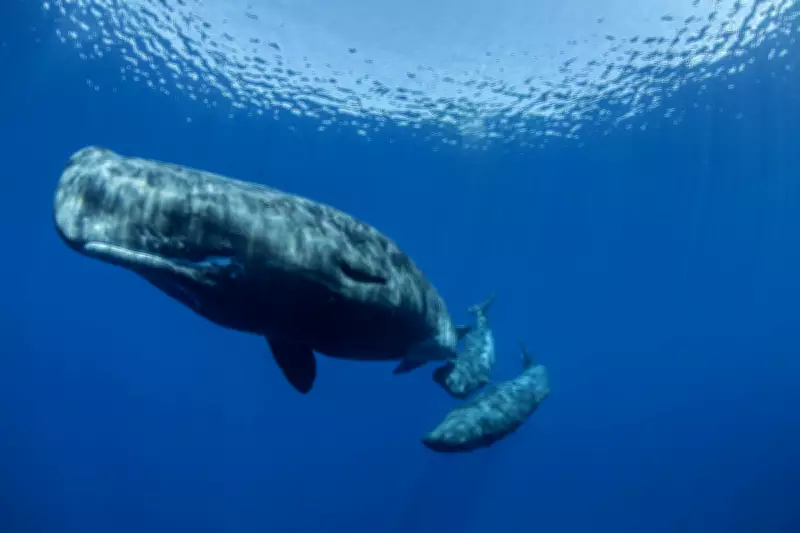
Researchers have made a groundbreaking discovery that sperm whales, those colossal ocean-dwelling mammals that last shared a common ancestor with humans over 90 million years ago, possess communication systems with remarkable similarities to human language. A new study published in the Proceedings B journal reveals that these marine giants use vocalizations containing complex structures that closely mirror the phonetics and phonology of human speech.
The 'Alphabet' of the Deep
Sperm whales communicate through a series of short clicks known as codas, which researchers have discovered function much like an alphabet. These vocalizations contain vowel-like sounds that whales can manipulate by varying click duration and tone patterns. The study found that whales differentiate vowels through short or elongated clicks and through rising or falling tones, using patterns similar to those found in human languages including Mandarin, Latin, and Slovenian.
"Sperm whale coda vocalizations are highly complex and represent one of the closest parallels to human phonology of any analyzed animal communication system," states the research paper. The structure of whale communication shows "close parallels in the phonetics and phonology of human languages, suggesting independent evolution" of these sophisticated systems.

Project CETI's Revolutionary Research
These findings represent the latest breakthrough from Project CETI (Cetacean Translation Initiative), an organization studying whales off the coast of Dominica in an effort to decode their communication. The project has been using modern technology, including artificial intelligence, to analyze whale vocalizations - a significant advancement from the 1950s when scientists weren't even certain sperm whales vocalized at all.
David Gruber, founder and president of Project CETI, described the discovery as "another humbling moment that we're not the only species with rich, communicative, communal and cultural lives." He emphasized that "These whales could be passing information along generation to generation for over 20 million years. Humans now are just having the right tools and desire to be able to look at whale voices in this way to see the complexity that has been there all along."
The Social Lives of Sperm Whales
Studying these deep-diving creatures presents unique challenges. Sperm whales can remain submerged for up to 50 minutes while hunting squid, surfacing for only about 10 minutes at a time. It's during these brief surface intervals that researchers have observed the whales engaging in what Gruber calls "chit-chat" - gathering with their heads close together to communicate.
Gašper Beguš, a linguist at University of California, Berkeley who led the research, noted that the complexity of sperm whale communication surpasses anything he has studied in other animals, including parrots and elephants. "They have very different lives to us - they're not stuck to the ground all the time, they float in the water, they sleep vertically," Beguš explained. "Yet you realize that there's a lot that unifies us. They have grandmas, they babysit each other's calves, they give collaborative births, they're very loud during a birth and so on. It's such a distant intelligence, but in many ways very relatable."
Unlocking Oceanic Conversations
Mauricio Cantor, a behavioral ecologist at the Marine Mammal Institute not involved in the study, commented that the research shows "sperm whale communication isn't just about patterns of clicks - it involves multiple interacting layers of structure. With this study, we're starting to see that these signals are organized in ways we didn't fully appreciate before."
Project CETI has set an ambitious goal to comprehend 20 different vocalized expressions within the next five years, relating to whale behaviors such as diving and sleeping. While full understanding of whale communication or actual conversation with these creatures remains a longer-term prospect, Gruber remains optimistic about the possibilities.

"It's totally within our grasp," he asserted. "We've already got a lot further than I thought we could. But it will take time, and funding. At the moment we are like a two-year-old, just saying a few words. In a few years' time, maybe we will be more like a five-year-old."
The research represents a significant step forward in understanding one of the ocean's most intelligent inhabitants and challenges our assumptions about what constitutes complex communication in the animal kingdom.