
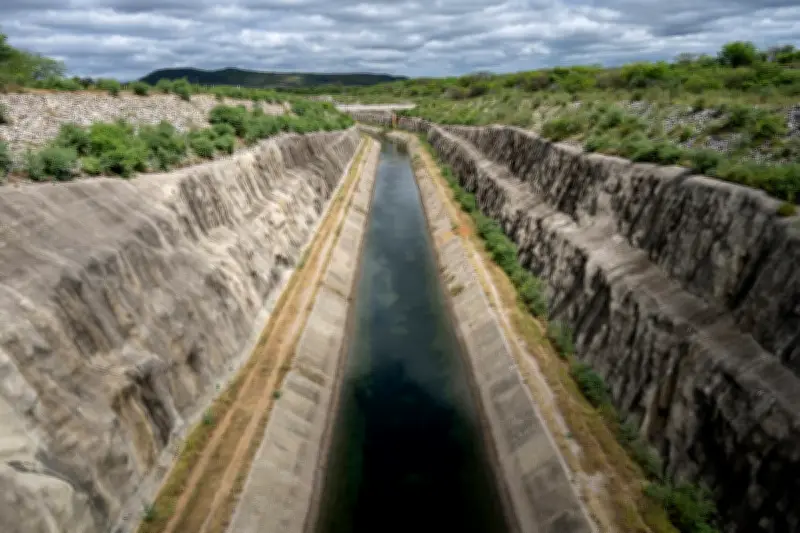
A concrete canal carrying water from the São Francisco River to Monteiro in northeast Brazil passes within two and a half miles of Maria de Fátima Ferreira da Silva's home, yet her house has no water supply. Displaced nearly 20 years ago by the canal's construction, she now lives in Vila Salão, a planned community that lacks running water despite its proximity to a reservoir.
Displacement without water
Ferreira, 54, depends on what she can grow on her smallholding but has no water for irrigation or domestic use. She bathes at the reservoir, collects water for her crops and donkey, and pays monthly to fill a 1,000-litre barrel with drinking water. “There’s no water; what are we supposed to do without water?” she said.
The canal is part of a £2.1bn ($2.8bn) diversion of the 1,700-mile-long São Francisco River, which provides 70% of the water supply for Brazil's northeast region. The government says the project supplies 12 million people, but nine years after water first reached Monteiro, many affected communities still lack access.
Promises unfulfilled
Construction began in 2007 under President Luiz Inácio Lula da Silva, requiring the expropriation of about 2,000 properties to make way for two main canals, each over 130 miles long, plus tunnels, aqueducts, and pumping stations. The 848 most vulnerable families were relocated to 18 productive rural villages (VPRs) like Vila Salão, where each family received a three-bedroom house and a few hectares of land, plus financial support.
However, Vila Salão lacks running water and sewage services, and communal buildings stand abandoned. Janaína Andrade, a regional prosecutor for citizen rights in Paraíba state, said: “People were relocated to the productive village – but without water. They had no water for human consumption, for their livestock or for agricultural production. All these people who were relocated had artesian wells and were self-sufficient. They were taken to a territory without means of production and became dependent on benefits.”
Mixed outcomes
In Vila Lafayette, another VPR in Monteiro, residents have fared better due to persistent advocacy. Maria de Lourdes Souza da Silva, 64, recalls how her mother fell ill after being given two weeks to leave their home and died shortly afterward. “I just wasn’t that happy [about moving] because I lost my mother and the place where we lived in the process,” Souza said. “That was where we were raised, where our roots were. We’re trying to put down new roots.”
Agnaldo Freitas da Silva, vice-president of the Lafayette residents’ association, campaigned for water access. “I went knocking on the door of the state assembly, and I took part in their public hearings. I said: ‘I’m not going to let it go; the state government has to give us water. We can’t stay in this situation,’” he said. The village was the first VPR to be connected to mains water and, last year, received promised irrigation water.
Government responsibility disputed
The federal government considers its role complete with the diversion works, although Lula has inaugurated additional sections since returning to power in 2023. The ministry of development and regional integration declined an interview and said its responsibility was limited to transporting water, with distribution and relocation being the responsibility of state and municipal administrations.
Ana Paula Pires Koga, a geography professor at the Federal University of Catalão, said: “Some cities are feeling tangible benefits, but the big question is about water reaching the populations scattered across the semi-arid region.”
In Vila Salão, residents like Edileuza dos Santos Leite, 55, blame lack of unity for their continued waterlessness. “People aren’t united here,” she said, hoping the state governor will fix things. “God willing, we’ll have water soon.”



