
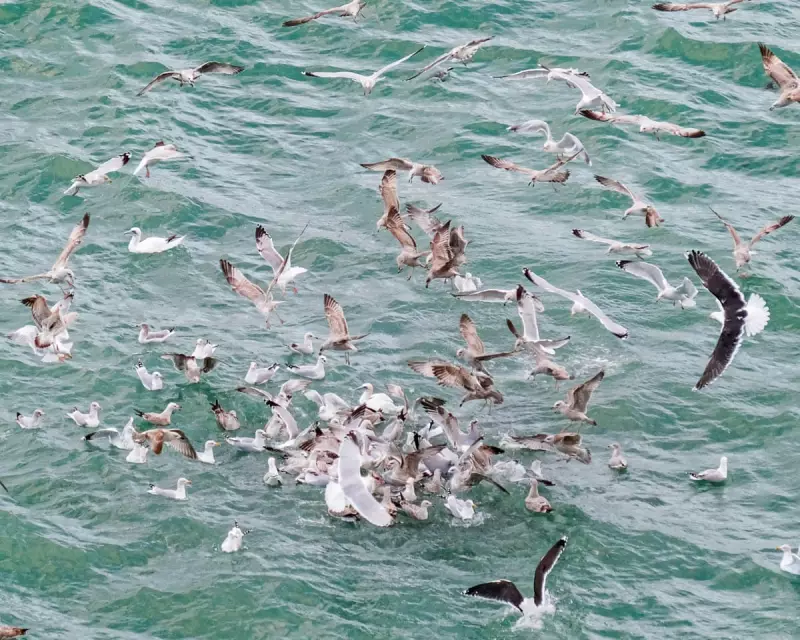
On the shores of Tyrella Beach in County Down, a spectacular natural drama unfolded as seabirds engaged in a frantic feeding frenzy, creating a breathtaking display of nature's raw intensity.
The Avian Gathering
Looking out to sea, an observer spotted a squadron of juvenile great black-backed gulls, their dark forms stark against the tide's limpid sheen. Through a telescope, the scene revealed a messy raft of birds including adult herring gulls, common gulls, and more great black-backed gulls dipping their heads casually into the water.
The gathering included a diverse range of species: a gannet wielding its sword-like bill irritably at the mob, razorbills and guillemots in their seasonal tuxedos diving and resurfacing around larger birds, and cormorants bucking smoothly under the surface away from the main fray. More gulls tipped from the sky as the action intensified.
The Bait Ball Phenomenon
The moment of realisation came when a winter-white black-headed gull struggled back into the air with a silver rag hanging from its bill. This was no ordinary gathering - this was a full-scale feeding frenzy centred around what marine biologists call a bait ball.
Fish typically gather in shoals as a defence mechanism, providing many eyes to scan for danger and cover within the crowd. Their coordinated movement, known as schooling, reduces the risk of individual fish becoming a predator's meal. However, this collective behaviour can backfire dramatically when it attracts multiple predators.
In the Irish Sea, small forage fish like sprat (Sprattus sprattus) or young herring (Clupea harengus) serve as primary prey for larger species including mackerel, cod, and sea bass. While these fish predators hunt individually rather than cooperatively, they often achieve greater success when attacking as part of a group.
The Frenzy Unfolds
When marine predators surround a school of forage fish that has been tracked by keen-eyed seabirds, the avian hunters join the assault by diving and swimming underwater. The besieged school, with escape routes cut off, instinctively swirls and flinches into an increasingly tight sphere - the formation known as a bait ball.
Driven from below by its attackers or attempting to escape through the only available route, the bait ball spirals upward through the water until it smashes against what the observer described as "air's wall" - the water's surface.
Through the telescope's tunnel vision, the aftermath revealed a sea surface churning with desperate fish and jostling with hungry birds in a life-and-death struggle. Then, almost as if a wand had been waved, the spectacle ended abruptly. The birds drifted apart over a slowly unwrinkling sea, leaving little evidence of the dramatic events that had just transpired.
This remarkable observation at Tyrella Beach serves as a powerful reminder of the complex predator-prey relationships that unfold just beyond our shorelines, visible to those patient enough to watch and understand nature's rhythms.



