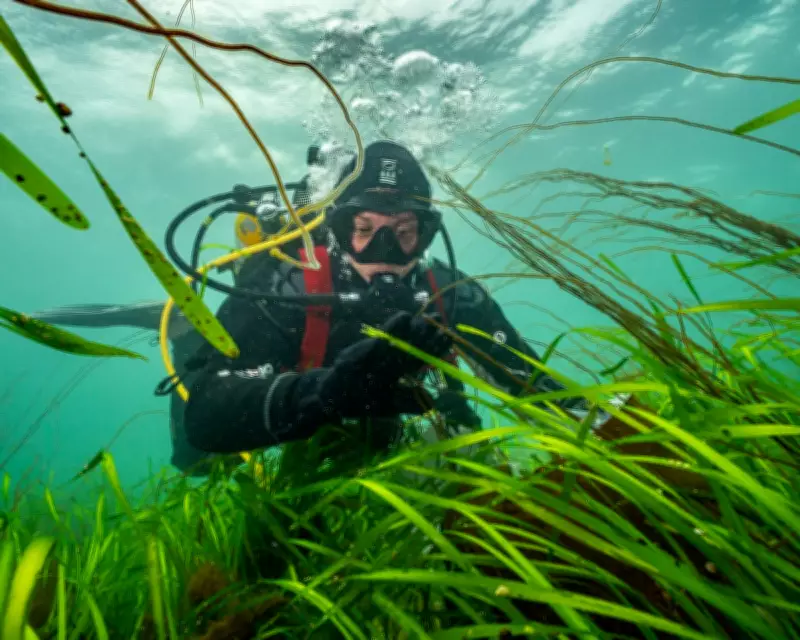
Sea Gardeners Battle to Revive UK's Lost Underwater Meadows
On the golden sands of Penrhyn beach in Ynys Môn, north Wales, Dr Oliver Thomas scans for flashes of eel grass that survived a harsh winter. As senior science officer at Project Seagrass, he describes his role as a rare opportunity: "There’s not many jobs where you get to be a sea gardener." This poetic title belies a monumental challenge—restoring vibrant seagrass meadows that once flourished around the UK but have been decimated by human activity, with up to 92% lost over the past century.
The Colossal Challenge of Underwater Restoration
Growing a meadow in the sea is no simple task. These underwater swards serve as vital nurseries for fish like cod, clean water, store carbon, and protect coastlines. "Last October, this was looking great," Thomas notes, pointing to a plot hit hard by winter rains and darkness. Yet, hope persists in the mahogany rhizomes poking through the sand, packed with sugars ready to sprout green shoots with the sun's return. The goal is ambitious: plant 10 hectares over several years, requiring millions of seeds collected by hand from remaining healthy meadows.
Volunteers, including 12-year-old Annabelle Campbell-Priest, are getting their wellies wet to make it happen. Using a caulking gun and recycled sealant tubes, she meticulously squirts seeds into marked plots, twisting after each squirt to embed them in the gloopy sand. "It can be hard work—my back is a bit sore—but it’s always worth it when you know you are doing something good for the environment," says Campbell-Priest, a seagrass ocean rescue champion from a local school. She recalls the beauty of the seagrass in October, a memory driving her efforts.

Community Engagement and Political Support
Rhun ap Iorwerth, leader of Plaid Cymru and member of the Senedd for Ynys Môn, is among the volunteers pushing a hand-pushed seeding machine, which injects multiple squirts as its drum rotates. He emphasizes the importance of youth involvement: "The engagement with young people is particularly important here because these seagrass beds will be theirs to look after in years to come. Getting them up close and literally pumping the seed into the sand hopefully will plant something in them too about the importance of what they’re doing."
Bridget Patterson, a research assistant from Project Seagrass, describes pristine meadows as "amazing," teeming with fish, crabs, cat sharks, and even seahorses. However, sudden changes—like new ports, pollution, disease outbreaks, and boat anchors—have devastated these ecosystems. Restoration faces additional hurdles, such as summer heatwaves exposing grass to 30C heat, storms wiping out new meadows, and threats from Brent geese and lugworms that gobble up seeds. Prof Richard Unsworth, chief scientist to Project Seagrass, laughs about the latter: "Little bastards!"
Scientific Experiments and Global Inspiration
Project Seagrass is now planting at sites across the UK, from the Isle of Wight to south Wales, with successes including meadows full of fish and cuttlefish nurseries. Unsworth explains that failures are part of the learning process, as seagrass planting is a relatively new science compared to millennia of crop farming. His group has conducted over 70 experiments, testing variables like seed sources, storage methods, planting depth, and protective measures like hessian bags to deter crabs.
Technology plays a key role, with centimetre-accurate GPS, drones, and environmental loggers deployed to find optimal sites. "We’ve now got very good knowledge of some factors, some we still haven’t got a clue about, but we’re getting a lot better," Unsworth says, noting there is no silver bullet. The restoration in the Wadden Sea in the Netherlands inspires the team, where concerted planting over five to six years led to significant recovery after a century of commercial use for pillows and insulation.

Environmental and Economic Benefits
Seagrass restoration breathes oxygen into sediment, fostering a flourishing of life both above and below the surface. Eden Jefferson, a master’s student from Swansea University, examines cores from the beach, finding worms, shrimps, and gastropods. Establishing initial patches is crucial, as they engineer the environment by slowing currents and clearing water for more growth. Innovative techniques like "seagrass hugs"—planting protective rings of adult grasses around new seedbeds—are being tested.
Rhun ap Iorwerth highlights the intertwined benefits for Wales: "The sea we’re celebrating here today and the part it can play in literally cleaning up our planet is the same sea that can create real economic benefits, such as fishing and tourism." Wales leads globally with a national action plan to restore 250 hectares of seagrass by 2030. With Plaid Cymru polling well ahead of Senedd elections, ap Iorwerth could become Wales’s next first minister, pledging continued support: "If we succeed in this election, we’ll always be a government right behind our environment and our coastal communities. This project is something that we have to see through."