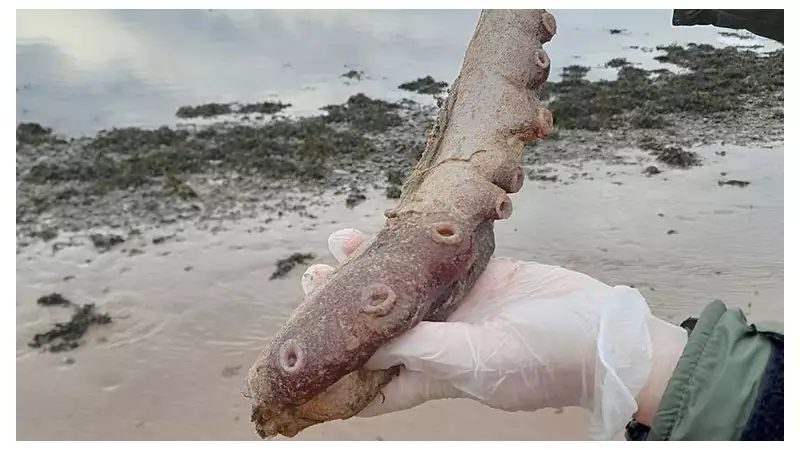
A rare and enormous deep-sea octopus has been discovered on a Scottish beach, in what scientists are calling an 'incredible find'.
Mysterious Remains Spark Investigation
The unusual discovery was made by local residents at the Forvie National Nature Reserve in Collieston, Aberdeenshire. After spotting the large, sucker-covered remains on Wednesday 3 December 2025, they immediately alerted reserve staff.
Marine biologist Dr Lauren Smith of the East Grampian Coastal Partnership rushed to the scene the following day to investigate. She told Sky News that the sheer size of the arms indicated this was no ordinary coastal creature.
Identity of the Deep-Sea Giant Revealed
The mysterious tentacles were identified as belonging to the seven-arm octopus (Haliphron atlanticus). This species is a denizen of the deep ocean, typically gliding through waters at depths greater than 500 metres and capable of reaching sizes of up to four metres.
Despite its common name, the species does have eight arms. However, males possess one modified arm, a reproductive organ, which is curled under the body, giving the appearance of seven.
'When I saw the photographs of these arms with the suckers... it was the sheer size of them that I realised it was something pretty special,' Dr Smith explained.
Theories and Future Research
Scientists are puzzled as to how such a deep-water creature ended up in the shallow coastal waters of Aberdeenshire. Dr Smith proposed a theory that the octopus may have become disorientated before being partially consumed, possibly by one of the large whales known to inhabit the area, with the remains subsequently washing ashore.
The significant remains have been secured in a freezer to preserve them for future study. 'I had to get them frozen down as soon as possible because they're obviously quite important finds,' Dr Smith stated.
The next step will see the octopus arms distributed to various laboratories, research groups, and potentially museums for detailed analysis, helping to shed more light on this elusive deep-sea giant.