Purple Catkins Herald Spring's Arrival in West Sussex Countryside
After weeks of persistent rainfall that have left the ground thoroughly sodden, making even simple walks a challenging endeavour, there are finally signs that drier times may be approaching. The recent wet weather has tested both the landscape and footwear, with leaky wellington boots becoming an unfortunate reality for many exploring the muddy paths.
Alder Trees Bathed in Maroon Haze
Today, attention turns to a distinctive line of alder trees (Alnus glutinosa) that faithfully traces the course of a meandering stream. These graceful trees stand out against the damp backdrop, their silhouettes enveloped in a remarkable maroon haze that catches the eye from a distance.
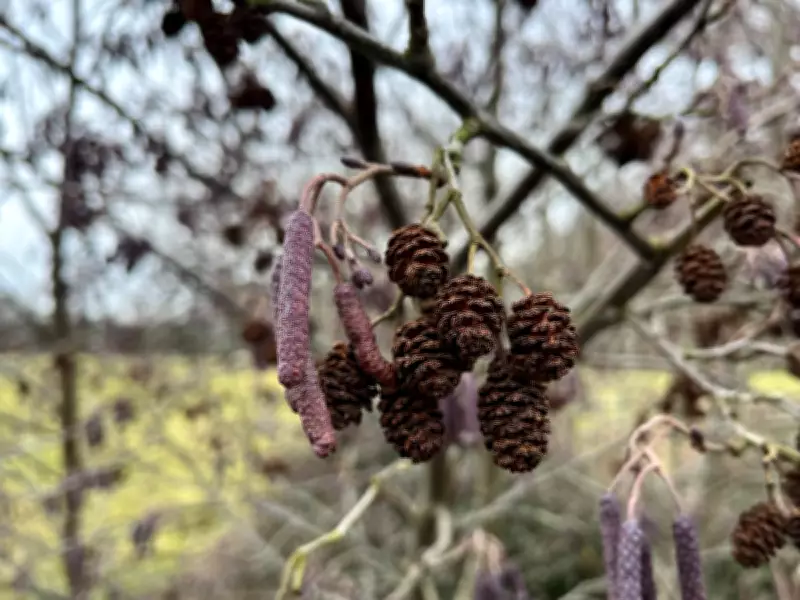
Upon closer inspection, this distinctive coloration reveals itself to be clusters of delicate purple catkins, hanging in elegant bunches from the very tips of each slender twig. These catkins, which formed towards the end of last summer, have recently begun their seasonal transformation, lengthening and gradually unfurling in response to the slowly warming days.

Nature's Lanterns Through Late Winter
In the coming weeks, well before the tree's characteristic rounded leaves make their appearance, these catkins will perform their annual spectacle. They will split open to reveal hundreds of vivid yellow stamens, creating what can only be described as nature's own tiny lanterns, providing visual guidance through what remains of winter's murk and mire.
The alder shares this early blooming distinction with its birch-family relative, the hazel (Corylus avellana). Together, they represent some of Britain's first trees to signal the changing seasons. The alder's light, wind-dispersed pollen serves as crucial early forage for emerging queen bees, playing a vital role in the ecosystem's awakening.
Remarkable Reproductive Strategy
Once fertilisation occurs, the currently inconspicuous female flowers undergo a remarkable transformation, swelling into fleshy, grape-sized green cones. These protective casings house seeds that become particularly valuable sustenance for hungry finches as winter gives way to spring.
One of the alder's most distinctive characteristics is the persistence of last year's reproductive structures. Clusters of spent cones, now darkened and woody, remain attached to the branches throughout the following spring, often positioned right alongside the fresh catkins. This fragile, rattling presence provides an excellent identification feature for what might otherwise be considered an unshowy species.
Ecological Importance and Historical Significance
Alders are true pioneer trees, capable of transforming landscapes through their remarkable adaptability. They demonstrate exceptional tolerance for compacted, infertile soils, gradually creating more porous and welcoming conditions for other plant species to establish themselves.
Their root systems host specialised bacteria that perform the crucial task of converting atmospheric nitrogen into a usable form, effectively fertilising the surrounding soil. These qualities have made alders invaluable in ecological restoration projects, particularly in healing damaged post-industrial landscapes where they can transform barren mine spoil and toxic tailings into thriving, biodiverse ecosystems.
Historical Uses and Water Resistance
The alder's relationship with water extends beyond mere tolerance. Remarkably, the wood actually becomes stronger when saturated, a property that made it historically invaluable for aquatic engineering projects. Much of Venice's famous architecture stands supported by alder pilings that have withstood centuries of immersion.
During the 19th century, coppiced alder wood found widespread use in manufacturing the soles of clogs for factory workers. Its natural water resistance and grease-proof qualities, combined with its ability to mould comfortably to the shape of feet, made it an ideal material for footwear. This historical use provides a poignant connection to contemporary needs for reliable waterproof footwear in Britain's damp countryside.