
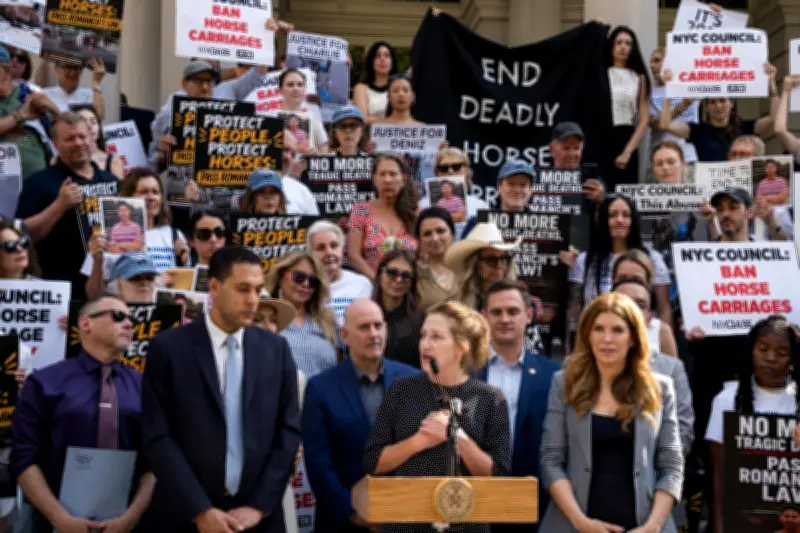
A New York City Council bill seeks to phase out Central Park's iconic horse-drawn carriages by June 2028, reigniting a long-simmering debate between animal rights advocates and industry workers. The bill, renamed "Romanch's Law" after 18-year-old tourist Romanch Mahajan who died last month when a carriage horse spooked, has gained momentum with Council Speaker Julie Menin's support.
Mahajan, visiting from India with his family, fell from the carriage after the horse Samson bolted while the driver was taking a photo. His father, Deepak Mahajan, testified via Zoom from India, describing the terror inside the carriage: "It was shaking. It was speeding. There was no one holding the reins, and we could do nothing but hold on to each other and scream."
Industry Defenders and Worker Concerns
Stable hands, drivers, and the Transport Workers Union (TWU) argue the 165-year-old industry provides jobs, particularly for immigrant laborers, and treats horses well. John Chiarello, president of TWU Local 100, emphasized the workers' American dream, noting that most drivers are immigrants. He compared carriage accidents to those involving pedicabs, food delivery services, and electric tricycles, citing city data showing 28 deaths from motorized two-wheeler accidents between January 1 and June 28 this year—a 20% increase from the same period last year. "Nobody's talking about them," Chiarello said. "There's a 165-year history of transportation that I would put up against any other means of transportation, and I would guarantee that others have done worse."
Driver Angel, originally from Mexico, said he invested all his savings in the carriage horse business. "I own horses and they say they want to help all the immigrant people. But this isn't going to help me at all." Conner McHugh, a second-generation driver and stable manager for 40 years, noted a broader battle to push workers off Manhattan land and buildings, coinciding with rezoning of stable areas. "Intimidation has taken various forms," he said, including "reporting us to ICE and the IRS, keyboard warriors trashing us on social media, animals rights volunteers who have come to Central Park to harass our drivers and create an unsafe situation."
Animal Welfare Arguments
Animal rights advocates, including actress Edie Falco, argue the industry is inherently cruel. Falco told the council she was "here for the horses" because "the horse can't say it… they have the right to a God-given… life, just as we do." Supporters cited the death of a carriage horse named Dennis in June after ingesting toxic Japanese yew from Central Park Conservancy plantings.
Bill sponsor Christopher Marte said that if a human or other animal were forced to pull a carriage, "we would call it inhumane." TWU countered that comparing a 1,600-pound horse to a chihuahua, cocker spaniel, or Siamese cat was absurd.
Opposition Claims and Horse Welfare
Driver Alanna claimed the "fix is in" for the industry, alleging billionaire donors to Central Park and Council Speaker Menin—who has a $22 million Hamptons house—want the stables and park drives. Menin has voiced support for the ban following Mahajan's death.
Most carriage horses are Standardbred and draft horses from Amish settlements, accustomed to working. Drivers say drawing carriages is light work compared to plowing. Without work, many horses would face slaughter. Driver Hansen said her horse Sherman, formerly an Amish family's vegetable hauler, was heading for dog food before she bought him. "He'd be bored out of his mind. He loves being around people, and he loves the water trough in Central Park."
Edita Birnkrant, executive director of New Yorkers for Clean, Livable, and Safe Streets (Nyclass), countered that stables are "torture for a horse… living in a cell with no grass." She claimed a network of sanctuaries and rescue farms exists for retired horses, unlike the NYPD's mounted unit which keeps 35-55 horses with a retirement plan. She called claims that her organization is a front for real estate interests "crazy."
Future of the Industry
Wayne Pacelle, president of Animal Wellness Action, said the industry rejected offers to replace carriages with electric versions. He called the ban "part of a larger ethical framework that we should not countenance cruelty… a vestigial practice with no practical value."
The bill is scheduled for a vote in August. Supporters have promised a workforce development program for displaced drivers, including hospitality sector jobs. Mayor Zohran Mamdani supports the legislation's "spirit" but worries about workers' livelihoods.



