
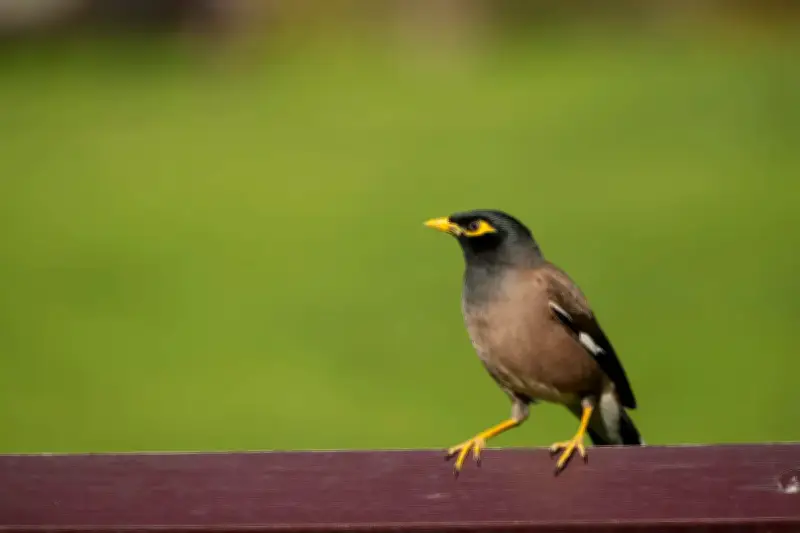
Common myna birds spotted riding a Sydney train in a viral video are not on a joyride but are likely foraging for food, according to wildlife experts. The birds, which appeared calm and well-behaved on a seat, have been identified as regular commuters on the inner-city North Shore line.
Viral video captures mynas on train
ABC producer Jackie Dent encountered the pair of myna birds on Sydney’s North Shore line last month and was surprised to learn they were apparently regular commuters. Dent boarded at Roseville station and observed the birds “very relaxed and at home.” She got off at Chatswood to change trains and alerted a train guard, posting a video on social media with the caption: “I got off at Chatswood to change trains and spoke to a lovely train guard to raise the alert that two birds were stuck on the train.”
The guard responded that the birds “always” caught the train, jumping on and off between Lindfield and Artarmon, supposedly to scrounge for food. Dent’s post quickly went viral, with commenters sharing similar stories. One user wrote, “I’d always watch them when I caught the train to Lindfield in my uni days! They know exactly where they are going.”
Experts explain the behavior
Sean Dooley, senior advisor at BirdLife Australia, said it was “unusual” for birds to fly onto trains but not “unexpected.” He noted, “The common myna is a highly intelligent bird. It does seem very likely that it is the same birds riding the same train … to take advantage of food resources along the line.” Dooley added that mynas are monogamous and territorial, so the duo are likely a couple, but the habit could spread to other mynas as they share behavior.
Andrea Griffin, associate professor in wildlife conservation at the University of Newcastle, said the video “doesn’t surprise me at all” because mynas are “incredibly accustomed” to living around humans, a trait dating back to ancient Egypt. She described them as “incredibly good learners,” noting their ability to mimic speech, good memories, and navigation skills.
Food-driven foraging, not joyriding
Griffin echoed Dooley’s suspicion that the behavior is food-driven. “They’re not trying to go somewhere. They’re not going out for a joyride,” she said. “All you need, basically, is to have a bird where the door opens and there’s some food at the entry and they hop on. And then they learn, ‘oh, this is quite a good foraging ground. I might do this.’”
The experts agree that the mynas have adapted to urban environments, exploiting food waste along the train line. Dooley noted, “They’ve learned to exploit all sorts of food resources from us, and they’re particularly good at feeding on the waste that we have, whether it’s in bins or stuff that’s strewn around. Clearly they’ve worked out that there’s a veritable smorgasbord along the Northern line.” Griffin added, “I suspect that a few birds have learned to do this. Mynas are quite loyal to their foraging areas so those birds would predictably be on that platform every day around the same time.”



