Mount Arthur's Quiet Truth: Nature as Reality, Not Escape
In a world increasingly dominated by digital noise and urban sprawl, writer Joseph Earp finds profound clarity in the quiet embrace of Tasmania's Mount Arthur. His personal evolution from a city-centric skeptic to a nature advocate underscores a powerful truth: immersion in natural environments is not an escape from reality, but a return to it.
From Urban Cynic to Nature Convert
Earp recalls his younger self, heavily influenced by poet Frank O'Hara's urban-centric philosophy. "I can't even enjoy a blade of grass unless I know there's a subway handy," O'Hara wrote, a sentiment Earp once embraced wholeheartedly. He viewed nature as a "kindly but fatally boring uncle"—something to tolerate briefly before returning to the "real" concerns of art, music, and cinema in the city.
This perspective has undergone a radical transformation. Earp now describes contemporary urban life as "a complex machine geared towards both destruction and distraction," arguing that these two forces are ultimately indistinguishable. The shift has been so profound that he no longer feels authentically himself within city confines.
The Awakening Power of Mount Arthur
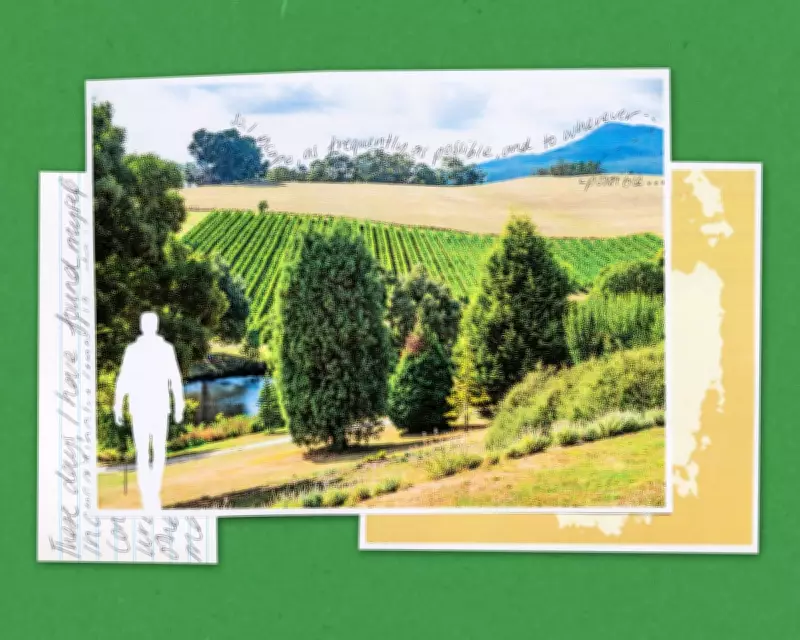
Mount Arthur, a secluded area in northern Tasmania, has become Earp's sanctuary of authenticity. He cherishes its peace and "astonishing, at times almost overwhelming, natural beauty." The nearby town of Lilydale rests gently in the mountain's shadow, while fields "undulate unpredictably but gracefully, like occasional bars of music in a symphony mostly made of silence."
Earp describes the sensory experiences: birds gathering at twilight, fog rolling off hills, and the humble gaze of sheep with their "at best only passing interest in your activity." He emphasizes that these elements create not just scenery, but a fundamental reconnection with existence.
Beyond Quaint Descriptions: Nature as Rousing Force
Importantly, Earp resists romanticizing Mount Arthur as merely "quaint" or "sleepy." Instead, he argues that nature's effect is ultimately rousing and awakening. "On our last trip there, my partner and I felt as though Mount Arthur had quickened us into life," he writes. Such environments dispel the "sense of unreality that sitting in an office for eight hours a day generates."
This awakening brings uncomfortable truths into sharp focus. From the perspective of green hills and clear skies, Earp observes "the colossal cruelty and stupidity of this country's politicians" who have ceded control to corporations intent on creating "a lonely world entirely composed of things they have created."
The True Extremism of Modern Urban Life
Earp challenges the notion that modern urban existence nourishes or protects us. He describes it as "the gluggy simulacrum of existence" filled with "Microsoft Teams, Instagram reels and the endless crowding noise of the digital world"—none of which exist meaningfully compared to natural reality.
Trapped in this "ersatz world," he argues, we become desensitized to environmental crimes. "A news story about a mine expansion might strike us as sad, but it doesn't strike us as an urgent, unfolding crime—which is exactly what it is."
Finding Reality in Greenery and Abundance
Ultimately, Earp's journeys to Mount Arthur represent not escape, but homecoming. "When I run to a place like Mount Arthur and I immerse myself in nature—the greenery and abundance that isn't our enemy, but our kin—I know I'm not ducking out of 'real life'," he asserts.
In those quiet morning moments, as clouds break over mountains, everything else reveals itself as artificial. "Despite what those in power want us to believe, all that exists is the trees, swaying. Birdsong. The next clean breath. And the next clean one after that."
Joseph Earp's experience at Mount Arthur serves as a powerful reminder that in our increasingly manufactured world, nature remains the ultimate benchmark of reality—a truth we ignore at our peril.