There comes this moment in May when I’m still anticipating the fresh green of spring, but looking up at the oak see it in a lustreless summer hue. A little rain would renew its sheen, but it’s been dry for weeks and there is no reprieve from this fleeting sense of loss.
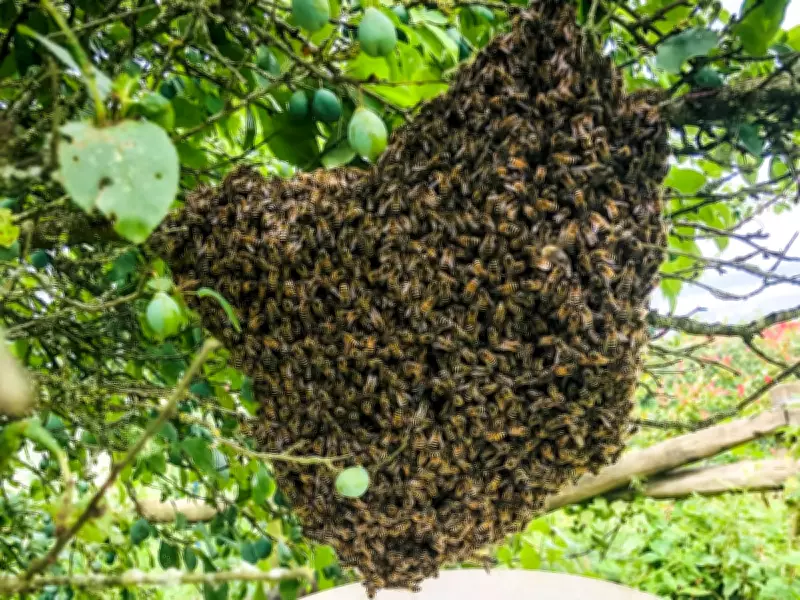
Abruptly, there comes a noise, a rising hum almost mechanical in tone, but as I look for the contraption responsible, I see instead a mass of insects flowing over the line of hawthorns. The honeybee swarm swirls in a cloud before the queen, imperceptibly landing, triggering a leisurely implosion. Guided by pheromones, thousands of worker bees join her to form a solid ball, hanging precariously from the twig of a plum tree.
Few naturally occurring events in our benign countryside elicit as much panic as a swarm, which, considering the tens of thousands of stinging insects involved, is not unreasonable. Having split from the mother colony as part of its reproductive cycle, however, a swarm is entirely focused on finding new habitation, and has no interest in attacking people unless significantly provoked. Left to its own devices, a swarm will harmlessly depart for its new abode within a few days.

To the beekeeper, a settled swarm is an opportunity to fill a hive – and is particularly valuable in early summer, when it has plenty of time to establish and become productive. “A swarm in May is worth a load of hay,” as the old rhyme goes, an idea I once tested by selling honey from a May swarm hive. I was tickled when the proceeds literally bought me a trailer full of bales.
Hiving an accessible swarm is a surprisingly simple business and, without bothering to get my bee suit (a slightly reckless behaviour that I cannot advise), I approach the insects carrying a wicker basket and secateurs. Holding the basket beneath them, I cut the supporting twig, causing the bees to drop in with a weighty jolt, and promptly close the lid. In my apiary, a prepared hive awaits, a white cloth serving as a ramp to the entrance, on to which I empty the docile bees, who dutifully crawl up and into their new home. I just hope they like it and decide to stay.