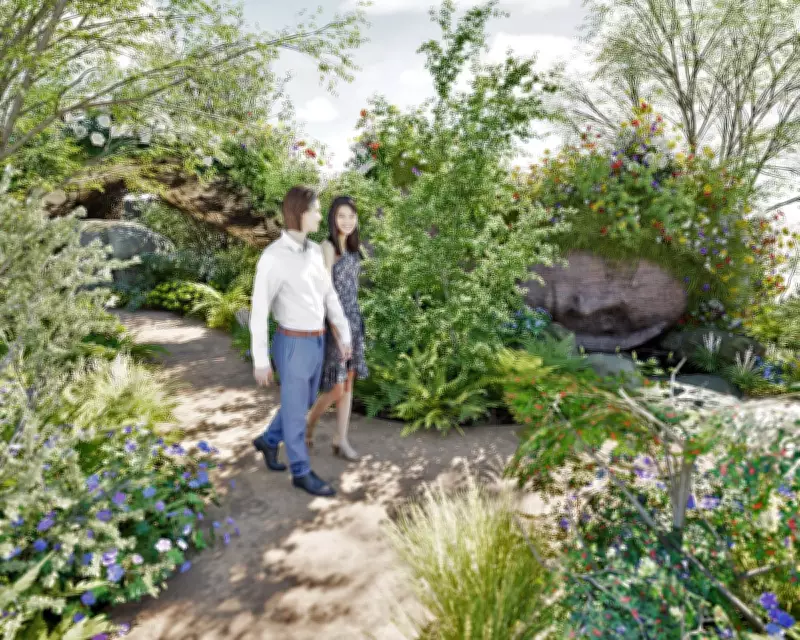
Stinging nettles, buttercups, broken crockery, fly-tipped flowers, and a discarded gnome are not the usual hallmarks of an RHS Chelsea flower show garden. But this year's On the Edge garden by Sarah Eberle, the most decorated designer at Chelsea, is designed not to look like a garden at all. Instead, it transports visitors to the liminal spaces on the outskirts of towns where the countryside begins and nature is in critical need of protection.
A Garden for the Edgelands
“The garden is about the fringe lands of towns and cities – and how vulnerable they are to development,” said Eberle, who created the garden for the Campaign to Protect Rural England (CPRE) to mark the charity's centenary year. “There is very much a feel of the countryside to it, but with a town edge coming in, in its plant material.”
Right at the front is its centrepiece: a fallen mature tree sculpted into a reclining female figure by chainsaw carver Chris Wood. “A mixture of stone and timber carved from a sequoia that's fallen on this piece of edgelands,” said Eberle.

Mother Nature in Wood and Stone
The sculpture represents Mother Nature or Gaia, the Greek goddess of the Earth, evoking the peacefulness and vulnerability of green belts and other countryside surrounding urban centres. Its arm touches rainwater collected in a gravel pool, and its willow hair flows into a dry stone wall that winds through a landscape dotted with native trees such as hornbeam, field maple, and hawthorn. “Her hair will have birds' nests in it and wild roses climbing over it, and it lifts up and goes over the path, so you walk underneath her,” said Eberle.
Eberle hopes the garden will convey how fragile, scrappy patches of countryside on the edges of towns and cities can serve as important sanctuaries for wildlife and urban communities. “If we look after these spaces, they can be good for nature and good for people,” she said.
Weeds as Wildlife Havens
The planting scheme includes many wildlife-friendly native plants typically viewed as weeds, such as buttercup, wild strawberry, purple foxglove, cow parsley, and stinging nettles. “There is beauty in our ordinary, native landscapes and the plants you find there – and a weed is only a plant in the wrong place,” said Eberle, marking her 50th year in horticulture and her 20th Chelsea. “Many of our native plants support pollinators, moths, and other native wildlife, such as birds and small mammals.”
Ornamental garden plants are also present, not planted but dumped there – alongside a discarded gnome from Eberle's personal collection. “The idea is that a community has come in, and is using this space, so it's been subject to a little bit of fly-tipping,” she said. “You'll sometimes see plants which would normally be found in a garden taking root in natural areas on the edges of towns and cities where people have dumped their garden waste.”
Resilient Plants and Urban Nature
These “tough garden plants that can survive being ditched” include geranium, amsonia, Russian iris, and disporum. “We've also planted echium, a showy plant with a blue spire that's a strong grower and would respond well to a little fly-tipping, and crocosmia, a classic plant that people chuck out because it gets too heavy in their gardens,” said Eberle.
At the back, a leaky concrete agricultural trough full of duckweed and rainwater creates an area of damp planting, and the garden's boundary is old corrugated tin, suggesting the side of a barn or an industrial building.
A Living Manifesto for Change
Eberle hopes visitors to the garden, which will eventually be relocated to a regeneration housing development in urban Sheffield, will be inspired to nurture and celebrate fringe lands near them. “These edgelands, which are so vulnerable, are so valuable,” she said.
To coincide with the garden at Chelsea, CPRE is calling on people to contribute to an interactive map of the English countryside on the edges of towns and cities by submitting observations and stories about overlooked patches they use and care about.

“These places are usually overlooked because they're not national parks and they're not protected places or epic landscapes,” said Elli Moody, director of policy and advocacy at CPRE. “We're hoping we can record and make visible why these 'in-between places' – where communities and nature find each other – really matter to people, through this new map, which is the first of its kind.”
The organisation is lobbying the government to protect England's 14 green belts and other rural edgelands, fund and support edgeland farmers, and give urban communities a greater stake in the countryside they use. “In the future, we'd like to see towns and cities engaging their residents much more than they do now in how to use and plan local countryside and nature spots around where they live,” said Moody.
She would like to see more focus by policymakers and local authorities on empowering communities to buy land through community land trusts and create a new generation of parks, community gardens, and protected green spaces. “We know there's huge demand for these spaces and that local communities do so much work to restore nature in their local places,” said Moody. “We hope the map and the garden – which we see as a living manifesto showing what's possible – will bring that to light and make the value of these edgelands more visible for decision-makers.”