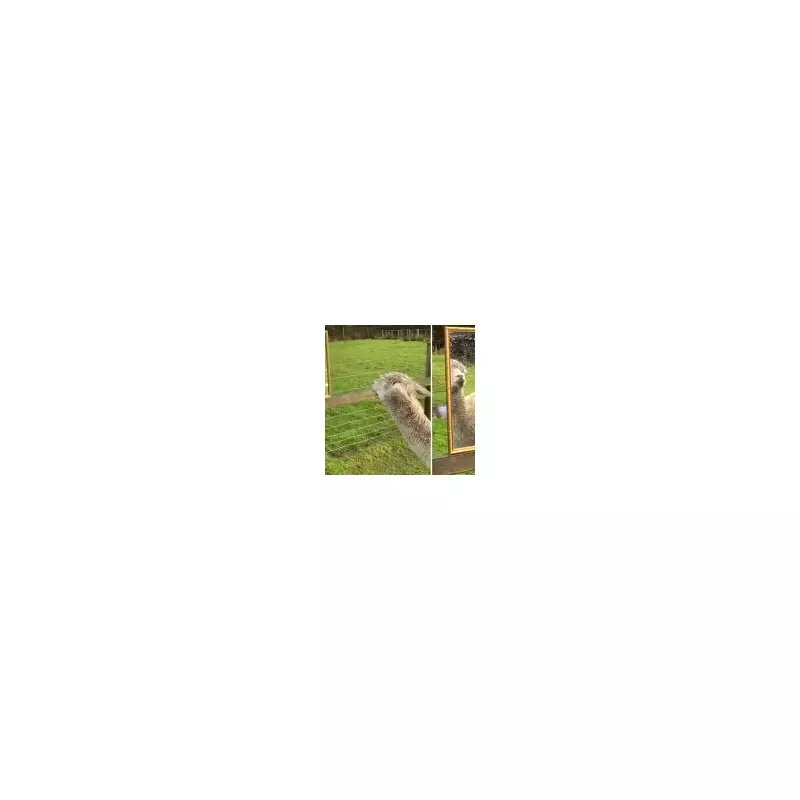
If you spotted an alpaca gazing intently at its own reflection, you might assume the creature was displaying a touch of vanity. However, in this heartwarming case, the alpaca is not self-obsessed but simply seeking solace from loneliness. Giovanni, an elderly 18-year-old male alpaca, has been gifted a mirror after tragically losing his two companions, providing him with a sense of much-needed company.
Sanctuary's Appeal for Mirror Donations
The Screech Owl Sanctuary & Animal Park in Cornwall recently issued a public appeal for mirror donations to help comfort Giovanni. In a Facebook post, the sanctuary explained the situation, stating: ‘Since losing his best friend last week, Giovanni is in need of a special treat. While it is too cold for his paddling pool, we are asking if any of you are able to donate a mirror for him. A tall full-length mirror or a smaller mirror that is able to hang would be ideal.’
The sanctuary emphasised that mirrors serve as an excellent form of enrichment for alpacas, offering them a perception of companionship. This is particularly crucial for social animals like alpacas, which naturally thrive in family herds and can experience significant stress and loneliness when isolated.
Overwhelming Response and Immediate Impact
Following the heartfelt call for assistance, the animal park was inundated with mirrors from generous members of the public. One mirror has now been securely attached to the fence of Giovanni's pen, and it has already begun to lift his spirits after the recent passing of his companion, Eddy, earlier this month.
Gary Zammit, operations director at the park, shared with the BBC: ‘He seems quite happy seeing his reflection. He’s been pretty good but it’s even better when he’s got that there so he can see another alpaca as far as he, hopefully, thinks in the paddock with him.’ This simple intervention has proven effective in mitigating Giovanni's solitude, showcasing the innovative approaches sanctuaries take to ensure animal welfare.
Future Plans for Giovanni's Companionship
Fortunately, Giovanni's loneliness is set to be short-lived. A regular visitor to the park has generously pledged to donate two female alpacas to keep him company. Zammit elaborated on the next steps, noting: ‘We’ve just got to do some planning, because obviously you can’t just take animals from anywhere and add them to a collection of this size. We would hopefully be looking at picking them up as soon as possible, and then hopefully quarantine, once all the tests are done, [it] won’t take long at all.’
This careful planning ensures the health and safety of both the new arrivals and the existing herd, adhering to best practices in animal management. Alpacas, members of the camel family, typically live for around 20 years in captivity, making Giovanni's advanced age a factor in his need for stable social bonds.
Understanding Alpacas and Their Social Nature
Alpacas are inherently social creatures that flourish in family herds, with an estimated 4 million worldwide, predominantly in Peru and Bolivia. Their well-being is closely tied to companionship, and isolation can lead to noticeable stress and behavioural issues. The sanctuary's proactive measures highlight the importance of addressing such needs in captive animal care.
This story not only sheds light on Giovanni's individual journey but also underscores broader themes in animal welfare, demonstrating how communities and sanctuaries collaborate to support vulnerable animals. As Giovanni awaits his new herd mates, the mirror continues to provide a temporary but meaningful source of comfort, bridging the gap until permanent companionship arrives.